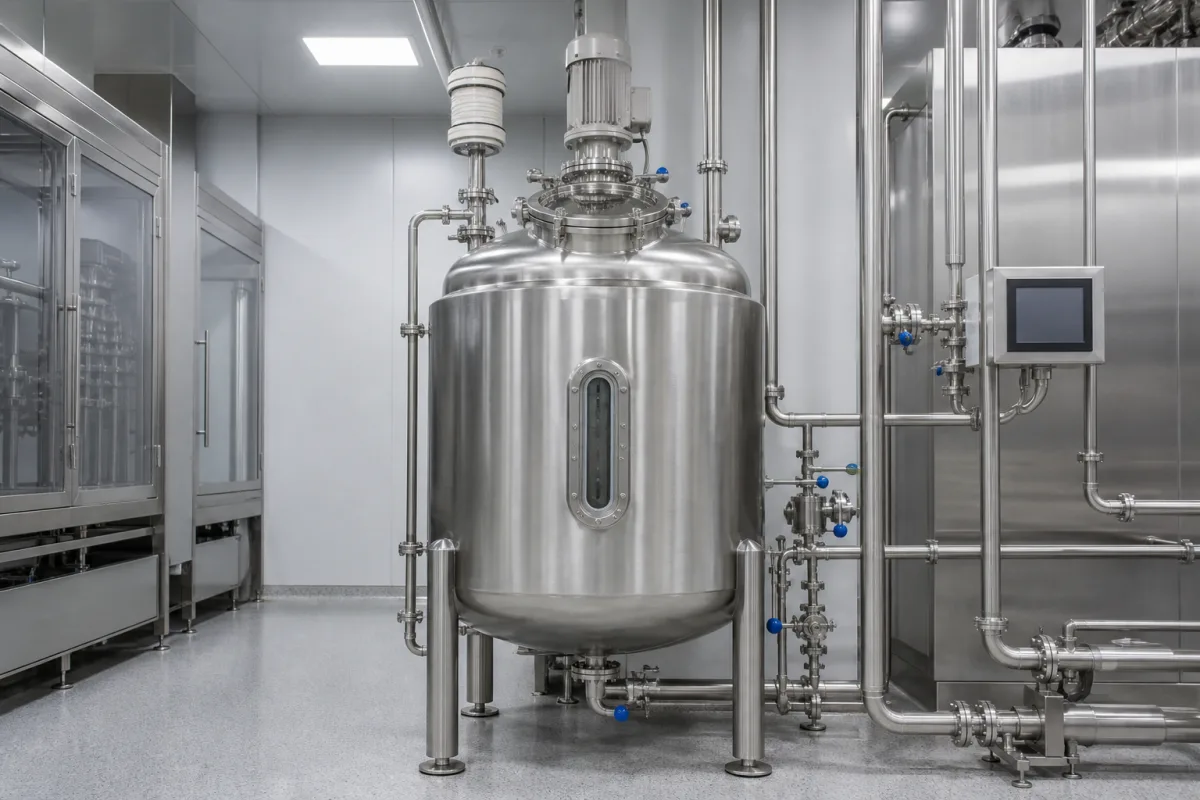
Aseptic surge tank: presterilizing the empty vessel, holding sterile product under sterile-air overpressure, and refilling it with air after steam
The sterile buffer vessel between a UHT or HTST product sterilizer and the aseptic filler · presterilization by steam at about 130 °C or pressurised hot water at 120–150 °C, sterile-air overpressure as a recorded process value, and the vacuum that forms when steam condenses
Tetra Laval's patent puts the reason for the tank plainly: the capacity of the UHT plant does not always correspond to the capacity of the filling machines. The surge tank between them holds already-sterile product until the filler can take it. Everything about the tank follows from one condition: it must become sterile before product arrives and stay sealed against outside air for as long as product is inside.
Aseptic surge tanks (sterile or aseptic buffer tanks) that store commercially sterile liquid food between a continuous product sterilizer and aseptic fillers: their presterilization, sterile-air or sterile-gas overpressure and its supply, shaft and valve barriers, inlet and outlet arrangement and records. Aseptic filling machines, container sterilization and the sterile zone of the filler are covered on the Aseptic filling machine page; filling valves and their cores, the Sterile chamber and tunnel on an aseptic bottle filler page and complete cold-fill PET lines have their own pages. Product buffer tanks ahead of bottle, can and bag-in-box fillers, with supply pressure, level probes and the choice between open, sterile-gas and aseptic designs, are covered on the Liquid storage tank ahead of the bottle filler page. Non-sterile balance tanks, CIP tanks and product sterilizers (UHT, HTST) are not covered here.
CNFX editorial research · Sources checked October 12, 2026 · 4 sources
Presterilizing the empty tank and its pipes: steam at about 130 °C and 1 h 10 min, or pressurised hot water at 120–150 °C for 10–20 min
Before an aseptic tank goes into production it is washed and then presterilized; Tetra Laval's patent compares the established steam method with circulating pressurised hot water. [2]
Under 21 CFR 113.40, the product sterilizer and all product-contact surfaces downstream, which includes the surge tank, must be brought to a condition of commercial sterility before aseptic processing starts. [1] The presterilization conditions for a given tank belong in the scheduled process established for that line, not in the equipment brochure.
Item
Steam presterilization (as described in the patent background)
Hot-water presterilization (the patented method)
Medium and temperature
Steam at about 130 °C and high pressure; the injection is repeated before the sterilization proper to drive all air out [2]
Cold water of about 1–10 % (preferably 1–5 %) of tank volume, heated in a heat exchanger to 120–150 °C (preferably 130–150 °C) [2]
How it reaches the surfaces
Fills tank and conduits; air pockets can block sterilization, and condensation in long conduits and valves can leave pockets 10–20 °C below steam temperature [2]
Sprayed through a rotating high-flow nozzle at the centre of the tank and pumped through the conduits at about 3 bar for 10–20 min (preferably 10–15) [2]
Cooling afterwards
Sterile water, or a cooling jacket on the tank; with no air left in the tank, air must be drawn through the sterile filter, which must be sized larger [2]
The same water is cooled through the heat exchanger and circulated, then discharged [2]
About 50 min in trials, close to the about 45 min to presterilize a filling machine [2]
Ask which presterilization method the tank is designed for, the temperature and time at the coldest point of tank and conduits, and how long the full cycle including cooling takes.
02
Keeping product sterile in storage: sterile-air overpressure as a recorded process value, steam barriers on shafts and stems, and what a pressure drop costs
21 CFR 113.40 names the aseptic surge tank directly. Product coolers, surge tanks and other equipment downstream of the holding tube with rotating or reciprocating shafts, valve stems or instrument connections should have steam seals or other effective barriers at those points, with a means for the operator to monitor them. Sterile air pressure or other protection means in the surge tank is one of the readings to record at start-up and at intervals that should not exceed 1 hour. [1]
If the sterile-air overpressure or other protection drops below the scheduled process value, commercial sterility may be lost: product flow to and from the tank may not resume until the potentially contaminated product in it is removed and the tank is returned to commercial sterility. [1] A flow-diversion system, where installed, sits between the product cooler and the filler or surge tank and diverts away from both automatically when holding-tube temperature or regenerator pressure differential drops below limits. [1]
Editorial calculation: the cost of that rule scales with tank size. A tank holding 10,000 L when its overpressure fails loses all 10,000 L plus a full presterilization cycle of roughly 50 min to 1 h 10 min, depending on the method above. [1][2]
Specify the overpressure set point and alarm, how it is recorded, the barriers on every shaft, stem and instrument connection, and how their performance is shown to the operator.
03
Sterile air after steam: why the tank goes into vacuum as steam condenses, and how the air supply is made sterile
House Food Industrial's patent sets out the problem. Sterile air keeps the pressure inside the aseptic tank above atmospheric so outside air cannot leak in; it is made by passing air through a sterilizing filter, which is itself steam-sterilized and gradually loses capture efficiency from that steaming. It describes the pressure inside the tank going negative as the steam left after sterilization condenses while it is replaced with sterile air, so that a large amount of sterile air is needed quickly. [3]
The patent combines the filter with an electric air heater that heats the compressed air to a set temperature between about 250 and 450 °C, and adds a discharge valve so the first air from the heater is vented, rather than sent to the tank, while the heater comes up to temperature. [3] Tetra Laval's hot-water method addresses the same issue from the other side: with water and air in the tank instead of only steam, cooling is faster and a smaller volume of sterile air has to be supplied. [2]
Ask for the tank's vacuum rating or vacuum protection, the sterile-air flow available during cool-down, and how the sterile filter or heater is itself sterilized and tested.
04
How long product can wait: buffer duty and the running time a supplier will state
Tetra Laval describes aseptic tanks as the buffer between a UHT plant and filling machines whose capacities do not always match, avoiding excess treatment of the product, and as temporary storage during operational disruptions; in its drawing the product inlet is in the lower region of the tank, the outlet at the lowest point and the sterile filter in the upper region. [2] Tetra Pak lists its own aseptic tank for products such as milk, yoghurt, rice pudding, goulash and sauces, states that it can handle fibres and smaller particles, and gives a guaranteed running time of up to 122 hours depending on the application. [4]
Editorial calculation: with a sterilizer delivering 10,000 L/h and fillers stopped, a 5,000 L working volume fills in 5,000 / 10,000 = 0.5 h; with fillers running at 8,000 L/h it fills in 5,000 / (10,000 − 8,000) = 2.5 h. The rates and volume are assumptions for illustration.
State the sterilizer rate, the combined filler rate, the longest filler stop the tank must absorb, the product (including particle size), and the running time required between presterilizations.
05
What to send when specifying an aseptic surge tank
Paste it into your enquiry below or into an email to a maker, then replace every bracket.
Product: [type; viscosity; particles or fibres; storage temperature]
Rates: [sterilizer output; filler demand; longest filler stop to absorb]
Tank: [working volume; design pressure and vacuum rating; agitation if any]
Presterilization: [steam or pressurised hot water; temperature; time; cooling method]
Protection: [sterile air or gas overpressure set point; filter and heater; recording]
Barriers: [steam seals on shafts, valve stems and instrument connections; monitoring]
Running time: [hours required between presterilizations]
Explore company information and manufacturing capabilities, then discuss the scope of your project with a relevant supplier.
Share this page
Compiled and source-reviewed by the CNFX editorial team.
Each manufacturer above links to the page on that company's own website where the product is listed, with the date we checked it. How we source and review
· Page last updated 13 October 2026
Buyer questions
What does an aseptic surge tank do?
It holds already-sterile product between the product sterilizer and the aseptic fillers when their capacities differ, and stores product during operational disruptions. [2]
How is an aseptic tank presterilized?
Conventionally with steam at about 130 °C, taking roughly 1 h 10 min including cooling; Tetra Laval patented circulating pressurised water at 120–150 °C for 10–20 min, about 50 min in total. [2]
What happens if the sterile-air overpressure is lost?
Under 21 CFR 113.40, product flow to and from the tank may not resume until the potentially contaminated product is removed and the tank is returned to commercial sterility. [1]
Why does an aseptic tank need a large sterile-air supply after steaming?
House Food Industrial describes the steam left inside condensing and the pressure going negative, so that a large amount of sterile air is needed quickly to keep the tank above atmospheric pressure. [3]
Sources and what still needs a direct check
Sources checked 2026-10-12. Regulatory requirements come from 21 CFR 113.40; presterilization methods and tank layout from a Tetra Laval patent; sterile-air supply after steaming from a House Food Industrial patent; running time and product range from Tetra Pak's aseptic tank page.