Industry-Verified Manufacturing Data (2026)

Overflow Weir/Drain

Based on aggregated insights from multiple verified factory profiles within the CNFX directory, the standard Overflow Weir/Drain used in the Food Manufacturing sector typically supports operational capacities ranging from standard industrial configurations to heavy-duty production requirements.

Technical Definition & Core Assembly

A canonical Overflow Weir/Drain is characterized by the integration of Weir Plate and Drain Valve. In industrial production environments, manufacturers listed on CNFX commonly emphasize Stainless Steel 304 construction to support stable, high-cycle operation across diverse manufacturing scenarios.

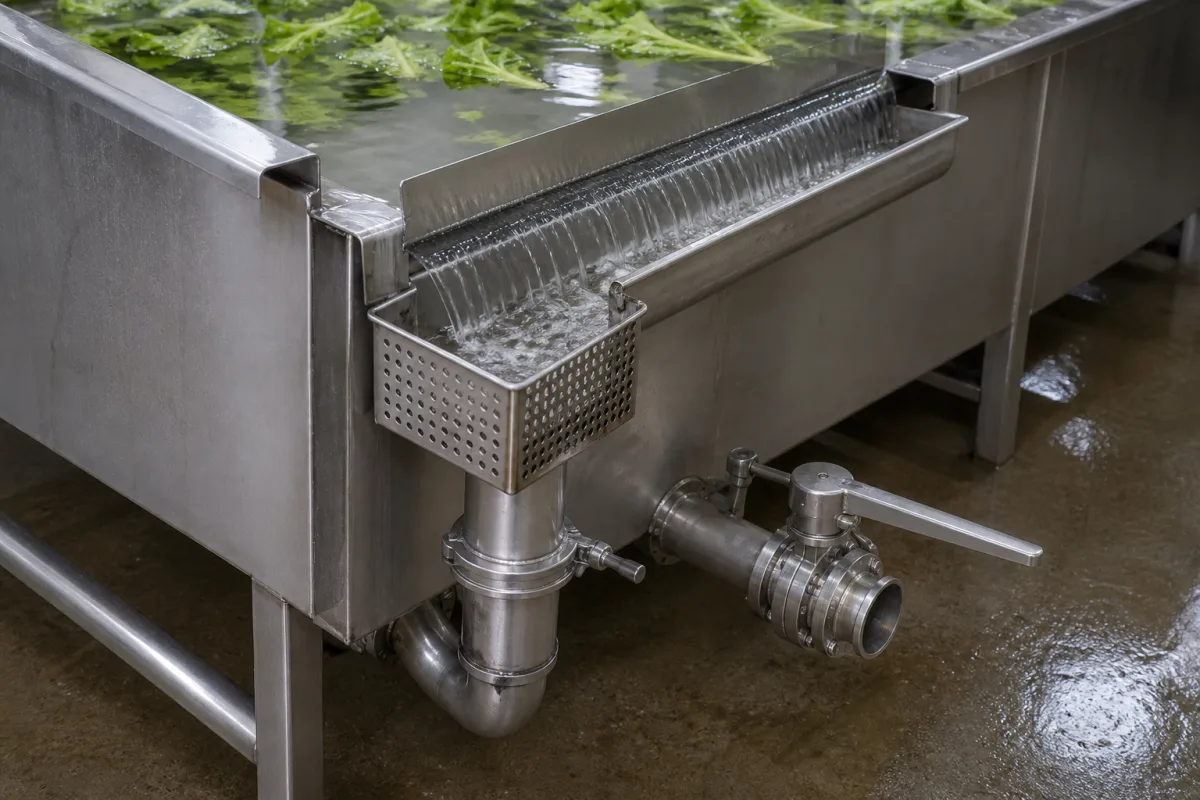
A combined overflow and drainage component for stainless steel washing tanks that regulates liquid level and facilitates drainage.
Product Specifications

Technical details and manufacturing context for Overflow Weir/Drain

Definition
An integrated overflow weir and drain assembly designed for stainless steel washing tanks, serving dual functions: maintaining optimal liquid levels by allowing excess fluid to overflow, and providing a controlled drainage point for complete tank emptying during cleaning or maintenance cycles.
Working Principle
The weir portion creates a controlled overflow point where excess liquid spills over when the tank reaches capacity, while the drain portion features a valve or gate mechanism that can be opened to allow complete drainage of the tank contents.
Common Materials
Stainless Steel 304, Stainless Steel 316
Technical Parameters
  • Diameter/width of the overflow weir and drain opening (mm) Per Request
Components / BOM
  • Weir Plate
    Creates the overflow barrier that controls liquid level
    Material: stainless steel
  • Drain Valve
    Controls opening and closing of the drainage port
    Material: stainless steel
  • Mounting Flange
    Secures the assembly to the tank wall
    Material: stainless steel
Engineering Reasoning
0-1.5 m liquid head, 0-60°C fluid temperature, 0-2 m/s flow velocity
304 stainless steel yield strength of 205 MPa at 20°C, 170 MPa at 100°C; cavitation threshold at vapor pressure of 0.023 bar at 20°C
Design Rationale: Stress corrosion cracking from chloride ion concentration >25 ppm at >60°C; fatigue failure from cyclic loading exceeding 10^6 cycles at 100 MPa stress amplitude
Risk Mitigation (FMEA)
Trigger Chloride ion concentration exceeding 25 ppm in wash solution at temperatures above 60°C
Mode: Intergranular stress corrosion cracking initiating at weld heat-affected zones
Strategy: Replace 304 stainless steel with 316L grade (2.5% molybdenum content) for chloride resistance; implement post-weld annealing at 1050°C followed by rapid quenching
Trigger Cyclic pressure fluctuations exceeding ±0.3 bar at frequencies above 5 Hz from pump pulsations
Mode: High-cycle fatigue failure initiating at sharp radius transitions (<3 mm) in weir geometry
Strategy: Implement radius transitions ≥5 mm with surface finish Ra ≤1.6 μm; add pulsation dampener with 2:1 pressure reduction ratio upstream

Industry Taxonomies & Aliases

Commonly used trade names and technical identifiers for Overflow Weir/Drain.

Applied To / Applications

This component is essential for the following industrial systems and equipment:

Industrial Ecosystem & Supply Chain DNA

Complementary Systems
Downstream Applications
Specialized Tooling

Application Fit & Sizing Matrix

Operational Limits
pressure: 0 to 1.5 bar (gauge)
flow rate: Up to 50 m³/h
temperature: -20°C to 120°C
slurry concentration: Up to 15% solids by weight
Media Compatibility
✓ Potable water ✓ Food-grade cleaning solutions ✓ Mild chemical effluents
Unsuitable: Highly corrosive acids (e.g., hydrochloric acid >10%)
Sizing Data Required
  • Tank volume (L)
  • Required drainage time (min)
  • Maximum liquid level above weir (mm)

Reliability & Engineering Risk Analysis

Failure Mode & Root Cause
Abrasive erosion
Cause: High-velocity flow carrying suspended solids, sand, or debris that physically wears away the weir surface, particularly at the crest and downstream face.
Structural cracking or deformation
Cause: Cyclic thermal stress from temperature fluctuations, freeze-thaw cycles, or mechanical overloading due to debris accumulation or improper installation, leading to material fatigue.
Maintenance Indicators
  • Visible thinning, pitting, or grooves along the weir crest or downstream face, indicating active erosion.
  • Audible water leakage or irregular flow sounds downstream, suggesting misalignment, cracks, or blockages altering the intended overflow pattern.
Engineering Tips
  • Apply a wear-resistant lining or coating (e.g., polyurethane, ceramic tiles) to the weir crest and high-impact areas to reduce abrasive wear and extend material life.
  • Implement regular debris removal and install upstream screening or settling basins to minimize solid particle load, reducing both abrasive erosion and structural stress from blockages.

Compliance & Manufacturing Standards

Reference Standards
ISO 9001:2015 - Quality management systems ANSI/ASME B16.5 - Pipe flanges and flanged fittings DIN 19569-10 - Wastewater treatment plants - Principles for the design of structures and technical equipment
Manufacturing Precision
  • Weir crest level: +/-2 mm
  • Surface flatness: 0.5 mm per meter
Quality Inspection
  • Dimensional verification with laser scanning
  • Leakage test with hydrostatic pressure

Factories Producing Overflow Weir/Drain

Verified manufacturers with capability to produce this product in China

✓ 92% Supplier Capability Match Found

T Technical Director from United States Feb 16, 2026
★★★★★
"Testing the Overflow Weir/Drain now; the technical reliability results are within 1% of the laboratory datasheet."
Technical Specifications Verified
P Project Engineer from United Arab Emirates Feb 13, 2026
★★★★☆
"Impressive build quality. Especially the technical reliability is very stable during long-term operation. (Delivery took slightly longer than expected, but technical support was excellent.)"
Technical Specifications Verified
S Sourcing Manager from Australia Feb 10, 2026
★★★★★
"As a professional in the Food Manufacturing sector, I confirm this Overflow Weir/Drain meets all ISO standards."
Technical Specifications Verified
Verification Protocol

“Feedback is collected from verified sourcing managers during RFQ (Request for Quote) and factory evaluation processes on CNFX. These reports represent historical performance data and technical audit summaries from our B2B manufacturing network.”

8 sourcing managers are analyzing this specification now. Last inquiry for Overflow Weir/Drain from Brazil (56m ago).

Supply Chain Compatible Machinery & Devices

Automated Food Moisture Analyzer

Automated system for precise moisture content measurement in food products

Explore Specs →
Automated Food Color Consistency Analyzer

Automated inline system for real-time color measurement and consistency control in food processing.

Explore Specs →
Control Panel

A centralized interface for monitoring and controlling industrial equipment and processes

Explore Specs →
Industrial Vacuum Tumbler

Industrial machine for massaging and marinating meat under vacuum to enhance texture and flavor.

Explore Specs →

Frequently Asked Questions

What is the difference between 304 and 316 stainless steel for this overflow weir/drain?

304 stainless steel offers excellent corrosion resistance for most food manufacturing applications, while 316 stainless steel provides superior resistance to chlorides and acids, making it ideal for environments with harsh cleaning chemicals or salty products.

How does this overflow weir/drain regulate liquid levels in washing tanks?

The weir plate creates a controlled overflow point that maintains consistent liquid levels, while the integrated drain valve allows for complete drainage when needed, ensuring optimal washing efficiency and preventing overflow accidents.

What maintenance is required for this overflow weir/drain system?

Regular inspection for debris buildup, periodic cleaning of the weir plate and drain valve, and checking mounting flange seals are recommended. The stainless steel construction minimizes corrosion, but visual inspections should be part of routine equipment maintenance schedules.

Can I contact factories directly on CNFX?

CNFX is an open directory, not a transaction platform. Each factory profile provides direct contact information and production details to help you initiate direct inquiries with Chinese suppliers.

Get Quote for Overflow Weir/Drain

Request technical pricing, lead times, or customized specifications for Overflow Weir/Drain directly from verified manufacturing units.

Your business information is encrypted and only shared with verified Overflow Weir/Drain suppliers.

Thank you! Your message has been sent. We'll respond within 1–3 business days.

Need to Manufacture Overflow Weir/Drain?

Connect with verified factories specializing in this product category

Add Your Factory Contact Us
Previous Product
Overflow Vortex Finder
Next Product
Oxidation System