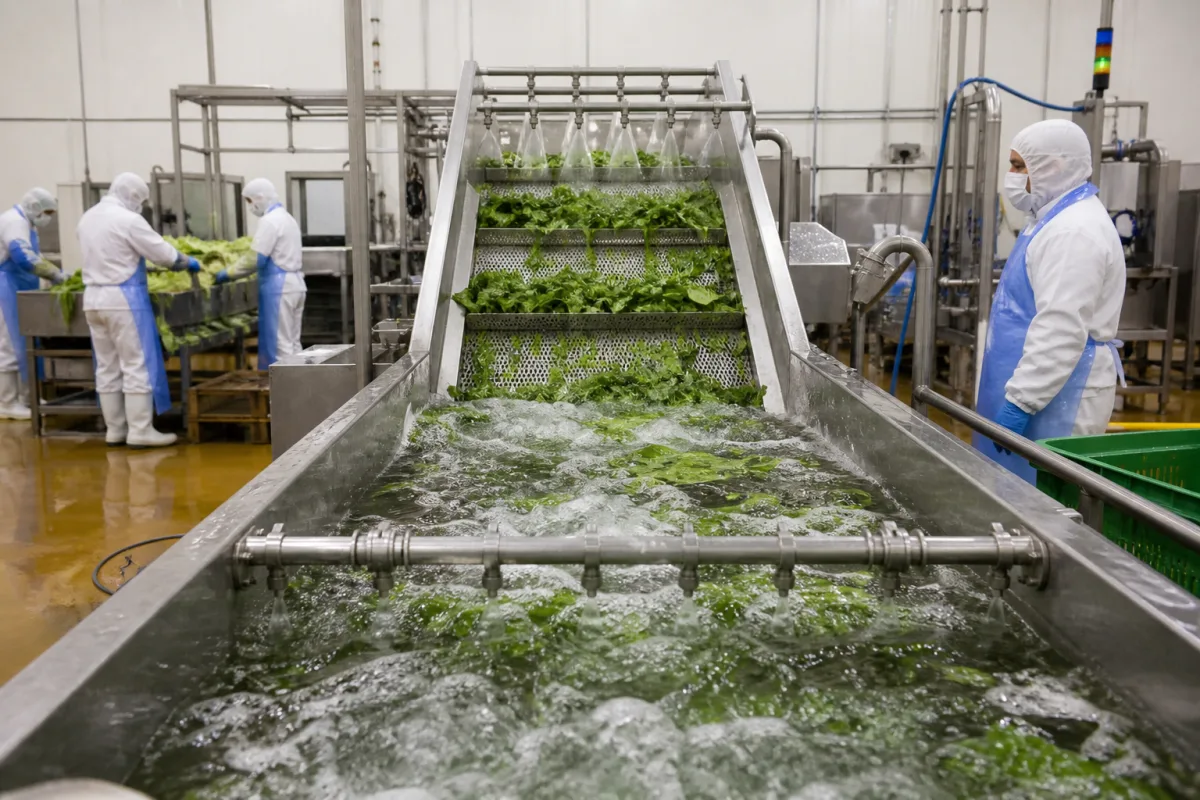
Stainless steel washing tank for leafy greens and cut produce
The stainless vessel of a produce wash line · 304 or 316 against chloride and free chlorine, tank volume and drains against throughput, sheet finish and seams that drain clean
A produce washing tank is the open stainless trough that holds the wash water while lettuce, herbs, cut vegetables or fruit are carried through it by water flow, air bubbles or a conveyor, then lifted out over an overflow onto a dewatering outfeed. Three choices decide whether it lasts and stays clean: the steel grade against the chloride and sanitiser in the water, the tank and pump-tank volume against the throughput, and the sheet finish, seams and drains that decide whether soil and biofilm can collect.
Open stainless steel wash tanks and flumes for leafy greens, herbs, cut vegetables and fruit, treated as the vessel itself: steel grade, wash-tank and pump-tank volume, overflow, sand trap, strainers, drains, air-bubble pipes, spray bars and the finish and seams of the food-contact surfaces. Complete washers that add ultrasound to the wash, with their trial results and wash-water chemistry, are covered on the Industrial ultrasonic vegetable washer page. Encircling ultrasonic transducer arrays for bar and tube testing are a different product, covered on their own page. Household sinks, parts-cleaning tanks and CIP vessels are outside this page.
CNFX editorial research · Sources checked October 13, 2026 · 5 sources
304 or 316 for a tank holding chlorinated wash water
Chlorine dosed as a sanitiser and chloride carried in by salt or source water attack stainless steel very differently. The Australian Stainless Steel Development Association (ASSDA) cites Nickel Institute guidelines for continuous exposure at about 20 °C and pH 7: 304 can cope with 2 ppm chlorine and 316 with about 5 ppm, while chloride is permitted at 200 ppm for 304, 1000 ppm for 316 and 3600 ppm for 2205 duplex. [2]
The same ASSDA note says the chloride limits allow for crevices such as bolt heads, flanges or deposits but assume a passivated surface; higher temperatures lower the permissible level, and 304 and 316 are not recommended above 60 °C because of the risk of chloride stress corrosion cracking. [2]
For a wash tank the warnings about where chlorine concentrates matter more than the bulk figure. ASSDA describes attack from bleach-laden washdown water left standing in pools in drains, higher chlorine in droplets and water films just above a still tank, and concentrated dosing streams eating out tank walls near the chlorine inlet when the dose is not well mixed. It also notes that the food industry can use up to 100 ppm in hot water for minutes followed by rinsing or passivation, because pitting has to initiate and stabilise before failure. [2]
Kronen states that the wash and pump tanks, pipes, pump casing, covers and switch cabinet of its HEWA washing machines are AISI 304 stainless steel. [1]
Editorial calculation: on the Nickel Institute figures quoted by ASSDA, moving from 304 to 316 raises the continuous chlorine allowance from 2 ppm to about 5 ppm (×2.5) and the chloride allowance from 200 ppm to 1000 ppm (×5). [2]
Give the tank maker the free-chlorine or other sanitiser level and how it is dosed, the chloride content of the make-up water and of any brine, the water temperature, the cleaning chemicals and their temperature, and whether the tank stands full overnight; ask which grade the wash tank, pump tank and dosing inlet are built from.
02
Wash-tank and pump-tank volume, strainers and drains
In Kronen's HEWA washers the product is carried through the wash tank, leaves over an overflow at the far end with the water and is sprayed with fresh water on the outfeed; the water then passes a strainer into a pump tank and is pumped back into the wash tank. [1]
Kronen lists filter strainers with holes of 2, 5, 8 or 10 mm on the vibration outfeed, a lateral drum with a 0.5 mm slotted strainer that removes fine particles from the circulating water so the filter above the pump tank does not block, and a sand trap in the bottom of the wash tank where stones and sand settle instead of leaving with the product. [1]
For water level, the optional water management system adds a level sensor that opens pneumatic valves to top up with fresh water, and its standard form has two valves for filling and two for emptying; a pressure switch can be fitted outside the filter tank so the tank itself stays easy to clean. An air system blows air through a perforated pipe network to make bubbles in the wash tank for whole leaves and curly products. [1]
Editorial calculation: from the HEWA 3800 to the HEWA 4000 the total volume rises from 817 L to 1,505 L (×1.84) while the stated maximum capacity rises from 2,500 to 4,000 kg/h (×1.6). Kronen adds that capacity depends on factors such as the product. [1]
Sheet finish, seams and drainable surfaces inside the tank
US food rules set the outcome rather than a number: food-contact surfaces must be corrosion-resistant, nontoxic and able to withstand the food, cleaning compounds and sanitising agents, and seams on food-contact surfaces must be smoothly bonded or maintained to minimise accumulation of food particles, dirt and organic matter. [4] The produce safety rule applies the same seam requirement to equipment used on covered produce and adds that equipment must be installed so it and the spaces around it can be cleaned. [5]
For sheet finish, ASSDA quotes ASTM A480: a No 4 polished finish may have an average roughness of up to 25 micro-inches (Ra 0.64 µm), and EN 10088-2 defines a 2K finish as Ra below 0.5 µm. ASSDA's surface traces give Ra 0.41 µm (typ.) for No 4 and Ra 0.20 µm (typ.) for 2B. [3]
ASSDA lists process vessels and tanks in food processing among 2B applications, but notes that this mill finish cannot be matched after fabrication, whereas a No 4 finish is directional and lets fabricators refinish welds to match. [3] For a welded tank that means asking which finish is left on the weld seams, not only which sheet was bought.
Kronen describes its HEWA tanks as having no horizontal surfaces, so water drains off, with all edges designed against biofilm and the whole machine able to be dismantled for cleaning. [1]
Ask for the sheet grade and finish certificate, the roughness after polishing at weld seams, the slope of the tank floor and pump-tank floor toward the drains, whether strainers, sand trap, air pipes and spray bars come out without tools, and how the drain valves are cleaned.
04
Data to send for a produce wash tank
Paste it into your enquiry below or into an email to a maker, then replace every bracket.
Product: [lettuce, herbs, cut vegetables, fruit; whole or cut; floating or sinking]
Throughput: [kg/h]
Water: [sanitiser and free-chlorine level; chloride; temperature]
Tank: [grade; wash-tank and pump-tank volume; length and width]
Water path: [overflow; strainer hole size; sand trap; fine-particle removal]
Services: [fresh-water and drain connections; air system; spray bar]
Hygiene: [sheet finish and weld finish; floor slope; dismantling]
Explore company information and manufacturing capabilities, then discuss the scope of your project with a relevant supplier.
Share this page
Compiled and source-reviewed by the CNFX editorial team.
Each manufacturer above links to the page on that company's own website where the product is listed, with the date we checked it. How we source and review
· Page last updated 13 October 2026
Buyer questions
Is 304 stainless enough for a chlorinated produce wash tank?
ASSDA cites Nickel Institute guidelines of 2 ppm chlorine for 304 and about 5 ppm for 316 in continuous exposure at about 20 °C and pH 7, and warns that concentrated dosing streams and pooled washdown water cause local attack. Kronen builds its HEWA wash and pump tanks from AISI 304. [2][1]
How much water does a produce wash tank hold?
Kronen lists total volumes of 607 L for the HEWA 2600, 817 L for the HEWA 3800 and 1,505 L for the HEWA 4000, each with two 2-inch drains. [1]
What surface roughness should the tank sheet have?
ASSDA quotes ASTM A480 as allowing Ra up to 0.64 µm for a No 4 finish and EN 10088-2 as defining 2K as below Ra 0.5 µm; US rules require smoothly bonded seams on food-contact surfaces. [3][4]
Sources and what still needs a direct check
Sources checked 2026-10-13. Kronen describes its own washing machines; ASSDA is the Australian stainless steel industry association; the two US rules are quoted from the eCFR.