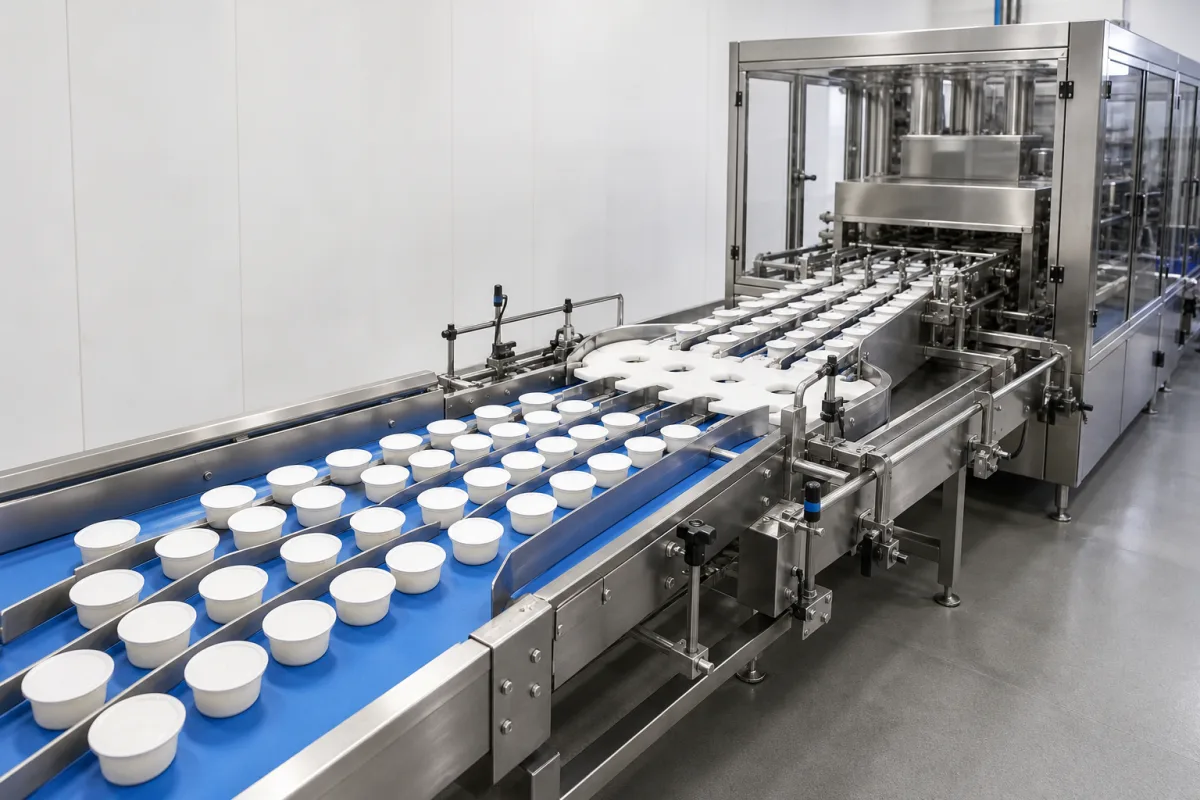
Product infeed system for a continuous hydrostatic sterilizer: grouping sealed containers into rows and loading them into the carriers at the chain's cycle time
Continuous hydrostatic sterilizers · lining up filled and sealed cans, jars, cups and bottles into rows and loading one row into each carrier at the main chain's cycle time, which the scheduled process fixes
A hydrostatic sterilizer moves sealed containers through its water legs and steam dome on carriers fixed between a pair of endless chains. The infeed system in front of it collects the containers, lines them up in a row as long as a carrier and pushes that row into each carrier as it passes. Its speed is not free: the chain speed is part of the scheduled process for the product, so the infeed has to deliver one full row per chain cycle.
Infeed systems that take filled and sealed cans, glass jars, plastic cups and pots, trays and bottles from the closing machine and load them into the carriers of continuous hydrostatic sterilizers: lane forming and row building, transfer into side-loading or front-loading carriers, cycle time against chain pitch, and the link to the chain speed fixed in the scheduled process. Blanching raw vegetables in a hot-water bath is covered on the Hydrostatic immersion belt blancher page and in rotating drums on the Rotary fruit and vegetable blanching drum page; blanch-water pumps on the Water circulation pump for hot-water blanchers page. Tunnel pasteurizers for bottles and cans are on the Tunnel sterilizer (tunnel pasteurizer) page, in-pack spray pasteurizing of trays and pouches on the Automated food sterilization tunnel and Hot-water spray heating zone pages, underwater pack conveyors on the Submerged belt conveyor page, batch retort doors on the Quick-opening sealing door page, tray conveyors in front of tray sealers on the Tray infeed conveyor for tray sealing lines page, and starwheels handing bottles into filler pockets on the Container infeed starwheel page.
CNFX editorial research · Sources checked October 13, 2026 · 3 sources
One row per carrier per cycle: infeed rate, cycle time and chain pitch
Campbell Soup's patent on preheating soups so that different products can share one hydrostatic sterilizer at one line speed gives the clearest published numbers for an infeed. Its first embodiment has a single infeed system with a maximum capacity of 850 cans per minute at a 2.4 s cycle, and a nominal 800 cans per minute at a 2.55 s cycle with a 50-minute sterilizing time. [2] Its open carriers act as bucket elevators that pick up cans waiting in rows. [2]
Editorial calculation: both the maximum and the nominal case work out to 34 cans per cycle, which on the patent's figures is the row the infeed has to build and push each time a carrier position passes. At 2.55 s per cycle, the 50-minute sterilizing time corresponds to about 1,176 cycles, assuming one carrier position per cycle. [2]
JBT describes two carrier families for its Hydromatic sterilizers, and they set what the infeed has to do. In the side loader, the carrier is two tubes or channels on the main chain and containers are loaded and unloaded from the side; in the front loader, each Q-shaped carrier holds a single stick of containers loaded from the front. [3] Bottles go into carriers with individual pockets, conical fish and meat cans into pocketed carriers with a visor and a dedicated loading and unloading system, and aluminium pet-food tubs into hanging carriers that keep them upright. [3] JBT lists speeds of up to 2,000 containers per minute for the Hydromatic, and a soft-touch system for baby-food jars at up to 1,200 jars per minute in a twin-tower overpressure configuration. [3]
800 cans/min, 2.55 s cycle, 50 min sterilizing [2]
800 × 2.55 / 60 = 34 cans per cycle
Main chain pitch 152 mm instead of 120 mm
Nominal speed for 211×400 cans 631 cans/min instead of 800 [2]
800 × 120 / 152 ≈ 632, so the rate falls in proportion to the pitch
Larger pitch, second embodiment
Double infeed and discharge, also handles 303×500 cans [2]
—
Lower sterilizing and cooling sections
Each step down about 50 cans/min less capacity [2]
—
Give the infeed supplier the container dimensions and material, the number of containers per carrier, the chain pitch and the cycle time at the nominal and maximum chain speed, the carrier type (side or front loading, pocketed, hanging), and whether one infeed or two will feed the sterilizer.
02
The chain speed is in the scheduled process: what the infeed follows and what it must not change
For low-acid canned foods processed in hydrostatic retorts in the United States, 21 CFR 113.40(f)(8) requires the speed of the container-conveyor chain to be specified in the scheduled process, determined and recorded at the start of processing and at intervals frequent enough to show it is maintained; it recommends recording every 4 hours. [1] The same paragraph recommends an automatic device to stop the chain when the temperature drops below the scheduled value, and requires a means, such as a lock or a posted management notice, to prevent unauthorized speed changes. [1]
Editorial note: for the infeed this means its speed is a follower of the main chain rather than an independent setting: it has to fill each carrier at whatever cycle time the scheduled chain speed gives, and it has to cope with the chain stopping on a temperature fault. The Campbell patent states the same relation from the process side: steam enters at a fixed temperature and the dwell time is adjusted through the conveyor chains, which is why changing products used to mean emptying and resetting the sterilizer. [2]
JBT's control package stores process parameters and alarm limits per recipe and, when a recipe is selected, sets temperature and pressure and adjusts the handling speeds. [3] Its product monitoring and registration system tracks each group of packages by dwell time, temperature and events. [3] Among retrofits JBT lists frequency-controlled replacement drive systems, an indexing mechanism replacing the pawl and ratchet that reduces cycle time, and new-generation infeed and discharge handling for higher throughput, faster changeover and gentler handling of vulnerable packages. [3]
Item in 21 CFR 113.40(f)
Requirement
Retort speed (f)(8)
Chain speed specified in the scheduled process; determined and recorded at start and at sufficient intervals, every 4 h recommended [1]
Chain stop (f)(8)
Automatic device recommended to stop the chain when temperature drops below the scheduled value [1]
Speed changes (f)(8)
Means to prevent unauthorized changes, such as a lock or posted notice [1]
Fill-in or drained weight (f)(9)
Where a maximum is specified, measured and recorded at intervals frequent enough to stay within it; intervals not over 15 min recommended [1]
Ask how the infeed is synchronised to the main chain (mechanical drive, encoder or indexing signal), what it does when the chain stops on a temperature alarm, how containers already in a half-built row are handled, and how speed settings are protected from change.
03
Data for a hydrostatic sterilizer infeed
Paste it into your enquiry below or into an email to a maker, then replace every bracket.
Containers: [type, material, dimensions, closure; fill weight]
Sterilizer: [maker and model; carrier type; containers per carrier; chain pitch]
Rates: [cycle time and containers/min at nominal and maximum chain speed; single or double infeed]
Supply: [from seamer or sealer; number of lanes; accumulation before the infeed]
Control: [synchronisation to the main chain; behaviour on chain stop; recipe changeover]
Records: [speed recording and locks required by the scheduled process]
Explore company information and manufacturing capabilities, then discuss the scope of your project with a relevant supplier.
Share this page
Compiled and source-reviewed by the CNFX editorial team.
Each manufacturer above links to the page on that company's own website where the product is listed, with the date we checked it. How we source and review
· Page last updated 13 October 2026
Buyer questions
How many containers does a hydrostatic sterilizer infeed load at once?
It loads one row per carrier. By editorial calculation from a Campbell Soup patent, 800 cans per minute at a 2.55 s cycle (or 850 at 2.4 s) is 34 cans per cycle. [2]
Can the infeed speed be changed freely?
No. In the US, 21 CFR 113.40 requires the container-conveyor chain speed of a hydrostatic retort to be specified in the scheduled process, recorded, and protected against unauthorized change, so the infeed follows the chain. [1]
How do containers get into the carriers?
JBT describes side-loader carriers loaded from the side into two tubes or channels, and Q-shaped front-loader carriers each holding a single stick of containers loaded from the front. [3]
Does chain pitch affect infeed capacity?
Yes. In the Campbell patent, a 152 mm main chain pitch instead of 120 mm lowers the nominal speed for 211×400 cans from 800 to 631 cans per minute. [2]
Sources and what still needs a direct check
Sources checked 2026-10-13. The US regulation for low-acid canned foods sets the rules for chain speed; a Campbell Soup patent supplies infeed rates, cycle times and chain pitch; JBT's Hydromatic brochure describes carrier types, handling speeds and controls.