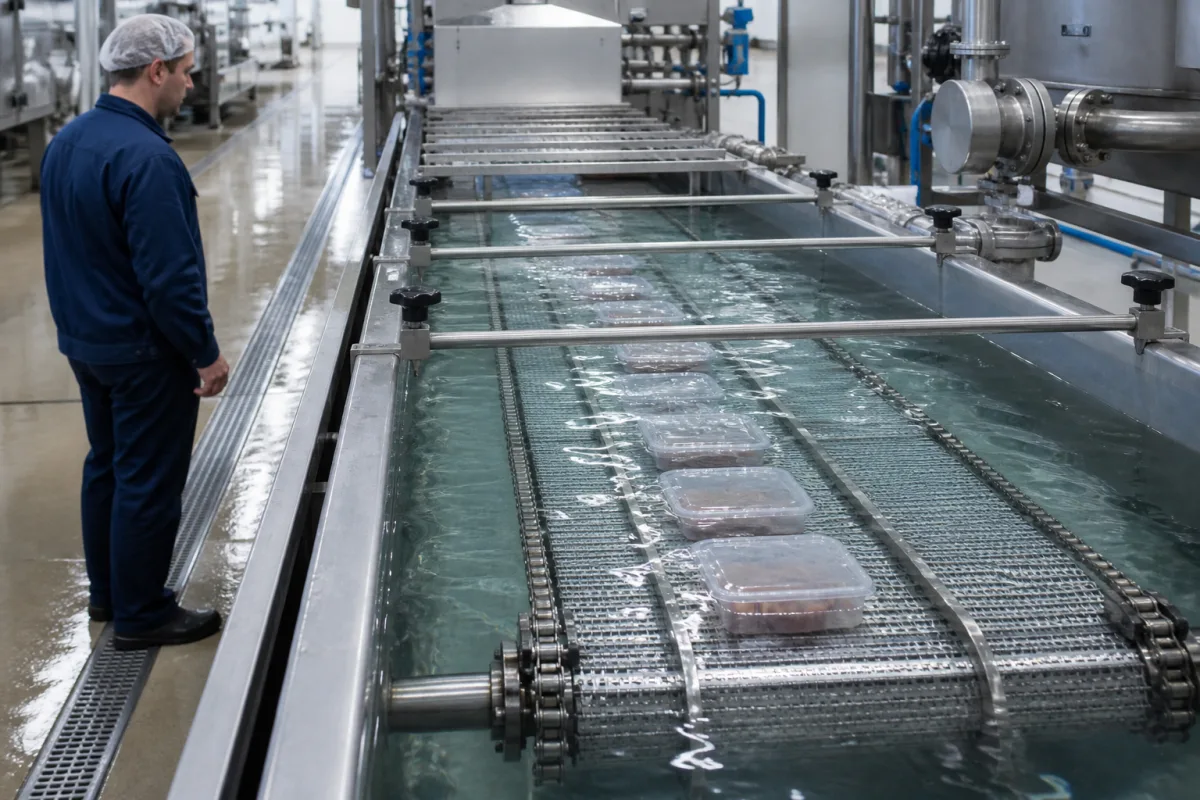
Submerged belt conveyor for in-package water pasteurizing and chilling: holding sealed packs under water for a set time
Belt conveyors that run under water to heat or chill food already sealed in its pack · keeping buoyant packs submerged, setting time under water from belt speed, and the 90.6 to 96.1 °C hot-water regimes validated for deli meats
A submerged conveyor carries food that is already sealed in its bag or pouch through a tank of hot or chilled water, so that the water, not air, heats or cools it. The time each pack spends under water is set by the length of the submerged run and the belt speed, which only holds if every pack stays under. Vacuum-packed meat, pouches with headspace and shrink bags all tend to rise, which is why the hold-down method is the first thing to ask about.
Conveyors that run below the water line of a tank to pasteurize, shrink or chill sealed food packages: submerged mesh or flighted belts, over-belts and other hold-down means, extraction conveyors and the tank's water circulation and temperature control as they bear on the conveyor. Conveyor systems as a plant-wide category are covered on the Conveyor systems page, and its modular sections on the Conveyor section page; chilled-water spray sections that cool packs on an open conveyor are covered on the Cooling zone for cooked and packed foods page; open-product blanchers, hydrostatic retorts and bulk flume conveyors are not covered here.
CNFX editorial research · Sources checked October 12, 2026 · 6 sources
Packs that float: over-belts, flights, water flow and showers
Packages lighter than water float on the surface and are not treated under the intended conditions; the patents and the maker's brochure below describe five ways round it.
Marlen says its flighted belt reduces the risk of damage to packaging that causes leakers. [4] Editorial note: a pack that floats for part of the run sees a shorter time under water than the belt speed implies, so the hold-down method needs to be checked with the lightest pack in the range, the one that floats highest.
Approach
How it keeps the pack treated
Source
Second belt over the carrying belt
A further belt placed over the first keeps products immersed while the belt carries them through the hot bath.
The belt dips below the bath at an immersion point and rises at an extraction point; belt speed sets the time submerged. Light shrink-bag packages may still float and move slowly, if at all, to the exit, prolonging hot-water exposure.
Packs dropped into a tank are carried by a unidirectional hot-water flow; a pair of convergent, concave baffles at the inlet makes a vortex that pulls them under, and an inclined extraction conveyor at about 30° with rod flights over a wire grid lifts them out.
The water level is set by an adjustable gate flush with the products, too shallow for them to float, while hot water drips onto them from a perforated container above.
Give the supplier pack dimensions, mass and whether the lightest pack floats in water at the process temperature, so the hold-down means can be chosen.
02
Time under water at 90.6 to 96.1 °C: what the deli-meat studies measured
Muriana and colleagues at Oklahoma State University vacuum-sealed turkey, ham and roast beef in shrink bags, inoculated them with a four-strain Listeria monocytogenes cocktail at about 10⁷ CFU/ml, and heated them in a precision-controlled, steam-injected water bath. [1]
The 2002 authors found much smaller reductions on product than in their decimal-reduction assays, and attributed this to surface cuts, folds and grooves that may shield bacteria and to chilled purge migrating to the surface. [1] This is why the time a pack spends fully submerged, not the tank temperature alone, governs the result.
Marlen describes its Aquaflow water pasteurizer as validated in the 2002 study and quotes the same 195 to 205 °F (90.6 to 96.1 °C) regimes; it states water temperature control to ±1 degree with multiple probes, across the belt width and along the tank length, and direct steam injection for heating. [4]
Editorial calculation (assumed figures, not from a source): with a 6 m submerged run, a 2-minute treatment needs a belt speed of 6 ÷ 2 = 3 m/min; a 10-minute treatment on the same run needs 0.6 m/min, so the drive's speed range must cover the shortest and longest regimes on the product list.
2 to 3 log, with no growth over 10 weeks at 6.1 °C [3]
Ask for the submerged run length, the belt speed range, how residence time is recorded, and temperature mapping across and along the tank.
03
Chilled-water runs after cooking: the same conveyor, below -1 °C
Marlen offers the same flighted water-bath conveyor for single or multi-stage chilling, using high-volume recirculation to chill products below 30 °F (-1 °C), with a shower drench for products that float and a sparging manifold that feeds fresh chilled water to each submerged flight to shorten residence time. [4] It bases the case for water on thermal conductivities of 0.58 W/m·K for water and 0.024 W/m·K for air, which it puts as heat transfer about 24 times faster. [4] Editorial calculation: 0.58 ÷ 0.024 ≈ 24; the ratio compares conductivities only and is not a measured cooling-time ratio.
Marchetti's patent describes the hot-water version used for shrinking polyethylene packaging films, which shrink below 100 °C, where too long under hot water can harm the food. [5]
04
What to tell a builder of a submerged pack conveyor
Paste it into your enquiry below or into an email to a maker, then replace every bracket.
Packs: [type; size; mass; floats or sinks at process temperature]
Process: [pasteurize, shrink or chill; water temperature; time under water for each product]
Throughput: [packs per minute; lanes]
Conveyor: [submerged run length; belt type; flights; hold-down means; speed range]
Water: [heating method; recirculation; temperature uniformity; filtration]
Records: [temperature and residence-time logging; validation study reference]
Explore company information and manufacturing capabilities, then discuss the scope of your project with a relevant supplier.
Share this page
Compiled and source-reviewed by the CNFX editorial team.
Each manufacturer above links to the page on that company's own website where the product is listed, with the date we checked it. How we source and review
· Page last updated 13 October 2026
Buyer questions
How do submerged conveyors stop packs floating?
Designs in the sources use a second belt over the carrying belt, flighted belts with a sparging manifold, water flow with vortex baffles, shallow water with drip from above, or a shower drench for products that float. [6][5][4]
What temperatures are used for in-package water pasteurization of deli meats?
Oklahoma State studies used 90.6, 93.3 and 96.1 °C for 2 to 10 min and reported 2- to 4-log reductions of Listeria monocytogenes. [1]
Can the same conveyor chill packs?
Marlen offers its flighted water-bath conveyor for chilling below 30 °F (-1 °C) with high-volume recirculation. [4]
Sources and what still needs a direct check
Sources checked 2026-10-12. Time and temperature results come from Oklahoma State University studies in the Journal of Food Protection, read through their PubMed abstracts; hold-down approaches from two patents by individual inventors; control and chilling figures from Marlen's own brochure for its Aquaflow system.