Industry-Verified Manufacturing Data (2026)

Conveyor Belt/Chain

Based on aggregated insights from multiple verified factory profiles within the CNFX directory, the standard Conveyor Belt/Chain used in the Rubber and Plastic Product Manufacturing sector typically supports operational capacities ranging from standard industrial configurations to heavy-duty production requirements.

Technical Definition & Core Assembly

A canonical Conveyor Belt/Chain is characterized by the integration of Belt Carcass/Chain Links and Cover/Attachment Points. In industrial production environments, manufacturers listed on CNFX commonly emphasize Rubber construction to support stable, high-cycle operation across diverse manufacturing scenarios.

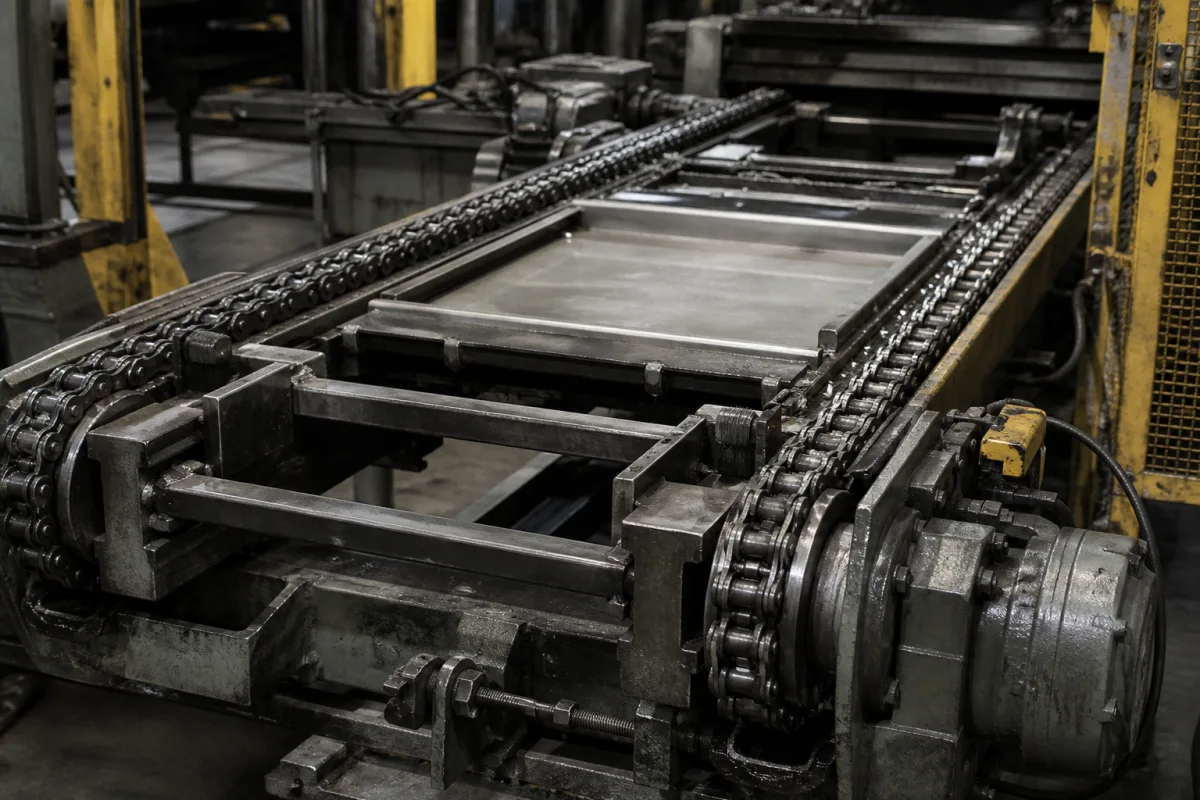
A continuous moving surface or linked series used to transport molds between stations in a conveyor system.
Product Specifications

Technical details and manufacturing context for Conveyor Belt/Chain

Definition
The conveyor belt or chain is a critical component of the Mold Conveyor System, responsible for the physical movement and positioning of molds through various processing stages such as heating, cooling, filling, and ejection. It ensures consistent, automated transfer, maintaining production flow and alignment.
Working Principle
The belt or chain is driven by a motorized pulley or sprocket. As it moves along a fixed path on supporting rollers or guides, it carries molds placed upon it. Tension is maintained to prevent slippage, and the speed is controlled to synchronize with other system operations.
Common Materials
Rubber, Steel, Polymer
Technical Parameters
  • Width and pitch (for chains) or thickness (for belts) determining load capacity and mold compatibility. (mm) Per Request
Components / BOM
  • Belt Carcass/Chain Links
    Provides the primary structural strength and continuous surface for load bearing and motion transmission.
    Material: Steel, Fabric, Polymer
  • Cover/Attachment Points
    The outer layer of a belt providing grip and wear resistance, or the points on a chain where molds are secured.
    Material: Rubber, Polyurethane, Steel
Engineering Reasoning
0.5-3.0 m/s linear velocity, 0-1000 kg/m load density, -20°C to 80°C ambient temperature
Tensile stress exceeding 50 MPa for belt carcass, chain link shear stress exceeding 120 MPa, belt surface temperature exceeding 90°C causing polymer degradation
Design Rationale: Fatigue failure from cyclic bending stress at pulley interfaces (σ_max > σ_endurance limit), abrasive wear coefficient exceeding 5×10⁻⁵ mm³/N·m, thermal expansion mismatch (ΔL/L = αΔT) exceeding 0.3% causing tracking misalignment
Risk Mitigation (FMEA)
Trigger Belt tension exceeding 150% of design specification due to improper tensioning or load surge
Mode: Belt carcass delamination and longitudinal tearing along reinforcement cords
Strategy: Install automatic tension monitoring with load cells and feedback-controlled tensioning system maintaining 1.0-1.2 kN/m tension
Trigger Material accumulation at pulley-belt interface creating localized pressure exceeding 2.5 MPa
Mode: Belt tracking failure and edge damage from lateral forces exceeding 300 N/m
Strategy: Implement self-cleaning pulley design with 5 mm clearance and automated scraper system with 0.1 mm tungsten carbide blades

Industry Taxonomies & Aliases

Commonly used trade names and technical identifiers for Conveyor Belt/Chain.

Applied To / Applications

This component is essential for the following industrial systems and equipment:

Industrial Ecosystem & Supply Chain DNA

Complementary Systems
Downstream Applications
Specialized Tooling

Application Fit & Sizing Matrix

Operational Limits
pressure: Max 5 bar (for pneumatic/hydraulic drive systems)
other spec: Max load capacity: 500 kg/m, Speed range: 0.1-5 m/s, Slurry concentration: Up to 40% solids by weight
temperature: -20°C to 120°C
Media Compatibility
✓ Metal molds (steel/aluminum) ✓ Plastic injection molds ✓ Ceramic molds
Unsuitable: Highly corrosive chemical environments (e.g., strong acids/alkalis)
Sizing Data Required
  • Total conveyor length (m)
  • Maximum mold weight (kg)
  • Required throughput (molds/hour)

Reliability & Engineering Risk Analysis

Failure Mode & Root Cause
Belt misalignment and tracking failure
Cause: Improper installation, worn or damaged pulleys, material buildup on pulleys, or structural misalignment of conveyor frame leading to uneven tension and edge wear.
Chain elongation and sprocket wear
Cause: Inadequate lubrication, excessive load, corrosion, or abrasive contamination causing increased pitch length, sprocket tooth wear, and eventual skipping or jamming.
Maintenance Indicators
  • Audible squealing, grinding, or irregular clicking noises indicating friction, misalignment, or chain/sprocket engagement issues
  • Visible excessive vibration, belt/chain slipping, or material spillage along the conveyor path signaling tension loss or mechanical failure
Engineering Tips
  • Implement laser alignment and regular tension checks to ensure proper belt/chain tracking and prevent premature wear from misalignment
  • Establish a proactive lubrication schedule using manufacturer-recommended lubricants and contamination control measures to reduce friction and corrosion

Compliance & Manufacturing Standards

Reference Standards
ISO 14890:2013 - Conveyor belts - Specification for rubber- or plastics-covered conveyor belts of textile construction for general use ANSI/CEMA 402-2003 (R2015) - Belt Conveyors DIN 22101:2011 - Continuous conveyors - Belt conveyors for bulk materials - Basis for calculation and dimensioning
Manufacturing Precision
  • Chain pitch tolerance: +/-0.1% of nominal pitch
  • Belt thickness variation: +/-0.5mm across full width
Quality Inspection
  • Non-destructive testing (NDT) - Magnetic particle inspection for chain links
  • Tensile strength test - ASTM D378-07 for belt carcass strength

Factories Producing Conveyor Belt/Chain

Verified manufacturers with capability to produce this product in China

✓ 97% Supplier Capability Match Found

T Technical Director from Canada Jan 22, 2026
★★★★★
"Testing the Conveyor Belt/Chain now; the technical reliability results are within 1% of the laboratory datasheet."
Technical Specifications Verified
P Project Engineer from United States Jan 19, 2026
★★★★☆
"Impressive build quality. Especially the technical reliability is very stable during long-term operation. (Delivery took slightly longer than expected, but technical support was excellent.)"
Technical Specifications Verified
S Sourcing Manager from United Arab Emirates Jan 16, 2026
★★★★★
"As a professional in the Rubber and Plastic Product Manufacturing sector, I confirm this Conveyor Belt/Chain meets all ISO standards."
Technical Specifications Verified
Verification Protocol

“Feedback is collected from verified sourcing managers during RFQ (Request for Quote) and factory evaluation processes on CNFX. These reports represent historical performance data and technical audit summaries from our B2B manufacturing network.”

16 sourcing managers are analyzing this specification now. Last inquiry for Conveyor Belt/Chain from Mexico (11m ago).

Supply Chain Compatible Machinery & Devices

Modular Injection Molded Plastic Pallet

Interlocking plastic pallet system for logistics and storage.

Explore Specs →
Multi-Layer Co-Extruded Barrier Film

Plastic film with multiple layers for superior barrier properties.

Explore Specs →
High-Precision Silicone Gasket

Custom-molded silicone seal for industrial equipment.

Explore Specs →
High-Density Polyethylene Storage Container

Industrial-grade plastic container for bulk material storage and transport.

Explore Specs →

Frequently Asked Questions

What materials are best for conveyor belts in rubber and plastic manufacturing?

Rubber, steel, and polymer materials are ideal for conveyor belts in this industry. Rubber provides flexibility and grip, steel offers durability and strength for heavy molds, while polymer materials resist chemicals and reduce maintenance needs.

How do conveyor belts/chains improve mold transport efficiency?

Conveyor belts and chains create continuous, automated movement of molds between production stations, reducing manual handling, minimizing downtime between processes, and ensuring consistent positioning for precision manufacturing operations.

What maintenance is required for conveyor systems in plastic manufacturing?

Regular inspection of belt carcass/chain links and cover/attachment points is essential. Maintenance includes cleaning to prevent material buildup, tension adjustments, lubrication of moving parts, and monitoring for wear on contact surfaces.

Can I contact factories directly on CNFX?

CNFX is an open directory, not a transaction platform. Each factory profile provides direct contact information and production details to help you initiate direct inquiries with Chinese suppliers.

Get Quote for Conveyor Belt/Chain

Request technical pricing, lead times, or customized specifications for Conveyor Belt/Chain directly from verified manufacturing units.

Your business information is encrypted and only shared with verified Conveyor Belt/Chain suppliers.

Thank you! Your message has been sent. We'll respond within 1–3 business days.

Need to Manufacture Conveyor Belt/Chain?

Connect with verified factories specializing in this product category

Add Your Factory Contact Us
Previous Product
Compression/Transition Section
Next Product
Cooling Unit