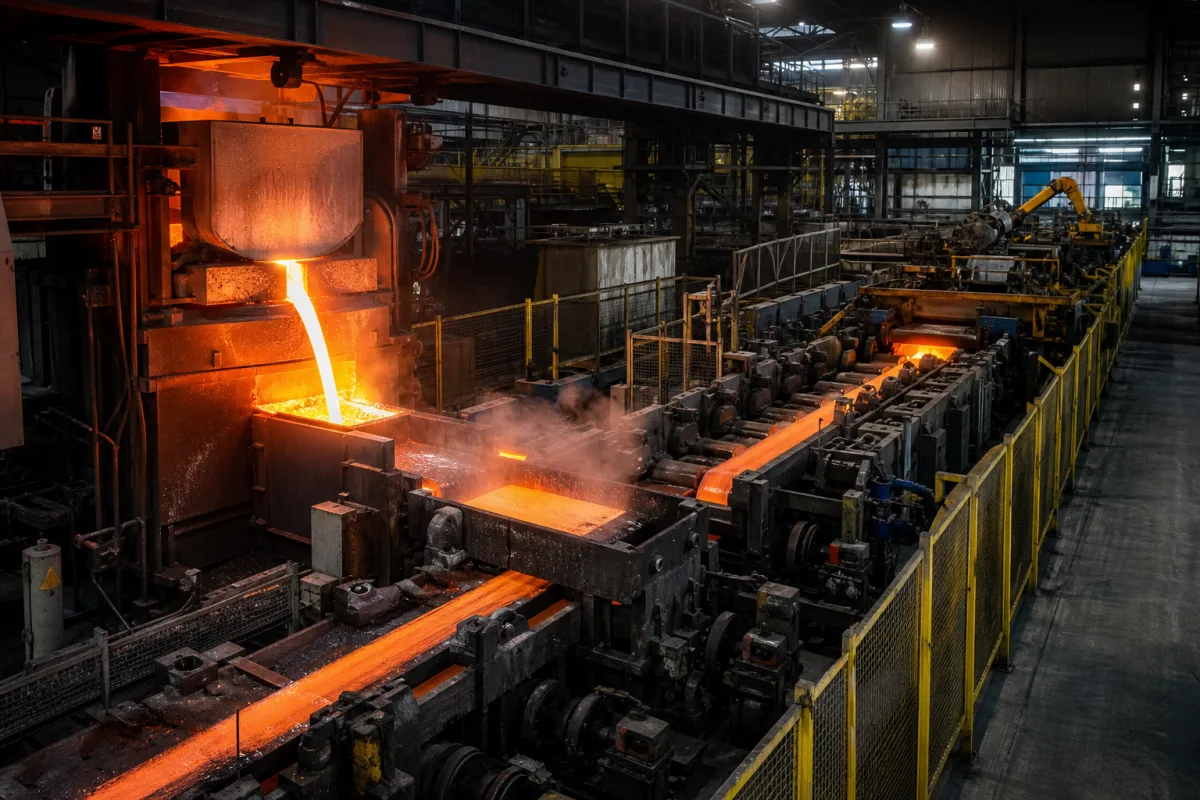
Endless casting and rolling plant for rebar and wire rod: billet caster linked directly to the bar mill
Caster and bar mill run as one machine · endless casting and rolling for rebar and wire rod: no billet reheating furnace, a short induction heater to even out temperature, and a casting speed that has to match the mill's mass flow
In a conventional minimill the caster and the bar mill are separate: billets are cut, cooled or stored, then reheated in a furnace before rolling. An endless casting and rolling plant removes that break. The strand leaves the caster, passes a short induction heater that evens out its temperature, and enters the first rolling stand while still continuous, so the caster and mill must run at the same mass flow for hours on end. That shifts the specification from two machines to one: billet section and casting speed are chosen to feed a particular mill at a particular tonnage, and the induction heater replaces the reheating furnace. The sections below use published plants and supplier statements to show the numbers involved.
Endless (directly linked) casting and rolling plants for long products — rebar, bar and wire rod — in which a billet caster feeds a bar or rod mill without intermediate cooling and reheating, including the induction equalising heater and the endless or semi-endless operating modes. Billet casters as stand-alone machines are covered on the Billet continuous caster page, with their spray cooling, cut-off machines and ladle turrets on separate pages; flat-product hot strip lines are on the Integrated hot strip rolling and finishing system page and non-ferrous cast-and-roll lines on the Non-ferrous strip continuous casting and rolling line page.
CNFX editorial research · Sources checked October 12, 2026 · 3 sources
No reheating furnace: what replaces it between strand and first stand
Primetals describes its Endless Bar Production as merging a billet caster and a high-speed bar mill, running continuously without reheating between casting and rolling: the strand is rolled as soon as it solidifies, which makes a conventional billet reheating furnace redundant. An induction heater handles temperature control, switched on by the process control when needed and off when not. [1]
Danieli describes the same function in its plants as a short induction heating system for billet temperature equalisation, with no reheating. [2] Primetals states that the plant can run in endless or semi-endless mode and that the technology derives from Arvedi Endless Strip Production. [1]
Primetals' stated results against conventional long-product casting and rolling are 60% lower energy consumption, over 90% lower CO₂ emissions, 99% yield and conversion costs 40% lower on average. [1] These are supplier claims without a stated reference plant or measurement basis; ask for the comparison plant, its reheating-furnace fuel and the measured figures behind them.
02
Two published endless plants: billet size, mills, product range and output
Two Danieli plants show the range from a large twin-strand plant to an upgrade of an existing single mill.
Danieli's automation at Guilin synchronises the two casting strands with their rebar and wire-rod mills. [2] SteelOrbis reports that Chiyoda's line was scheduled to start full-scale production in August 2026 after trials. [3]
Ultra-fine-grain process; direct rolling and bundling cuts rebar to length off the last stand [2]
Rebar from liquid steel in under 15 minutes; first endless casting and rolling operation for rebar in Japan [3]
03
Matching casting speed to mill throughput: the mass-flow arithmetic
Because the strand is never cut before rolling, the caster's output per minute is the mill's input per minute. The published plants give enough to check what casting speed their tonnage implies. [2][3]
Editorial calculation: all rows except the published output and billet size are assumptions made here — 7,500 operating hours a year and a solid-steel density of 7,800 kg/m³ — and ignore yield losses and corner radii. A lower utilisation raises the casting speed needed for the same tonnage. Ask the plant supplier for its own casting-speed, utilisation and yield basis for the guaranteed tonnage.
In an endless plant a caster stop also stops the mill. Ask how the plant switches to semi-endless operation, what happens to the strand in the mill when casting is interrupted, and how long a restart takes.
04
Data for an endless casting and rolling plant enquiry
Paste it into your enquiry below or into an email to a maker, then replace every bracket.
Products: [rebar, bar or wire rod; size range; grades]
Output: [t/y; operating hours; yield basis]
Caster: [strands; billet section; casting speed]
Mill: [number of stands; finishing speed; cutting and bundling]
Heating: [induction equalising heater power; endless or semi-endless modes]
Scope: [ladle furnace; automation; existing mill upgrade or new]
Guarantees: [energy per tonne; yield; CO₂ basis]
Explore company information and manufacturing capabilities, then discuss the scope of your project with a relevant supplier.
Share this page
Compiled and source-reviewed by the CNFX editorial team.
Each manufacturer above links to the page on that company's own website where the product is listed, with the date we checked it. How we source and review
· Page last updated 13 October 2026
Buyer questions
What is endless casting and rolling for long products?
A billet caster feeds a bar or rod mill directly, without cutting, storing and reheating billets; Primetals says the strand is rolled as soon as it solidifies and an induction heater controls temperature. [1]
How large are endless rebar plants?
Danieli's Twin-MIDA plant at Guilin Pinggang is rated 1.3 Mt/y with two 190 mm billet strands; Chiyoda Steel's single-strand line is rated 430,000 t/y. [2][3]
How fast must the billet be cast?
Editorial estimate: 650,000 t/y per 190 mm strand over an assumed 7,500 h needs about 5.1 m/min. [2]
How much energy does it save?
Primetals claims 60% lower energy use and over 90% lower CO₂ for its Endless Bar Production compared with conventional routes; these are supplier figures. [1]
Sources and what still needs a direct check
Sources checked 2026-10-12. Process description and claims from Primetals Technologies' Endless Bar Production page; Guilin Pinggang plant data from a Danieli press release; Chiyoda Steel data from a SteelOrbis report (July 2026).