Industry-Verified Manufacturing Data (2026)

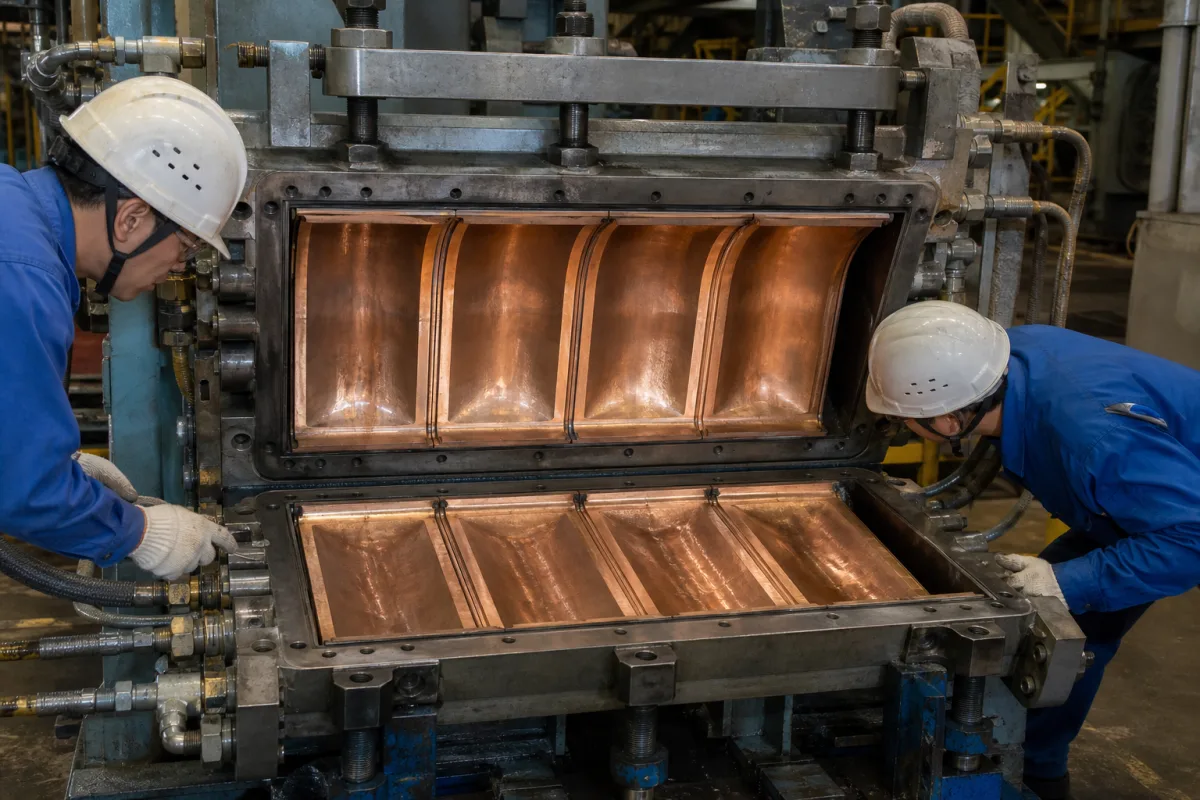
Continuous Casting Mold Assembly

Based on aggregated insights from multiple verified factory profiles within the CNFX directory, the standard Continuous Casting Mold Assembly used in the Basic Metal Manufacturing sector typically supports operational capacities ranging from standard industrial configurations to heavy-duty production requirements.

Technical Definition & Core Assembly

A canonical Continuous Casting Mold Assembly is characterized by the integration of Copper Mold Plates / Tubes and Mold Frame / Housing. In industrial production environments, manufacturers listed on CNFX commonly emphasize Copper Alloy (e.g., Cu-Cr-Zr) construction to support stable, high-cycle operation across diverse manufacturing scenarios.

A critical assembly in continuous casting that shapes molten metal into a solid strand with defined cross-section.
Product Specifications

Technical details and manufacturing context for Continuous Casting Mold Assembly

Definition
The Continuous Casting Mold Assembly is a precision-engineered component within the Integrated Continuous Casting Production System. It serves as the primary forming and initial cooling zone where molten steel from the tundish is solidified into a continuous strand with a specific cross-sectional profile (e.g., slab, bloom, billet). It is a key determinant of final product surface quality and internal structure.
Working Principle
Molten metal flows into the water-cooled copper mold cavity. Heat is rapidly extracted through the mold walls, causing a solidifying shell to form. The assembly may incorporate features like oscillation to prevent sticking and lubricant channels to reduce friction as the strand is withdrawn.
Common Materials
Copper Alloy (e.g., Cu-Cr-Zr), Stainless Steel (structural parts)
Technical Parameters
  • Mold cavity cross-sectional dimensions (e.g., thickness x width for a slab mold). (mm) Customizable
Components / BOM
  • Copper Mold Plates / Tubes
    Forms the primary cooling surface and defines the strand shape.
    Material: Copper Alloy (e.g., Cu-Cr-Zr)
  • Mold Frame / Housing
    Provides structural support, alignment, and houses cooling channels.
    Material: Carbon Steel or Stainless Steel
  • Oscillation Mechanism
    Imparts a reciprocating motion to the mold to prevent sticking of the solidifying shell.
    Material: Alloy Steel
  • Water Jacket / Cooling System
    Circulates cooling water to extract heat from the mold plates.
    Material: Stainless Steel
  • Lubrication System (e.g., oil nozzles)
    Applies lubricant (mold powder or oil) to the mold wall to reduce friction.
    Material: Stainless Steel
Engineering Reasoning
0.5-2.0 MPa (mold pressure), 1500-1600°C (molten steel temperature), 0.8-1.5 m/min (casting speed)
Thermal stress exceeds 350 MPa (yield strength of copper alloy), mold distortion exceeds 0.5 mm/m, cooling water temperature exceeds 45°C
Design Rationale: Thermal fatigue from cyclic temperature gradients (ΔT>200°C) causes crack initiation at stress concentrations, following Coffin-Manson fatigue law with exponent n=0.5
Risk Mitigation (FMEA)
Trigger Cooling water flow reduction below 80% of design rate (e.g., 25 m³/h vs 31.25 m³/h design)
Mode: Localized boiling in cooling channels creates vapor pockets, reducing heat transfer coefficient from 8000 to <2000 W/m²·K
Strategy: Redundant cooling circuits with independent pumps and flow sensors triggering automatic switchover at 85% flow reduction
Trigger Mold oscillation amplitude deviation beyond ±0.5 mm from 6 mm nominal at 200 cpm frequency
Mode: Stick-slip friction generates periodic tensile stresses exceeding 280 MPa, initiating surface cracks per Paris' law with da/dN=2.5×10⁻¹¹(ΔK)³
Strategy: Servo-hydraulic oscillation system with real-time position feedback and adaptive PID control maintaining amplitude within ±0.2 mm

Industry Taxonomies & Aliases

Commonly used trade names and technical identifiers for Continuous Casting Mold Assembly.

Industrial Ecosystem & Supply Chain DNA

Complementary Systems
Downstream Applications
Specialized Tooling

Application Fit & Sizing Matrix

Operational Limits
pressure: 0.5-2.0 MPa (cooling water system pressure)
other spec: Cooling water flow rate: 100-500 m³/h per mold, Strand withdrawal speed: 0.5-6.0 m/min, Mold oscillation frequency: 50-400 cpm
temperature: 1200-1600°C (molten steel operating range)
Media Compatibility
✓ Molten carbon steels ✓ Molten low-alloy steels ✓ Molten stainless steels (300 series)
Unsuitable: Highly corrosive molten metals (e.g., aluminum with high magnesium content, reactive metals like titanium)
Sizing Data Required
  • Required strand cross-section dimensions (mm)
  • Target casting speed (m/min)
  • Cooling water availability (flow rate in m³/h, temperature in °C)

Reliability & Engineering Risk Analysis

Failure Mode & Root Cause
Thermal fatigue cracking
Cause: Cyclic heating and cooling during casting cycles causes repeated thermal expansion and contraction, leading to stress concentration and crack initiation in the copper mold plates, particularly at water channel corners and bolt holes.
Wear and dimensional degradation
Cause: Abrasive contact with the solidifying steel shell and oscillation marks, combined with inadequate lubrication or misalignment, results in progressive wear of the mold's inner surface, altering critical taper and reducing heat transfer efficiency.
Maintenance Indicators
  • Visible longitudinal cracks or crazing on the mold's hot face, often accompanied by water leakage or steam emission from cooling channels.
  • Abnormal oscillation noise or increased friction sounds during operation, indicating excessive wear, misalignment, or lubrication failure in the mold assembly.
Engineering Tips
  • Implement strict water quality control and flow monitoring to prevent scaling and corrosion in cooling channels, ensuring consistent heat extraction and reducing thermal stress.
  • Establish a precision alignment and taper verification protocol during mold assembly and after each maintenance cycle, using laser measurement tools to maintain optimal geometry and contact with the strand.

Compliance & Manufacturing Standards

Reference Standards
ISO 9001:2015 - Quality management systems ASTM A48/A48M - Standard Specification for Gray Iron Castings DIN 1691 - Grey cast iron with lamellar graphite
Manufacturing Precision
  • Mold tube inner diameter: +/-0.05mm
  • Mold plate flatness: 0.08mm per 1000mm
Quality Inspection
  • Ultrasonic Testing for internal defects
  • Dimensional verification with CMM (Coordinate Measuring Machine)

Factories Producing Continuous Casting Mold Assembly

Verified manufacturers with capability to produce this product in China

✓ 92% Supplier Capability Match Found

P Project Engineer from United States Feb 15, 2026
★★★★★
"Reliable performance in harsh Basic Metal Manufacturing environments. No issues with the Continuous Casting Mold Assembly so far."
Technical Specifications Verified
S Sourcing Manager from United Arab Emirates Feb 12, 2026
★★★★★
"Testing the Continuous Casting Mold Assembly now; the technical reliability results are within 1% of the laboratory datasheet."
Technical Specifications Verified
P Procurement Specialist from Australia Feb 09, 2026
★★★★★
"Impressive build quality. Especially the technical reliability is very stable during long-term operation."
Technical Specifications Verified
Verification Protocol

“Feedback is collected from verified sourcing managers during RFQ (Request for Quote) and factory evaluation processes on CNFX. These reports represent historical performance data and technical audit summaries from our B2B manufacturing network.”

6 sourcing managers are analyzing this specification now. Last inquiry for Continuous Casting Mold Assembly from Vietnam (1h ago).

Supply Chain Compatible Machinery & Devices

Continuous Casting Machine

Industrial machine for solidifying molten metal into continuous billets/blooms/slabs.

Explore Specs →
Electromagnetic Induction Heater

Industrial heating device using electromagnetic induction for metal processing

Explore Specs →
Vacuum Induction Melting Furnace

Industrial furnace for melting metals under vacuum using electromagnetic induction

Explore Specs →
Electroslag Remelting Furnace

Secondary refining furnace for high-quality metal ingots

Explore Specs →

Frequently Asked Questions

What materials are used in continuous casting mold assemblies?

Our assemblies use copper alloy (Cu-Cr-Zr) for mold plates/tubes and stainless steel for structural parts to withstand high temperatures and thermal cycling.

How does the cooling system work in a continuous casting mold?

The water jacket/cooling system circulates water around the copper mold plates to rapidly extract heat from molten metal, ensuring proper solidification and strand quality.

What maintenance is required for continuous casting molds?

Regular inspection of copper plates for wear, lubrication system checks, and monitoring of cooling water flow/pressure are essential for optimal performance and longevity.

Can I contact factories directly on CNFX?

CNFX is an open directory, not a transaction platform. Each factory profile provides direct contact information and production details to help you initiate direct inquiries with Chinese suppliers.

Get Quote for Continuous Casting Mold Assembly

Request technical pricing, lead times, or customized specifications for Continuous Casting Mold Assembly directly from verified manufacturing units.

Your business information is encrypted and only shared with verified Continuous Casting Mold Assembly suppliers.

Thank you! Your message has been sent. We'll respond within 1–3 business days.

Need to Manufacture Continuous Casting Mold Assembly?

Connect with verified factories specializing in this product category

Add Your Factory Contact Us
Previous Product
Continuous Casting Machine for Non-Ferrous Metals
Next Product
Continuous Casting Mold Copper Plate