Industry-Verified Manufacturing Data (2026)

Assembly Workstations

Based on aggregated insights from multiple verified factory profiles within the CNFX directory, the standard Assembly Workstations used in the Furniture Manufacturing sector typically supports operational capacities ranging from standard industrial configurations to heavy-duty production requirements.

Technical Definition & Core Assembly

A canonical Assembly Workstations is characterized by the integration of Work Surface and Frame/Support Structure. In industrial production environments, manufacturers listed on CNFX commonly emphasize Powder-coated steel construction to support stable, high-cycle operation across diverse manufacturing scenarios.

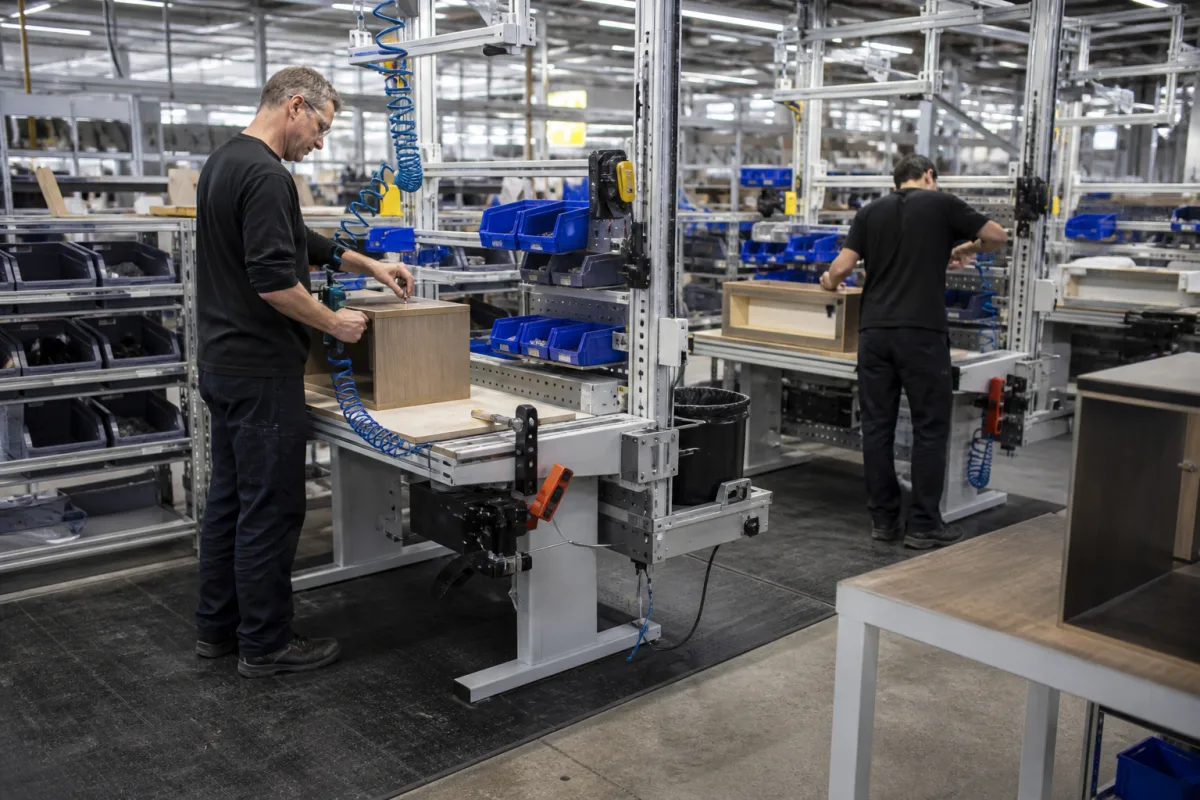
Specialized stations within a furniture assembly line where components are assembled into finished products.
Product Specifications

Technical details and manufacturing context for Assembly Workstations

Definition
Assembly workstations are dedicated positions along a furniture assembly line where specific assembly tasks are performed. These stations are designed to optimize workflow, ergonomics, and efficiency, allowing workers to systematically attach components, hardware, and finishes to furniture sub-assemblies or final products. They are integral to the linear production process, ensuring consistent quality and throughput.
Working Principle
Workstations are positioned sequentially along the assembly line. Furniture components arrive via conveyor or manual transfer. At each station, an operator performs a specific set of assembly tasks (e.g., frame joining, hardware installation, panel attachment, finishing) using provided tools and parts. The partially assembled item then moves to the next workstation until the final product is complete. The design often incorporates ergonomic features, part bins, tool holders, and sometimes pneumatic or electric tool interfaces to reduce fatigue and increase precision.
Common Materials
Powder-coated steel, Stainless steel, Industrial-grade laminate, Polyurethane work surface
Technical Parameters
  • Typical workstation dimensions (Length x Width x Height) to accommodate the furniture items being assembled and provide adequate operator space. (mm) Per Request
Components / BOM
  • Work Surface
    Primary area for assembling furniture components; designed to be durable, scratch-resistant, and easy to clean.
    Material: Industrial laminate or stainless steel
  • Frame/Support Structure
    Provides structural integrity and stability to the workstation; often includes leveling feet.
    Material: Powder-coated steel
  • Tool Tray/Organizer
    Holds assembly tools (screwdrivers, wrenches, drills) and fasteners within easy reach of the operator.
    Material: Plastic or steel
  • Parts Bins/Shelves
    Storage for hardware, fittings, and small components needed for the specific assembly tasks at that station.
    Material: Plastic or wire mesh
  • Power Strip/Outlet
    Provides electrical power for pneumatic tools, electric drivers, or lighting.
    Material: Plastic, metal
Engineering Reasoning
0.5-2.0 m/s linear feed rate, 15-45 N·m torque application
Exceeding 2.5 m/s feed rate causes bearing seizure, torque beyond 60 N·m induces gear tooth fracture
Design Rationale: Bearing seizure occurs due to hydrodynamic lubrication breakdown at 2.5 m/s (Stribeck curve transition), gear failure results from Hertzian contact stress exceeding 1500 MPa yield strength
Risk Mitigation (FMEA)
Trigger Misalignment exceeding 0.1 mm/m in linear guides
Mode: Recirculating ball bearing premature wear with 50% life reduction
Strategy: Laser alignment system with 0.01 mm/m tolerance and automatic compensation
Trigger Electrostatic discharge exceeding 8 kV during plastic component handling
Mode: Programmable logic controller memory corruption requiring full reset
Strategy: Ionizing air blowers maintaining surface potential below 100 V and Faraday cage shielding

Industry Taxonomies & Aliases

Commonly used trade names and technical identifiers for Assembly Workstations.

Applied To / Applications

This component is essential for the following industrial systems and equipment:

Industrial Ecosystem & Supply Chain DNA

Complementary Systems
Downstream Applications
Specialized Tooling

Application Fit & Sizing Matrix

Operational Limits
pressure: N/A (mechanical assembly only)
other spec: Max Load Capacity: 500 kg per workstation, Power Supply: 110-240V AC, 50-60Hz
temperature: 15-30°C (ambient, non-temperature-controlled environment)
Media Compatibility
✓ Wood components (particle board, MDF, solid wood) ✓ Metal hardware (screws, bolts, brackets) ✓ Plastic/laminate trim pieces
Unsuitable: Wet or high-humidity environments (>80% RH) causing material swelling/corrosion
Sizing Data Required
  • Product dimensions (LxWxH) of assembled furniture
  • Annual production volume (units/year)
  • Number of assembly steps/operators required per product

Reliability & Engineering Risk Analysis

Failure Mode & Root Cause
Mechanical wear of linear guides and bearings
Cause: Inadequate lubrication, particulate contamination from the assembly environment, and misalignment due to improper installation or foundation settling
Electrical/control system failure
Cause: Voltage spikes or brownouts, overheating of PLCs/motor drives due to poor ventilation or dust accumulation, and loose connections from vibration
Maintenance Indicators
  • Unusual grinding, squealing, or knocking noises from moving components
  • Inconsistent or erratic workstation cycle times, or unexpected stoppages
Engineering Tips
  • Implement a condition-based lubrication program using automated systems or scheduled checks with high-quality, appropriate lubricants, and install effective seals or enclosures to minimize contamination.
  • Establish a routine thermal imaging inspection schedule for electrical panels and motor drives to detect overheating early, and ensure all electrical connections are periodically torqued to specification to combat vibration-induced loosening.

Compliance & Manufacturing Standards

Reference Standards
ISO 6385:2016 - Ergonomic principles in the design of work systems ANSI/BIFMA X5.1 - Office Furnishings - General Purpose Office Chairs - Tests DIN EN 527-1 - Office furniture - Work tables and desks - Part 1: Dimensions
Manufacturing Precision
  • Surface flatness: +/- 0.5 mm per meter
  • Height adjustment repeatability: +/- 1.0 mm
Quality Inspection
  • Load capacity test (static and dynamic)
  • Ergonomic adjustment verification

Factories Producing Assembly Workstations

Verified manufacturers with capability to produce this product in China

✓ 94% Supplier Capability Match Found

T Technical Director from United Arab Emirates Feb 15, 2026
★★★★★
"Found 34+ suppliers for Assembly Workstations on CNFX, but this spec remains the most cost-effective."
Technical Specifications Verified
P Project Engineer from Australia Feb 12, 2026
★★★★☆
"The technical documentation for this Assembly Workstations is very thorough, especially regarding technical reliability. (Delivery took slightly longer than expected, but technical support was excellent.)"
Technical Specifications Verified
S Sourcing Manager from Singapore Feb 09, 2026
★★★★★
"Reliable performance in harsh Furniture Manufacturing environments. No issues with the Assembly Workstations so far."
Technical Specifications Verified
Verification Protocol

“Feedback is collected from verified sourcing managers during RFQ (Request for Quote) and factory evaluation processes on CNFX. These reports represent historical performance data and technical audit summaries from our B2B manufacturing network.”

7 sourcing managers are analyzing this specification now. Last inquiry for Assembly Workstations from India (41m ago).

Supply Chain Compatible Machinery & Devices

Furniture Assembly Line

Integrated production system for furniture assembly operations

Explore Specs →
Furniture Caster

Swiveling wheel assembly for furniture mobility

Explore Specs →
Furniture Hinge

Mechanical joint enabling door/cabinet opening and closing

Explore Specs →
Ergonomic Office Chair

Industrial-scale manufactured seating solution for workplace ergonomics and comfort.

Explore Specs →

Frequently Asked Questions

What materials are used in these assembly workstations for durability?

Our workstations feature powder-coated steel frames for corrosion resistance, stainless steel components, industrial-grade laminate surfaces, and polyurethane worktops that withstand heavy use in furniture manufacturing environments.

How can these workstations improve furniture assembly line efficiency?

With integrated parts bins, tool organizers, power access, and ergonomic design, these stations reduce movement, organize components, and streamline the assembly process, increasing productivity by up to 30%.

Are these workstations customizable for different furniture assembly needs?

Yes, we offer modular configurations with adjustable shelving, various work surface materials, optional lighting, and accessory mounts to accommodate different furniture sizes, assembly techniques, and production volumes.

Can I contact factories directly on CNFX?

CNFX is an open directory, not a transaction platform. Each factory profile provides direct contact information and production details to help you initiate direct inquiries with Chinese suppliers.

Get Quote for Assembly Workstations

Request technical pricing, lead times, or customized specifications for Assembly Workstations directly from verified manufacturing units.

Your business information is encrypted and only shared with verified Assembly Workstations suppliers.

Thank you! Your message has been sent. We'll respond within 1–3 business days.

Need to Manufacture Assembly Workstations?

Connect with verified factories specializing in this product category

Add Your Factory Contact Us
Previous Product
Anti-Fatigue Mat
Next Product
Bearing Assembly