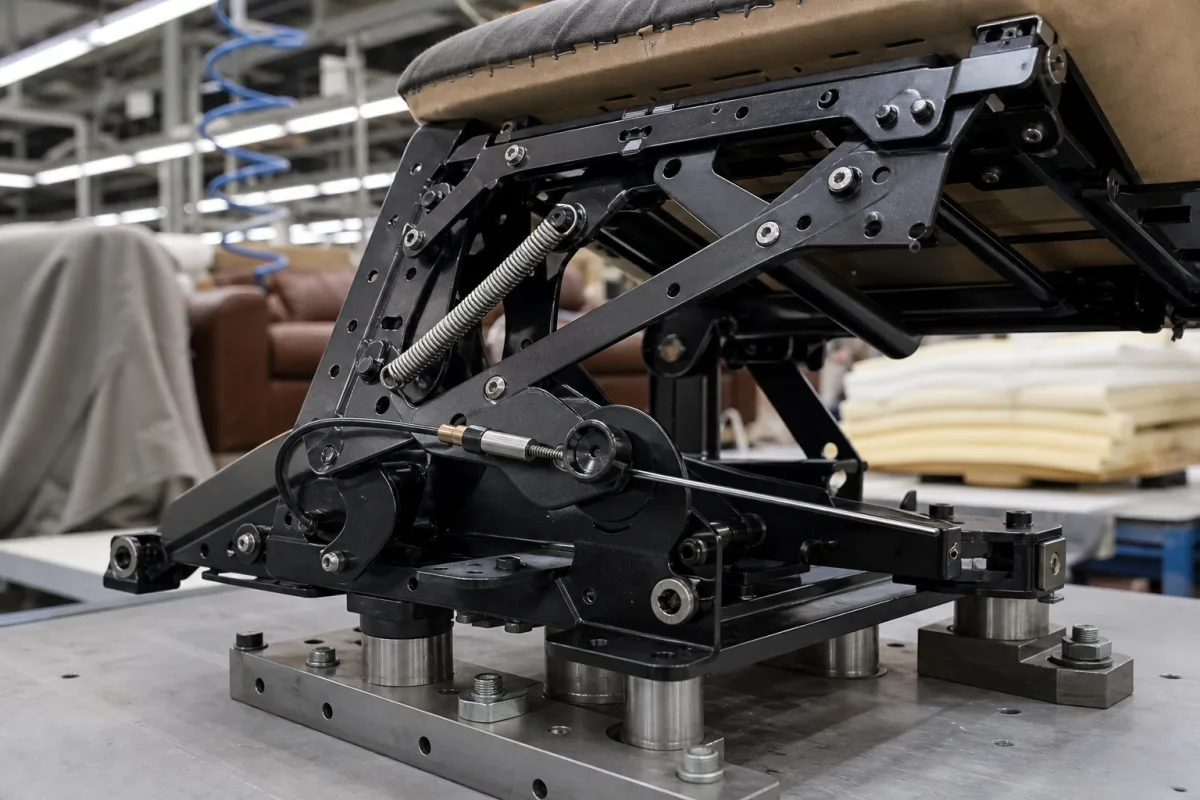
Brake mechanism for reclining seats: the lock that holds a backrest or footrest at the chosen angle
Backrest and footrest locks for reclining furniture · lockable gas springs with elastic or rigid locking, lever and Bowden cable releases, and mechanical wrap-spring drum brakes
In a reclining seat, the brake is the part that stops the backrest, seat or footrest from moving once the user has found a position, and lets it move again when a button, lever or cable is pulled. Two families do this job: lockable gas springs, which lock by closing a valve inside the spring and also carry part of the load, and purely mechanical locks such as a coil spring wound round a drum. This page explains how they hold, how much they hold, and how the release is sized.
Locking and braking mechanisms that hold the backrest, seat or footrest of reclining and adjustable seating (recliners, swivel-chair backrests, loungers, massage chairs) in position: lockable gas springs with elastic or rigid locking, their direct and Bowden cable releases, and mechanical wrap-spring backrest locks. Castor wheels and the wheel brakes on chair and furniture castors are covered on the Furniture caster page; vehicle seat recliners are mentioned only where a source compares them.
CNFX editorial research · Sources checked October 12, 2026 · 4 sources
Elastic or rigid locking: whether the backrest gives a little when locked
SUSPA recommends its elastic-locking gas springs where a spring-back of the lock is wanted: with the valve closed, the piston separates two gas chambers, so the piston rod still gives under outside loads and pulsed peak loads are damped. Its rigid-locking types put oil on one side of the piston and are used where spring-back is not wanted, for example for safety. [1][2]
SUSPA lists backrest adjustment of seats as an application for both the EL and the HY1/HY3 types. [1][2] Its standard program narrows the EL range to 20–250 mm of stroke and 200–800 N (EL1) or 200–1,000 N (EL2) of extension force, selectable in 50 N steps, so the wider limits in the specification table and the standard program are not the same offer; ask which applies to the part number quoted. [1]
Stabilus describes the same split for its BLOC-O-LIFT range: the standard type is gas-filled, locks elastically with a slight rebound and is installed rod-down, and Stabilus places it in the backrest mechanism of swivel chairs and massage armchairs for loads from the element's own weight only. Rigid-locking versions fill the piston travel with oil; one needs vertical mounting, the other has a separator piston and can be mounted in any orientation. [3]
Editorial calculation: for an HY1 spring with F1 = 500 N, SUSPA's 3.6 × F1 limit puts the end of rigid locking in compression at 3.6 × 500 = 1,800 N, well below the 6,500 N mechanical maximum; above 1,800 N the lock yields elastically. With F1 = 800 N the limit is 2,880 N. The rigid range therefore depends on the filling force chosen, not only on the model.
Tell the supplier which direction the lock must hold (backrest pushed back, footrest pressed down), the largest load a person can put on it, whether a slight give is acceptable, and the mounting orientation available in the frame.
02
Release force, release travel and the cable from the handle to the valve
The user unlocks a gas-spring brake by pressing a pin in the end of the piston rod. SUSPA gives the release force for both its elastic and rigid types as 0.25 × F1, with a normal release travel of 2.5 to 3.5 mm and a short-travel version of under 0.5 mm. [1][2]
Editorial calculation: with SUSPA's 0.25 × F1 rule, a backrest spring with F1 = 400 N needs 100 N at the release pin, and one with F1 = 800 N needs 200 N. A lever or cable actuator has to multiply the finger force up to that value inside the 2.5–3.5 mm of pin travel, which is why the lever ratio and cable stroke are specified together with the spring.
Stabilus also sells BLOC-O-LIFT springs with an override function. In the extension-override version the spring locks in the compressed state, but an excessive pull opens an overload valve and the spring extends; Stabilus recommends it for treatment tables and for furniture for sitting and reclining, because head and foot sections can then be adjusted without working a release. The override force can be specified within a range. [3]
For a spring mounted near a heater or in an unheated room, SUSPA gives −20 °C to +60 °C in operation and −20 °C to +80 °C in storage for the EL and HY types. [1][2]
Ask for the release force at the pin for your F1, the release travel, the cable length and routing, the handle or button type, and whether an override is wanted for a footrest that may be kicked down.
03
Mechanical alternative: a coil spring wound round a drum, backed by a toothed bolt
Not every recliner lock is a gas spring. US patent 4,685,736 (PL Porter, filed 1986) describes an infinitely positionable backrest lock in which a toothed rack on the backrest plate drives a gear train to a drum; a brake spring wound on the drum grips it, and the backrest cannot pivot until the release lever is moved. [4]
In that design a spring-loaded clamping lever winds the brake spring tighter to raise its grip beyond what the bare spring gives, and a release lever carries a bolt that engages teeth on the drum wheel as a back-up lock if the brake spring slips. Moving the release lever withdraws the bolt and, through a cam, slackens the clamping lever, so one lever serves both as release and as secondary lock. [4]
The patent sets this against two limits of earlier locks: designs that were complex, heavy or large, and simpler ones that only adjusted the backrest in fixed steps rather than continuously. [4] Editorial note: the patent covers reclining seats without naming furniture, and its background discusses vehicle seats; it gives no holding torque, so ask a supplier of a mechanical lock for a measured holding moment and a fatigue test count rather than a description.
04
Data for quoting a recliner lock
Paste it into your enquiry below or into an email to a maker, then replace every bracket.
Furniture: [recliner, swivel chair backrest, lounger, massage chair]
Motion: [backrest, seat or footrest; angle range]
Loads: [weight to be balanced; largest occupant load on the locked part; direction]
Locking: [elastic or rigid; mechanical lock acceptable]
Spring: [stroke; F1; installed length; mounting orientation; end fittings]
Release: [button, lever or Bowden cable; cable length; release force at the handle]
Options: [override; temperature range]
Tests: [cycle count; holding test]
Explore company information and manufacturing capabilities, then discuss the scope of your project with a relevant supplier.
Share this page
Compiled and source-reviewed by the CNFX editorial team.
Each manufacturer above links to the page on that company's own website where the product is listed, with the date we checked it. How we source and review
· Page last updated 13 October 2026
Buyer questions
What is the difference between elastic and rigid locking in a recliner gas spring?
SUSPA says elastic locking lets the rod still give under outside loads because two gas chambers are separated, damping peak loads; rigid locking uses oil on one side and is used where spring-back is not wanted. [1][2]
How much force does it take to release a locking gas spring?
SUSPA gives 0.25 × F1, with 2.5–3.5 mm of normal release travel or under 0.5 mm in the short version; Stabilus offers a 2.5 mm slide valve and a 1 mm poppet valve. [1][3]
Can a reclining backrest be locked without a gas spring?
Yes; US patent 4,685,736 describes a brake spring wound on a drum, geared to the backrest, with a toothed bolt as back-up lock. [4]
What is an override function on a locking gas spring?
Stabilus describes an overload valve that releases the lock when a set force is exceeded, so head and foot sections of reclining furniture can be moved without working the release. [3]
Sources and what still needs a direct check
Sources checked 2026-10-12. Load limits, release force and travel come from SUSPA's product pages for elastic and rigid locking gas springs; release valves, Bowden cable releases and the override function from Stabilus' BLOC-O-LIFT page; the mechanical wrap-spring lock from a US patent assigned to PL Porter.