Industry-Verified Manufacturing Data (2026)

Cam Mechanism

Based on aggregated insights from multiple verified factory profiles within the CNFX directory, the standard Cam Mechanism used in the Furniture Manufacturing sector typically supports operational capacities ranging from standard industrial configurations to heavy-duty production requirements.

Technical Definition & Core Assembly

A canonical Cam Mechanism is characterized by the integration of Cam Lobe and Mounting Hub/Bore. In industrial production environments, manufacturers listed on CNFX commonly emphasize Zinc Alloy construction to support stable, high-cycle operation across diverse manufacturing scenarios.

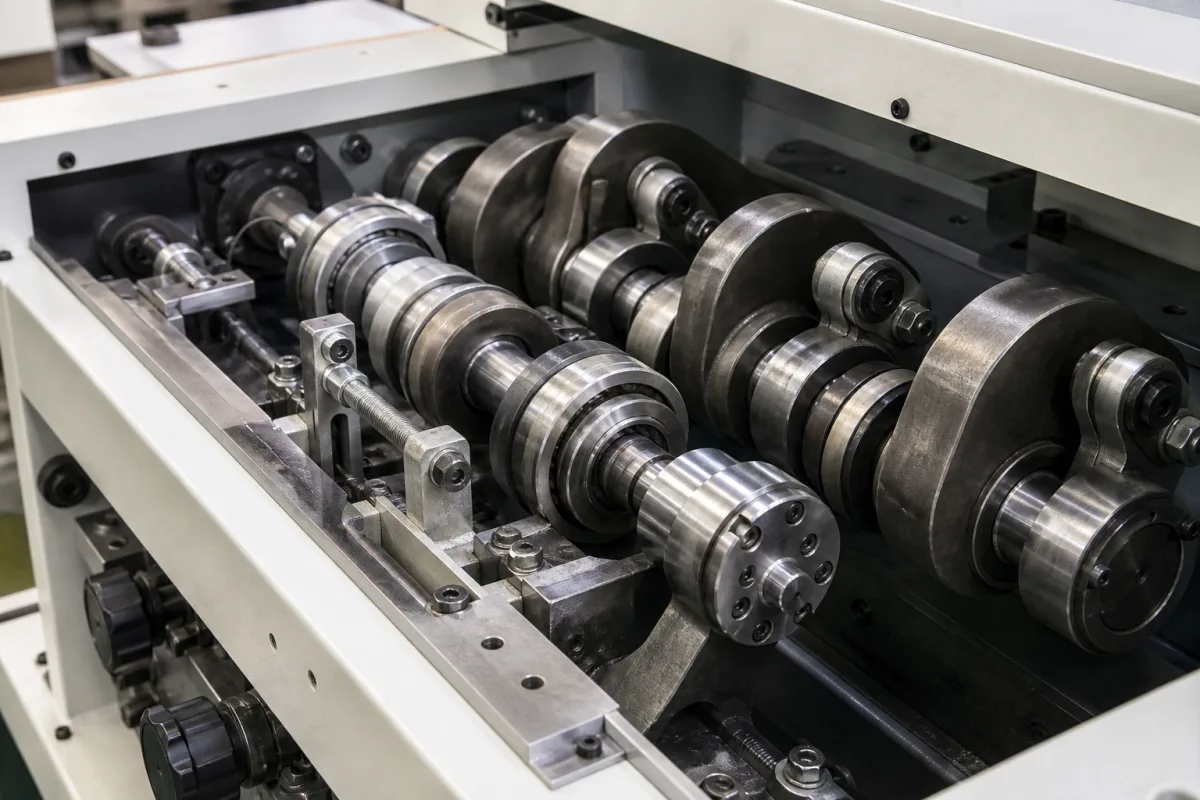
A mechanical component that converts rotational motion into linear motion or vice versa within a locking system.
Product Specifications

Technical details and manufacturing context for Cam Mechanism

Definition
The cam mechanism is the core actuating component within a Precision Furniture Cam Lock, responsible for translating the rotational force from the key or handle into the linear displacement needed to engage or disengage the locking bolt. Its precise profile determines the locking action's smoothness, security, and throw distance.
Working Principle
A cam, typically an eccentric disc or lobe, is rotated by the lock's actuator. As it rotates, its off-center profile pushes against a follower (often the lock bolt or a connecting piece), converting the rotary input into controlled linear output to extend or retract the locking element.
Common Materials
Zinc Alloy, Steel
Technical Parameters
  • Diameter and throw distance (eccentricity) of the cam lobe. (mm) Standard Spec
Components / BOM
  • Cam Lobe
    The eccentric profile that contacts the follower to create linear motion.
    Material: Steel
  • Mounting Hub/Bore
    The central feature for attaching the cam to the actuator spindle or handle.
    Material: Zinc Alloy or Steel
Engineering Reasoning
0.1-100 N·m torque input, 0.01-50 mm linear displacement output, 0-120° cam angle rotation
Hertzian contact stress exceeding 1.5 GPa at cam-follower interface, surface roughness Ra > 0.8 μm at sliding surfaces, cam shaft deflection > 0.05 mm per 100 mm length
Design Rationale: Surface fatigue failure due to cyclic Hertzian contact stress exceeding material endurance limit (typically 0.4-0.5 of ultimate tensile strength for steel), adhesive wear from boundary lubrication breakdown when Stribeck parameter < 0.001
Risk Mitigation (FMEA)
Trigger Insufficient lubrication film thickness (λ < 1) at cam-follower interface
Mode: Accelerated adhesive wear leading to surface scoring and increased friction coefficient from 0.1 to >0.3
Strategy: Implement forced lubrication system with minimum 0.02 mm oil film thickness, specify surface hardness > 58 HRC with DLC coating (coefficient of friction 0.05-0.1)
Trigger Cyclic bending stress exceeding material fatigue limit at cam shaft fillet radius
Mode: Fatigue crack initiation and propagation at stress concentration points (Kt > 2.5), leading to shaft fracture
Strategy: Design fillet radius ≥ 3 mm with shot peening to induce 400-600 MPa compressive residual stress, use vacuum-melted steel with inclusion rating ≤ 1.5 per ASTM E45

Industry Taxonomies & Aliases

Commonly used trade names and technical identifiers for Cam Mechanism.

Applied To / Applications

This component is essential for the following industrial systems and equipment:

Industrial Ecosystem & Supply Chain DNA

Complementary Systems
Downstream Applications
Specialized Tooling

Application Fit & Sizing Matrix

Operational Limits
pressure: 0 to 10 MPa
other spec: Max linear force: 5000 N, Max rotational speed: 3000 RPM
temperature: -40°C to 150°C
Media Compatibility
✓ Lubricated steel-on-steel systems ✓ Hydraulic fluid environments ✓ Clean dry air systems
Unsuitable: Abrasive slurry or corrosive chemical environments
Sizing Data Required
  • Required linear stroke length (mm)
  • Maximum operating torque (Nm)
  • Required cycle life (cycles)

Reliability & Engineering Risk Analysis

Failure Mode & Root Cause
Surface pitting and spalling
Cause: High contact stress exceeding material fatigue limit, often due to improper cam profile design, misalignment, or inadequate lubrication leading to metal-to-metal contact and subsurface crack propagation.
Cam follower wear and deformation
Cause: Excessive sliding friction, contamination ingress (abrasive particles), or improper follower geometry causing localized wear, mushrooming, or fatigue failure at the contact interface.
Maintenance Indicators
  • Audible clicking or knocking noises during operation, indicating excessive clearance, impact loading, or component deformation.
  • Visible abnormal wear patterns (e.g., scoring, galling, or uneven wear tracks) on cam surfaces or followers during inspection.
Engineering Tips
  • Implement precision alignment during installation and use high-pressure lubrication systems with filters to maintain clean oil supply, reducing friction and contamination-related wear.
  • Apply surface treatments (e.g., nitriding or hard chrome plating) to cam and follower surfaces, and conduct regular vibration analysis to detect early-stage fatigue or misalignment.

Compliance & Manufacturing Standards

Reference Standards
ISO 286-1:2010 (Geometrical product specifications - Limits and fits) ANSI/ASME B46.1-2019 (Surface Texture) DIN 5480-1:2006 (Involute splines based on reference diameters)
Manufacturing Precision
  • Cam profile deviation: +/-0.05mm
  • Surface roughness: Ra 0.8μm max
Quality Inspection
  • Coordinate Measuring Machine (CMM) profile verification
  • Hardness testing (Rockwell C scale)

Factories Producing Cam Mechanism

Verified manufacturers with capability to produce this product in China

✓ 94% Supplier Capability Match Found

P Project Engineer from United Arab Emirates Jan 17, 2026
★★★★★
"Great transparency on the Cam Mechanism components. Essential for our Furniture Manufacturing supply chain."
Technical Specifications Verified
S Sourcing Manager from Australia Jan 14, 2026
★★★★★
"The Cam Mechanism we sourced perfectly fits our Furniture Manufacturing production line requirements."
Technical Specifications Verified
P Procurement Specialist from Singapore Jan 11, 2026
★★★★★
"Found 13+ suppliers for Cam Mechanism on CNFX, but this spec remains the most cost-effective."
Technical Specifications Verified
Verification Protocol

“Feedback is collected from verified sourcing managers during RFQ (Request for Quote) and factory evaluation processes on CNFX. These reports represent historical performance data and technical audit summaries from our B2B manufacturing network.”

8 sourcing managers are analyzing this specification now. Last inquiry for Cam Mechanism from UAE (34m ago).

Supply Chain Compatible Machinery & Devices

Panel Saw

Industrial machine for cutting large wood panels with precision

Explore Specs →
Furniture Assembly Line

Integrated production system for furniture assembly operations

Explore Specs →
Furniture Caster

Swiveling wheel assembly for furniture mobility

Explore Specs →
Furniture Hinge

Mechanical joint enabling door/cabinet opening and closing

Explore Specs →

Frequently Asked Questions

What types of furniture applications use cam mechanisms?

Cam mechanisms are commonly used in flat-pack furniture, cabinets, shelving units, and modular systems where secure locking and easy assembly are required.

How does the material choice affect cam mechanism performance?

Zinc alloy offers corrosion resistance and smooth operation, while steel provides maximum strength and durability for heavy-duty furniture applications.

What maintenance do cam mechanisms require in furniture?

Cam mechanisms typically require minimal maintenance. Occasional inspection for wear and ensuring proper alignment during assembly will maintain optimal performance.

Can I contact factories directly on CNFX?

CNFX is an open directory, not a transaction platform. Each factory profile provides direct contact information and production details to help you initiate direct inquiries with Chinese suppliers.

Get Quote for Cam Mechanism

Request technical pricing, lead times, or customized specifications for Cam Mechanism directly from verified manufacturing units.

Your business information is encrypted and only shared with verified Cam Mechanism suppliers.

Thank you! Your message has been sent. We'll respond within 1–3 business days.

Need to Manufacture Cam Mechanism?

Connect with verified factories specializing in this product category

Add Your Factory Contact Us
Previous Product
Brake Mechanism
Next Product
Ceiling Plenum