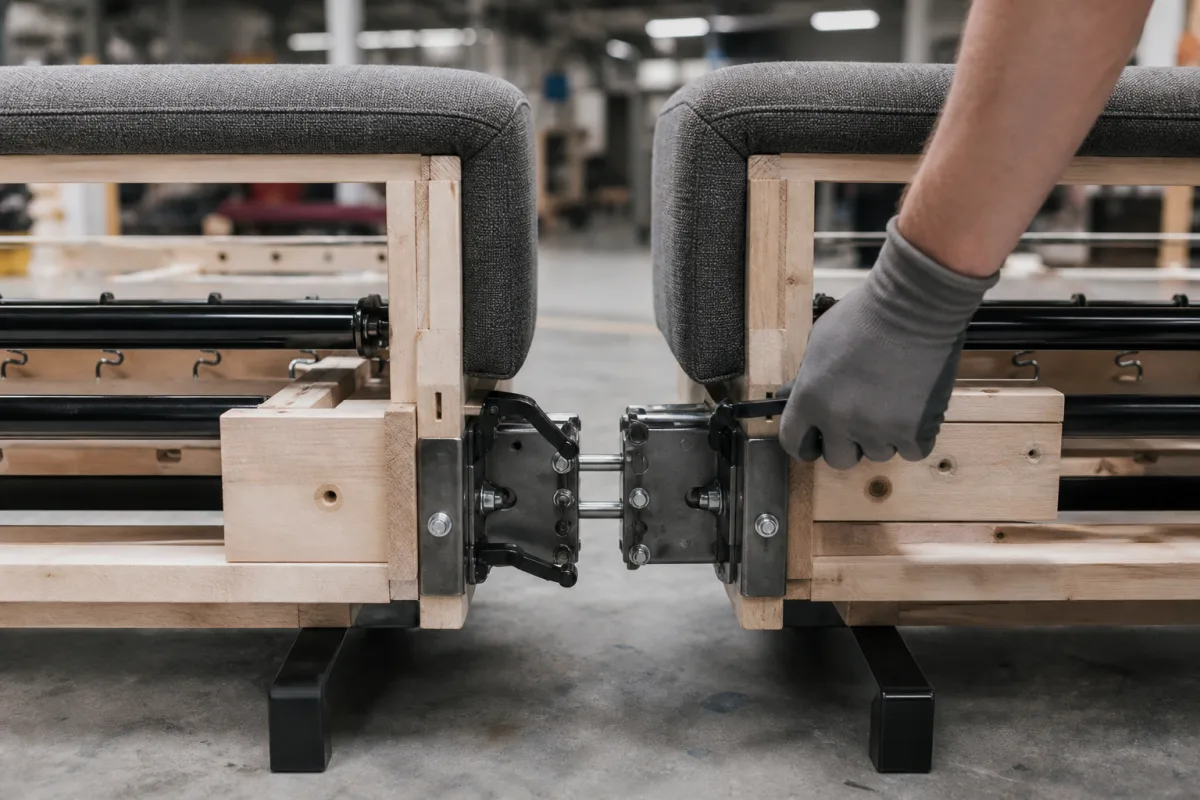
Modular connector system (the hardware that locks sectional sofa modules together and lets them be separated)
Connectors that lock the modules of a sectional sofa together · post-and-latch connectors that block sideways drift but lift apart, leg-slot connectors, why rod-and-sleeve joints fail on reclining sections, and how ganged seating is tested
A sectional sofa is only a sofa while its modules stay together. The connector system is the pair of fittings on adjacent modules that stops them drifting apart in use, yet lets a user part them to rearrange or move the sofa. Specify how the connector engages and releases, whether it has to cope with reclining sections, where it fixes to the frame, and what test evidence covers the joined units.
Connectors and linking hardware between the modules of sectional sofas and ganged lounge seating: post-and-latch, slot and leg connectors, their fixing to frames and their behaviour in use. Complete modular sofa ranges are covered on the Modular sectional sofa system page; recliner mechanisms and cabinet or panel connectors are outside this page.
CNFX editorial research · Sources checked October 12, 2026 · 4 sources
Ultra-Mek's US patent 6,932,428 (Marcus L. Murphy, 2005) sets out the problem as "maintaining the relative positions of the pieces once they are placed by the user." Its connector "prevents relative horizontal movement of the first and second seating units" yet "permits relative vertical movement", which it says "can enable the rapid interconnection and separation of adjacent seating units." One unit carries an upright post on a base plate; the other carries a slotted plate with a spring-biased locking finger that the post pushes aside and that snaps back to hold it. Lifting one unit clears the post. [1]
Zinus's US patent 12,245,691 (2025) joins two sofa components at their legs: "the connector 1 may comprise a middle board 11, one or more arms 13, and one or more slots 12", slid onto the legs and pushed up so the slots seat around a neck at the top of each leg, with a flanged tip that "may provide a handle when assembling and/or dissembling". It criticises earlier slot connectors because "it requires manual effort that includes lifting up one sofa component", "demands high accuracy in the manufacturing process", and when loose may "come apart during use." [2]
Ultra-Mek states that fastening sections with a rod and sleeve is "unsuitable if the arms and/or frame of the seating unit move relative to the floor", as happens when a unit reclines, besides making the sections "difficult and/or inconvenient" to attach. [1]
For each joint, state whether either module reclines or has a moving frame, where the connector can fix (base frame, legs, arm side), the frame material it screws into, and how the user is meant to separate the modules.
03
Test evidence for joined units
SGS notes that ANSI/BIFMA X5.4 public and lounge seating "includes products with single seat units, units with multiple seating positions within one unit or ganged seating units". [3] The US GSA requires sofas offered to it to be tested to its FNAE-80-214A method or to ANSI/BIFMA X5.4, on "the “worst case” unit which is generally the item having the greatest span between legs", which GSA says "is normally a 3-seat sofa" unless interior support legs give the 2-seat sofa the greatest span. [4]
Neither source sets a separate test for the connector between modules; ask the supplier how the joined configuration was tested, which modules were linked, and whether the connector was in place during the test. [3][4]
Ask for the test report naming the standard, the configuration tested (single module or linked modules) and the connector fitted.
04
Sofa connector order details
Paste it into your enquiry below or into an email to a maker, then replace every bracket.
Modules: [seat; corner; chaise; recliner]
Joint: [base frame; legs; arm side]
Connector type: [post and latch; slot; leg connector]
Release: [lift; slide; tool-free]
Fixing: [screws; frame material]
Finish: [steel; plating]
Tests: [BIFMA X5.4 or other; linked configuration]
Quantity: [sets per sofa; spares]
Explore company information and manufacturing capabilities, then discuss the scope of your project with a relevant supplier.
Share this page
Compiled and source-reviewed by the CNFX editorial team.
Each manufacturer above links to the page on that company's own website where the product is listed, with the date we checked it. How we source and review
· Page last updated 13 October 2026
Buyer questions
Why do sectional modules drift apart?
Ultra-Mek describes the difficulty of maintaining the pieces' positions once placed; its connector blocks horizontal movement while allowing the units to be lifted apart. [1]
Can a rod-and-sleeve joint be used on recliners?
Ultra-Mek calls it unsuitable where arms or frame move relative to the floor. [1]
What problems do slot connectors have?
Zinus lists lifting one component to engage, high manufacturing accuracy, and loose joints that can come apart in use. [2]
Does BIFMA X5.4 cover linked sofas?
SGS says the standard includes ganged seating units; ask how the linked configuration was tested. [3]
Sources and what still needs a direct check
Sources checked 2026-10-12. The US patents of Ultra-Mek and Zinus describe sofa module connectors; SGS reported the 2020 revision of ANSI/BIFMA X5.4; the US GSA publishes performance test requirements for upholstered seating.