Editorial Technical Reference

Lumbar Support Mechanism

This page explains how Lumbar Support Mechanism is classified within Furniture Manufacturing. Technical values and manufacturer relationships are research references; confirm the current specification and supplier evidence for each order.

Technical Definition & Core Assembly

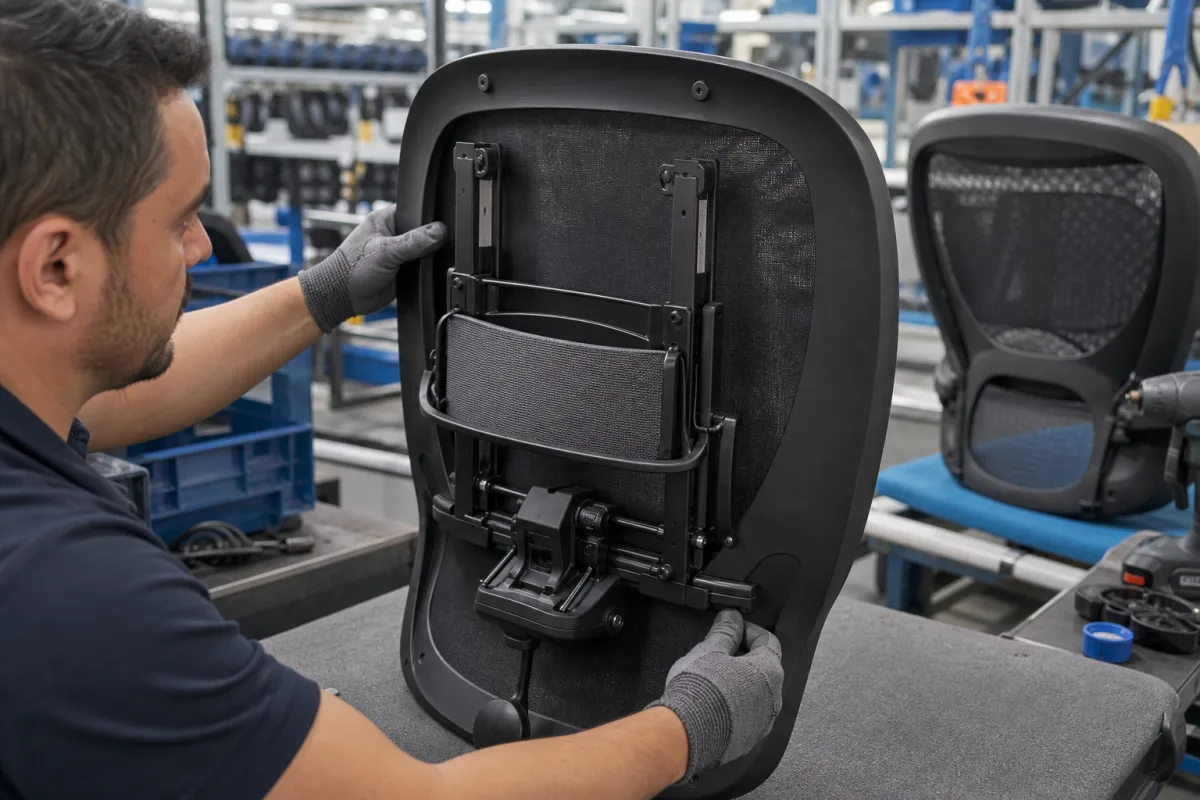
Adjustable lumbar support mechanism for ergonomic task chairs, designed to maintain spinal curvature and reduce lower back strain.

Representative product image. Confirm appearance and specifications with the manufacturer.

Product Specifications

Technical details and manufacturing context for Lumbar Support Mechanism

Definition
The Lumbar Support Mechanism is a specialized mechanical component integrated into ergonomic task chairs. It provides targeted support to the lumbar region of the spine, helping to maintain the natural S-curve, distribute body weight evenly, and reduce pressure on intervertebral discs during prolonged sitting. This mechanism is essential for preventing lower back pain and promoting proper posture in office and workstation environments. It typically employs spring-loaded, ratchet, or pneumatic adjustment systems, allowing users to customize the height, depth, and firmness of the support. The contoured support surface transfers force from the user's back, with adjustable tension mechanisms that can be fine-tuned to individual anatomical requirements and seating preferences. The mechanism is constructed from materials such as polypropylene, steel alloy, polyurethane foam, and nylon. Key parameters include a load capacity of 100–150 kg, adjustment travel of 30–50 mm, adjustment force of 20–40 N, operating temperature range of -10 to 50 °C, humidity resistance of 20–80% RH (non-condensing), ingress protection rating of IP40 per IEC 60529, material grade Q235 per GB/T 700, surface treatment of Zn–Ni with corrosion resistance ≥96h salt spray per ASTM B841, weight of 0.8–1.2 kg, cycle life of 50,000 cycles per ISO 7175, and noise level ≤45 dB(A) during adjustment at 1m distance per ISO 3744. These values are directory references and must be verified for the specific model and application with the legal manufacturer or supplier. The mechanism is designed for integration into chair bases and backrests, with interfaces for mounting and adjustment controls. Verification questions should address load testing, adjustment cycle endurance, and environmental compatibility. Maintenance signals include reduced adjustment smoothness, unusual noise, or visible wear. Failure boundaries include exceeding the rated load or operating outside the specified temperature and humidity ranges.
Working Principle
The mechanism operates through a combination of spring-loaded, ratchet, or pneumatic systems that allow users to adjust the height, depth, and firmness of the lumbar support. The contoured support surface transfers force from the user's back, and adjustable tension mechanisms enable fine-tuning to individual anatomical needs. The adjustment force required is 20–40 N, and the travel range is 30–50 mm. The mechanism is designed to withstand static loads up to 100–150 kg and operate within -10 to 50 °C. It is protected against solid objects >1mm (IP40) and has a cycle life of 50,000 adjustments per ISO 7175.
Common Materials
Polypropylene, Steel alloy, Polyurethane foam, Nylon
Technical Parameters
ParameterTypical rangeNotes & selection driver
Load Capacity100–150 kgMaximum static load on the lumbar support
Adjustment Travel30–50 mmRange of lumbar support protrusion
Adjustment Force20–40 NForce required to adjust the support
Operating Temperature-10–50 °CFunctional range for mechanism
Humidity Resistance20–80 % RHNon-condensing relative humidity
Ingress ProtectionIP40Protected against solid objects >1mmIEC 60529
Material GradeQ235Steel frame; other grades on requestGB/T 700
Surface TreatmentZn–NiCorrosion resistance ≥ 96h salt sprayASTM B841
Weight0.8–1.2 kgComplete mechanism assembly
Cycle Life50000 cyclesMinimum adjustment cyclesISO 7175
Noise Level≤45 dB(A)During adjustment at 1m distanceISO 3744

Ranges are indicative industry figures for RFQ preparation, not a supplier commitment. Confirm every value and standard with the legal manufacturer before ordering.

Components / BOM
  • Support Plate Part
    Primary contact surface that distributes pressure across lumbar region
    Material: Polypropylene
  • Adjustment Rail Part
    Vertical track allowing height positioning of support plate
    Material: Steel alloy
  • Tension Spring Part
    Provides adjustable resistance and return force for depth control
    Material: Spring steel
  • Locking Mechanism
    Secures support plate at desired height and depth positions
    Material: Nylon
  • Mounting Bracket Part
    Interface connecting mechanism to chair back frame
    Material: Steel alloy

Industrial Ecosystem & Supply Chain Structure

Complementary Systems
Downstream Applications
Specialized Tooling

Application Fit & Sizing Matrix

Operational Limits
pressure: 0 to 50 psi
other spec: Max user weight: 150 kg, Adjustment range: 0-100 mm lumbar extension
temperature: -20°C to 60°C
Media Compatibility
✓ Office chairs ✓ Automotive seating ✓ Medical seating
Unsuitable: High-vibration industrial machinery seating
Sizing Data Required
  • User torso length (cm)
  • Seat backrest width (cm)
  • Required lumbar support force (N)

Reliability & Engineering Risk Analysis

Failure Mode & Root Cause
Mechanical wear in adjustment mechanism
Cause: Repeated friction and stress on gears, levers, or hydraulic components leading to material fatigue and loss of precision
Electrical/electronic control failure
Cause: Corrosion, vibration-induced loose connections, or overheating in wiring, sensors, or control modules disrupting power or signal transmission
Maintenance Indicators
  • Unusual grinding, clicking, or whirring noises during adjustment
  • Inconsistent or non-responsive position changes despite control input
Engineering Tips
  • Implement regular lubrication of mechanical joints and inspection of electrical contacts to prevent corrosion and reduce friction
  • Install vibration dampeners and ensure proper mounting alignment to minimize stress on components during operation

Indicative industry ranges for design and RFQ preparation. Confirm the exact figures and applicable standard with the manufacturer before specifying.

Compliance & Manufacturing Standards

Applicable Standards
ISO 7174-1:2018 (Furniture - Chairs and stools - Determination of strength and durability) ANSI/BIFMA X5.1-2017 (General Purpose Office Chairs - Tests) CE EN 1335-1:2020 (Office furniture - Office work chair - Part 1: Dimensions - Determination of dimensions)

Quoted from the published standard.

Manufacturing Precision
  • Pivot axis alignment: +/-0.5 degrees
  • Support surface flatness: 0.3mm across contact area
Quality Inspection
  • Cyclic load testing (minimum 100,000 cycles at specified force)
  • Material hardness verification (Rockwell scale for metal components)

Manufacturers of Lumbar Support Mechanism

Manufacturer profiles associated with Lumbar Support Mechanism.

Sourcing Lumbar Support Mechanism from China?
Tell us your specification and target quantity — we will match it against manufacturer records and come back with the factories that fit.
Request manufacturers We manufacture this

Manufacturer listings support early research and capability understanding. They are not certification, ranking, or transaction guarantees.

Technical documentation
Request current drawings, revision history, and a signed specification sheet.
Manufacturing capability
Verify equipment lists, process limits, capacity, and representative production evidence.
Inspection readiness
Confirm test methods, calibrated equipment, sampling plans, and traceable reports.
Supplier transparency
Check the legal entity, factory address, ownership, certifications, and direct contacts.

CNFX does not score or rank suppliers. Buyers must verify all claims and documents with the legal manufacturer before ordering.

Supply Chain Compatible Machinery & Devices

Drawer Slide

A drawer slide is a precision-engineered mechanical component used in furniture manufacturing to facilitate the smooth, stable, and quiet movement of drawers.

Explore Specs →
Panel Saw

A panel saw is a stationary industrial machine used in furniture manufacturing to cut large sheets of wood-based panels like plywood, MDF, and particleboard.

Explore Specs →
Furniture Caster

A furniture caster is a wheeled component mounted to the base of furniture items to enable easy movement and repositioning.

Explore Specs →
Ergonomic Office Chair

Industrial-scale manufactured seating solution for workplace ergonomics and comfort.

Explore Specs →

Frequently Asked Questions

What is the load capacity of this lumbar support mechanism?

The directory lists a maximum static load of 100–150 kg. However, this is a reference range; you must verify the exact capacity for the specific model with the manufacturer or supplier.

How is the lumbar support adjusted?

The mechanism typically uses spring-loaded, ratchet, or pneumatic systems to adjust height, depth, and firmness. The adjustment force is 20–40 N, and the travel range is 30–50 mm. Confirm the adjustment method for your specific unit.

What standards apply to this component?

The directory references standards such as IEC 60529 for ingress protection (IP40), GB/T 700 for material grade (Q235), ASTM B841 for surface treatment (Zn–Ni), ISO 7175 for cycle life (50,000 cycles), and ISO 3744 for noise level (≤45 dB(A)). These are verification references, not proof of certification.

What maintenance is required?

Regularly check for smooth adjustment and unusual noise. If the mechanism becomes stiff or noisy, it may indicate wear. Ensure operation within the specified temperature and humidity ranges to avoid damage.

Data Basis

Editorial classification, named public sources where available, and source-reviewed manufacturer records.

Preliminary Technical Classification
This page supports structured research, RFQ preparation, and supplier evaluation. It does not replace buyer-led supplier qualification, standards review, or technical approval.
Buyer enquiry

Request manufacturing insight for Lumbar Support Mechanism

Ask for use case, specification boundaries, supplier type, and RFQ preparation information for this product.

Where it goes
Straight to the CNFX editorial desk, and to the manufacturer if this product is linked to a claimed profile. Nothing is broadcast to a supplier list.
Your details stay here
We do not sell or rent enquiry data, and we do not add you to a mailing list. Used only to answer this request.
No commission, no middleman
CNFX is a directory. We take no cut of any order and never negotiate on a supplier's behalf.
What we don't claim
A listing is not an endorsement. Qualify every supplier and verify every figure yourself before ordering.

Your business information is used only to process this request.

Thank you! Your message has been sent. We'll respond within 1–3 business days.
Sorry, we couldn't send your message. Please try again, or email us at contact@cnfx.com.

Need to Manufacture Lumbar Support Mechanism?

Compare manufacturer profiles with relevant product and process capability.

Previous Product
Soft-Close Damper
Last Product
Get QuotesChat