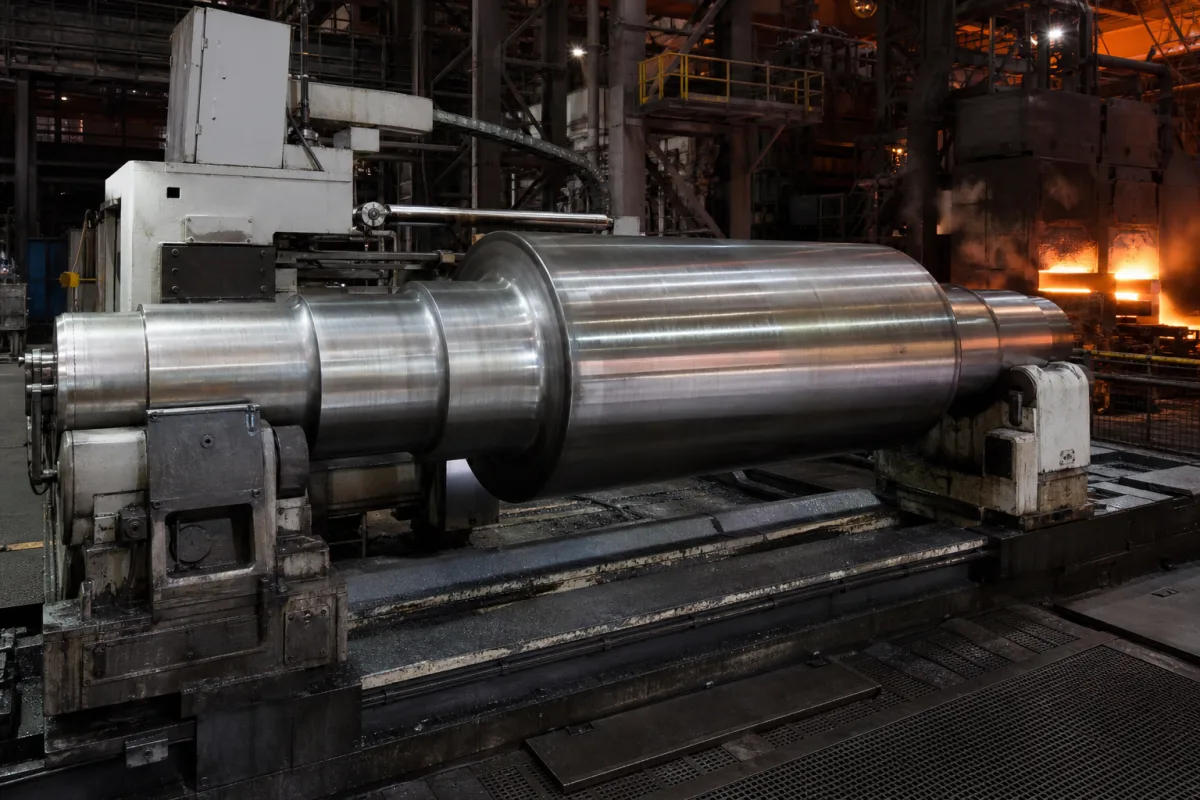
Rolling mill work rolls · Cast grades for hot strip stands, forged rolls for cold mills, surface hardness and hardened depth, degradation testing
A work roll is the roll in direct contact with the strip, plate or section in a rolling stand; it is backed by backup rolls in four-high and cluster mills. Its working layer must resist wear, thermal cracking, oxidation or banding and keep its surface finish, and it is reground between campaigns until the usable layer is gone. Ask three things first: which material suits your mill and stand, what surface hardness and hardened depth the roll will keep through its regrinds, and how the supplier tests and documents it.
Work rolls for hot strip, plate, section and cold rolling mills, cast or forged. Backup rolls, roll chocks and bearings, mill housings, straightening and leveller rolls, and roll grinding machines are outside this page.
CNFX editorial research · Sources checked October 12, 2026 · 5 sources
In an Iron & Steel Technology paper, the Centre for Research in Metallurgy (CRM) and Belgian roll founder Marichal Ketin describe the work roll grades they developed for hot strip mills: a chrome steel grade for roughing mills, which the paper dates to the early 1980s, high-speed steel (HSS) grades for the finishing stands developed from the early 1990s, and microalloyed indefinite chill cast iron (ICDP), researched from the early 2000s until 2005. [1]
CRM explains that carbide distribution, shape and size strongly affect toughness and thermal-fatigue resistance, that work roll materials' high-temperature properties change sharply over the range reached in contact with hot strip, and that work roll surface quality affects strip surface, with some defects appearing only after galvanising. Its laboratory 3-disc rolling simulator heats a disc to up to 1,100 °C to reproduce degradation in stands F1–F3, and a pilot line rolls inserts of different grades side by side in a 400 mm work roll. [1]
For cold mills, Sidenor supplies forged steel work rolls in 3% and 5% Cr grades, induction-hardened by a progressive double induction process with hardness depth matched to each application, and forged 3% Cr and 5% Cr backup rolls; it also forges steel rolls for roughing and intermediate stands of long-product mills. [3]
Give the supplier the mill type and stand, product rolled (strip, plate, section), roll drawing (barrel and neck diameters, lengths, maximum and minimum service diameter), rolling load and speed, cooling and lubrication, current roll grade and campaign performance, required surface hardness and hardness at the discard diameter, surface finish or texture, and ultrasonic and hardness test requirements.
02
Fix surface hardness and hardened depth for the regrind life
US patent 4,823,451, for a forged cold-rolling roll, lists the requirements of cold-mill work rolls as a surface hardness of 90–105 Shore C depending on the product rolled, a deep hardened layer to limit retreatments, high abrasion resistance, controlled retained austenite (excess promotes cracking in service) and a homogeneous surface structure to avoid 'orange peel' marks on the sheet. [2]
The patent states that conventional water-hardened forged rolls of grade 83CDV7 (0.8–0.9% C, 1.8–3.0% Cr) reach about 103 Shore C at the surface with a 15 mm layer of at least 85 Shore C on 550–650 mm diameter rolls, and that induction hardening at 50 Hz gives similar surface hardness with about 22 mm depth, but that both need at least two retreatments to use the full depth of the roll body. It notes that makers have sought hardened layers of about 30 mm to limit retreatment to one, and proposes a low-alloy steel in which Si with Mn raises hardenability; higher-Cr steels (up to 3% Cr) raise retained austenite, which may need a sub-zero treatment. [2]
Editorial calculation from the patent's figures: a 22 mm induction-hardened layer against 15 mm water-hardened gives about 47% more depth (22/15 ≈ 1.47) for regrinding before re-hardening, all else equal.
03
Map roll grades to the stand where they run
Union Electric Åkers, a roll maker with plants in Europe, North America and Asia, states that all its hot strip mill work rolls "are made using the vertical centrifugal casting method", with a forged grade, SDSII, also offered for roughing mill work rolls. Its grade list assigns each material to a position in the mill, from roughing stands to the late finishing stands. [4]
The list matches the pattern in the CRM and Marichal Ketin paper: chrome steel in roughing mills, HSS for finishing stands and enhanced indefinite chill (ICDP) grades [1]. The UES list places indefinite chill grades only in the late finishing stands F4-6(7), while HSS appears in both roughing and early finishing positions [4]. When a supplier quotes a grade, ask which stand positions it has supplied that grade to and for its product data sheet.
For cold mills, the same maker lists forged work and intermediate rolls for 2-high, 4-high and 6-high wide cold strip mills, in grades from "Forged Steel with 3%Cr" through 4%Cr and 5%Cr steels to forged semi high speed steels with 5%Cr or 10%Cr and a forged high speed steel (INVICTA), in electric steel or ESR quality, and cast High Chrome Iron cold mill work rolls. It forges these rolls at its plants in the US and Slovenia and offers re-hardening and re-cutting. [5] Sidenor supplies forged steel work rolls in 3% and 5% Cr grades [3]; ask each supplier for the chromium content and melting route (electric or ESR) of the grade quoted.
Editorial calculation: the UES hot strip list gives four grades for roughing stands, three for finishing stands F1-3(4) and three for F4-6(7), ten in total. [4]
Union Electric Åkers grade
Material (as listed)
Stand (as listed)
URMA
High Chrome Steel
Roughing stands
STELLA
Semi High Speed Steel
Roughing stands
SDSII
Forged High Alloy Steel
Roughing stands
SPECRA R
High Speed Steel
Roughing stands
CRONA / CRONA TT
High Chrome Iron
Finishing stands F1-3(4)
CICRA
Enhanced High Chrome Iron
Finishing stands F1-3(4)
SPECRA F / HSS #3
High Speed Steel
Finishing stands F1-3(4)
ICRA
Indefinite Chill
Finishing stands F4-6(7)
MICRA / APEX
Enhanced Indefinite Chill
Finishing stands F4-6(7)
VICTURA
TwinAlloy Steel
Finishing stands F4-6(7)
Grades and positions are from the Union Electric Åkers product pages; hardness ranges are in its product data sheets, which were not reviewed.
04
Forged rolls from general forging and machining shops
The suppliers reviewed are forging and machining shops listing forged rolls with other forgings; ask for the roll grade, heat treatment, hardness profile, ultrasonic test standard and reference mills.
Roll drawing and grade data a roll maker will ask for
Name the scale with the hardness: the patent's 90–105 figure is Shore C while this field is headed HSD, so a quoted number needs its scale and the hardness at the discard diameter beside it. [2]
Field
What it means and published values
Ask the supplier for
Roll Diameter (mm)
Maximum and discard diameter; e.g. 550–650 mm cold rolls in the patent. [2]
New and minimum diameters.
Barrel Length (mm)
Product width plus margins.
Drawing.
Neck Diameter (mm)
Bearing fit.
Diameters and tolerance.
Total Length (mm)
Roll drawing.
Length.
Surface Hardness (HSD)
E.g. 90–105 Shore C cold rolls (different scale). [2]
Explore company information and manufacturing capabilities, then discuss the scope of your project with a relevant supplier.
Share this page
Compiled and source-reviewed by the CNFX editorial team.
Each manufacturer above links to the page on that company's own website where the product is listed, with the date we checked it. How we source and review
· Page last updated 13 October 2026
Buyer questions
Which work roll grades are used in hot strip mills?
CRM and Marichal Ketin describe chrome steel for roughing, HSS for finishing stands and ICDP cast iron, noting a 2000–2005 shift from conventional to “enhanced” ICDP. [1]
How hard are cold mill work rolls?
A forged cold-roll patent cites 90–105 Shore C surface hardness depending on the product rolled. [2]
Why does hardened depth matter?
Rolls are reground; the patent notes water-hardened rolls reach about 15 mm and induction-hardened about 22 mm, both needing retreatments to use the full depth. [2]
Which work roll grade goes in which hot strip mill stand?
Union Electric Åkers lists high chrome steel, semi high speed steel, forged high alloy steel and high speed steel for roughing stands; high chrome iron, enhanced high chrome iron and high speed steel for finishing stands F1-3(4); and indefinite chill, enhanced indefinite chill and TwinAlloy steel for F4-6(7). [4]
Sources and what still needs a direct check
Sources checked 2026-10-12. CRM's paper describes its joint work with roll maker Marichal Ketin; Sidenor describes its own forged rolls; the patent describes the applicant's roll steel and cites conventional practice. Roll specifications should be agreed with the roll maker for your mill.