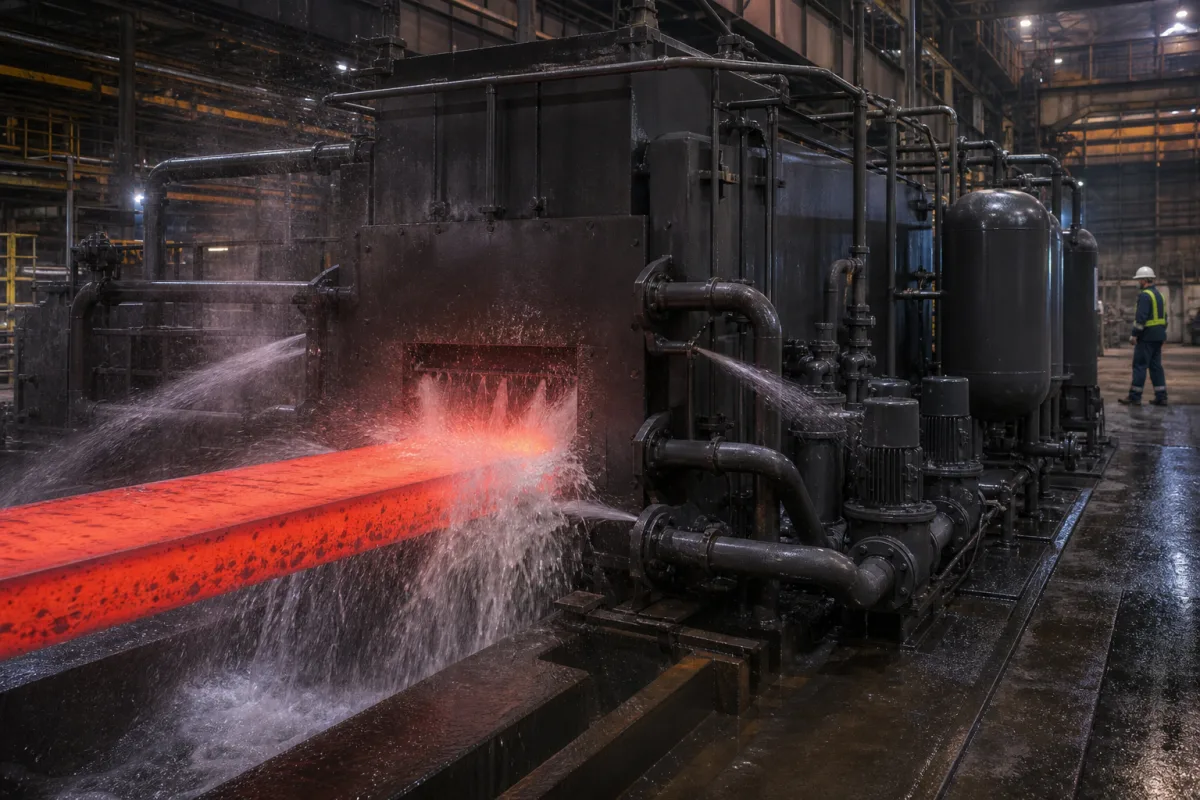
Hydraulic descaling system (high-pressure water descaler)
High-pressure water descalers for hot rolling · Why scale must be removed before rolling, spray headers above and below the pass line, pressure, nozzle stand-off and impact, height-adjustable nozzle rows, offset headers to cut pump load, and nozzle design
A hydraulic descaling system blasts high-pressure water jets from spray headers above and below the hot slab, bar or strip to break off the oxide scale formed in the reheating furnace and during rolling, so it is not rolled into the surface. Its effect depends on the impact of the jets, which falls with distance, so pressure, flow and nozzle stand-off must be designed together. Ask three things first: what stock, temperatures and locations it serves, what pressure, flow and nozzle layout give the required impact, and how pump energy and nozzle wear are managed.
High-pressure water descaling systems for hot rolling mills and casters: pumps and accumulators, valve stations, spray headers, nozzles and nozzle height adjustment; the cited patents describe them for steel slabs, bars and strip. Mechanical scale breakers, pickling lines for cold-rolled strip, and low-pressure cooling sprays (see laminar cooling system) are outside this page except where compared.
CNFX editorial research · Sources checked October 12, 2026 · 5 sources
US patent 7,367,518 B2 (Descaling nozzle) explains that hot rolled steel is made by heating slabs to about 1100–1400°C in an oxidising furnace atmosphere, which forms iron oxide scale on the surface; if the slab is rolled without removing it, scale defects form on the surface and lower the product value, so scale is removed by high-pressure water jets. It cites a prior method discharging water at a pressure of at least 40 MPa with the orifice no more than 150 mm from the plate (75–150 mm in one high-silicon steel method), and describes its own nozzle with a tapered segment of 30–80° behind an elliptical orifice to descale efficiently at lower pressure or flow. [1]
US patent 6,385,832 B1 (Descaling device for a continuous cast metal strip) notes descaling with high-pressure water at up to 1,000 bar, and that stationary upper and lower nozzles are known to be set "with relatively large spacing to the strip surface" so thickness variations and waves can pass, which means impact, spacing and coverage are right on wave peaks but poor on flat strip; compensating by raising pressure or flow costs much energy. Its nozzle rows are moved vertically according to a measured signal to keep the distance to the strip. [2]
Editorial calculation: 40 MPa equals 400 bar, and the 1,000 bar quoted as the upper end equals 100 MPa; specify pressure at the nozzle, not only at the pump, because line losses reduce it. [1][2]
Give the supplier the mill and descaler positions (after furnace, roughing, finishing), stock type and dimensions, temperatures, rolling speeds, required impact or pressure at the nozzle, flow, nozzle type and stand-off, header count above and below, height adjustment, pump and accumulator arrangement, water quality and filtration, valve response, and energy and nozzle wear targets.
02
Plan header layout and pump energy
US patent 5,661,884 A (Offset high-pressure water descaling system) describes descaling metal strip or plate by propelling high-velocity pressurized fluid, such as water, onto the surface to remove iron oxide, used at various points along continuous and reversing hot mills, and that conventional upper and lower headers spraying simultaneously need a large volume of water to reach the impact required, placing a very large load on the pump. Its upper and lower headers are offset along the pass line so they do not draw water at the same time, reducing pump energy while keeping the required flow. [3]
Editorial note: ask the supplier for the impact pressure at your stand-off and the water use per descale pass, and whether offsetting headers or adjusting nozzle height would let a smaller pump do the job.
03
Read nozzle catalogue data: pressure, angle, flow and water-stop valves
Lechler, a nozzle maker, states that hydro-mechanical descaling uses special flat-fan nozzles on spray headers in a descaling box, with a working pressure range from 80 to 450 bar, and that spray impact is the deciding property, reached through flat-fan nozzles with a particularly low spray depth using special tips and stabilizers. [4] Its SCALEMASTER HP and MiniSCALEMASTER HP series have tungsten carbide inserts, spray angles of 22°, 26°, 30° and 40°, a maximum pressure of 450 bar and flow rates at 100 bar of 12.00 to 134 l/min; the compact MicroSCALEMASTER covers 12.00 to 28 l/min at 100 bar with the same angles and pressure limit. Water-stop valves fitted to the nozzles stop the flow at low pressure in bypass operation, closing at 5 or 10 bar, or at 10 bar for the HPS series. [5]
Set these catalogue values beside the patent figures above, including the 40 MPa pressure and 75–150 mm stand-off of earlier methods and the header layouts that reduce pump energy. [1][3][2]
Editorial calculation: 40 MPa is 400 bar, inside Lechler's 80–450 bar range; nozzle flow scales roughly with the square root of pressure for a fixed orifice, so a nozzle passing 134 l/min at 100 bar would pass about 268 l/min at 400 bar, which sets pump size for each header.
Lechler descaling item
Published value
Working pressure range (descaling)
80–450 bar
SCALEMASTER HP / MiniSCALEMASTER HP
22°/26°/30°/40°; max 450 bar; 12.00–134 l/min at 100 bar
MicroSCALEMASTER
Same angles and 450 bar; 12.00–28 l/min at 100 bar
Nozzle insert
Tungsten carbide (hardened steel option on MicroSCALEMASTER)
Water-stop valve closing pressure
5 or 10 bar; 10 bar for HPS series
Give the supplier your working pressure, stand-off height, product width and speed, and ask for the impact value (N/mm²) at that height, the flow per nozzle at your pressure and the number of nozzles per header.
04
Pump, headers, nozzles and height adjustment in a descaler
Each row is tied to the patent that describes that part; valves and controls carry no citation because none of the three patents details them.
Pressure, flow and filtration values to settle with the descaler supplier
Pressure and nozzle flow are the only rows with published figures on this page; filtration, valve response, power and the remaining fields have to come from the supplier's own design for your mill.
Field
What it means and published values
Ask the supplier for
Operating Pressure (MPa)
E.g. ≥40 MPa; up to 100 MPa (1,000 bar) cited. [1][2]
Explore company information and manufacturing capabilities, then discuss the scope of your project with a relevant supplier.
Share this page
Compiled and source-reviewed by the CNFX editorial team.
Each manufacturer above links to the page on that company's own website where the product is listed, with the date we checked it. How we source and review
· Page last updated 13 October 2026
Buyer questions
Why descale before hot rolling?
Scale formed in the reheating furnace at about 1100–1400°C causes surface defects if rolled in (US 7,367,518). [1]
What pressure and stand-off are used?
One cited method uses at least 40 MPa with the nozzle within 150 mm of the plate; another patent mentions pressures up to 1,000 bar. [1][2]
How can descaler pump energy be reduced?
US 5,661,884 offsets the upper and lower headers so they do not draw water at the same time. [3]
What pressure do descaling nozzles run at?
Lechler gives a working pressure range of 80 to 450 bar for hydro-mechanical descaling, with its SCALEMASTER HP nozzles rated to 450 bar and 12.00–134 l/min at 100 bar. [4][5]
Sources and what still needs a direct check
Sources checked 2026-10-12. All three sources are US patents describing descaling in their own terms; the pressures quoted come from different patents and eras and are not directly comparable.