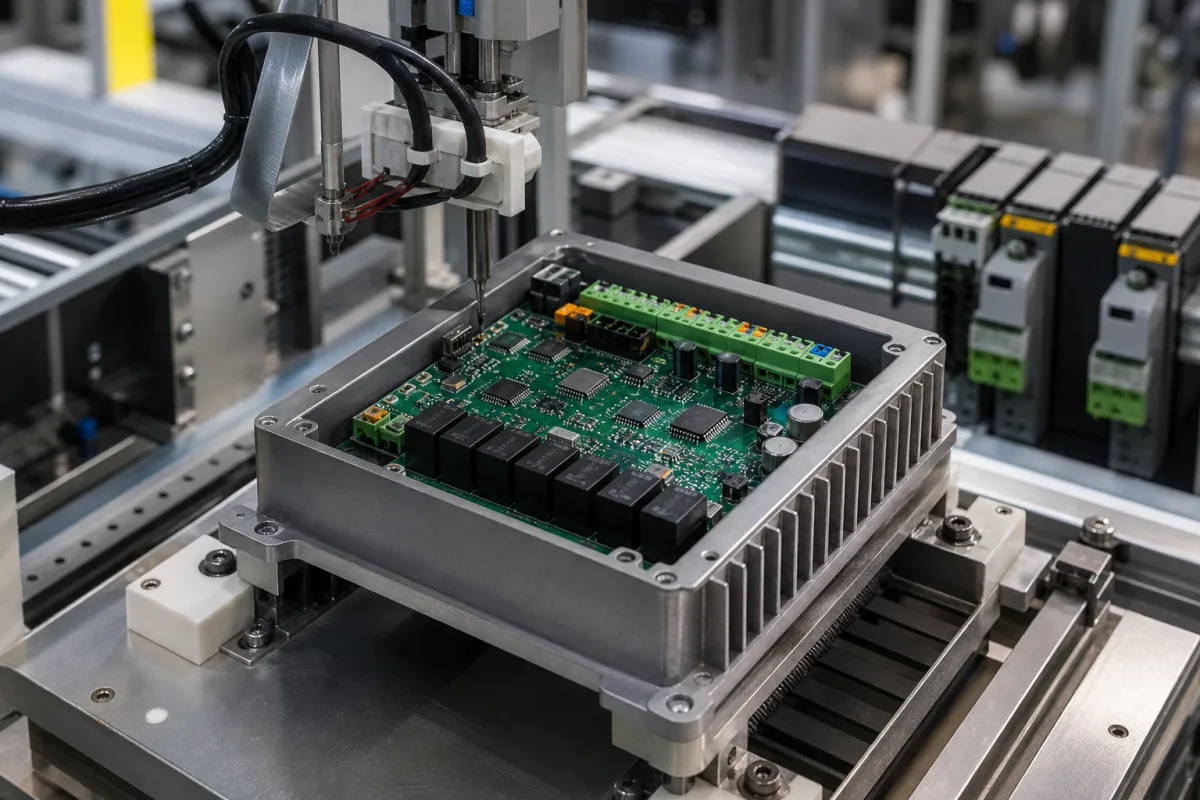
Control module (sealed, machine-mounted programmable controller with on-board inputs, outputs and CAN bus)
Machine-mounted control modules · sealed programmable controllers with on-board inputs and outputs, CAN (CANopen, J1939), IP67 or IP6K8 housings, -40 to +85 °C, CODESYS programming, safety-rated variants
A control module here is a self-contained programmable controller built into a sealed housing that bolts onto a machine or plugs into a relay socket, with its inputs, outputs and CAN interfaces on the module itself instead of on racks of cards in a cabinet. Ask three things first: how many inputs and outputs of which types the machine needs, which bus protocols and programming tools it must use, and what environment and safety rating the module must meet.
Sealed, machine-mounted control modules and electronic control units with on-board I/O and CAN for mobile, off-highway and compact machines, including safety-rated variants and small controllers in relay-socket format. Modular programmable logic controllers in control cabinets are covered on the Programmable logic controller page; single-loop temperature controllers, vehicle body control modules and fire alarm modules are outside this page.
CNFX editorial research · Sources checked October 12, 2026 · 3 sources
Count the inputs, outputs, buses and memory the machine needs
Epec describes its 3724 control unit as a "real multipurpose controller for distributed control systems" with 52 I/O pins (24 inputs and 28 outputs), a 16/32-bit CPU, 1.6 MB flash, up to 768 kB PLCopen application size, two CAN buses supporting CANopen, SAE J1939 and ISOBUS, CODESYS 2.3 programming and three AMP23 plus one AMP8 connectors. Its variant table splits the pins into PWM/digital outputs or digital inputs (24), feedback/analogue inputs at 1 A or 2 A, analogue/digital inputs (0-5 V or 0-22 mA), pulse inputs and reference outputs at 5 V and 12 V. Epec lists the 3724 among its previous product generations. [1]
At the small end, MRS Electronic's MicroPlex 7H has 12 pins, seven high-side outputs (six PWM-capable) switching 3 A at 85 °C with 2.2 A continuous current, one CAN interface, an 8-bit processor and programming in MRS Applics Studio, in a PA66GF30 housing of 30.4 × 23.6 × 25.75 mm. MRS says it can turn "previously simple ISO 280 boxes" into a CAN-connected system with diagnostics. [3]
Editorial check: the Epec 3724 totals 24 + 28 = 52 I/O and the SC52 14 + 8 = 22, as each page states. [1][2] Count the machine's sensors, valves and lamps by signal type, then add spare pins of each type before comparing modules.
Give the module maker the machine type, I/O list by signal type (digital, analogue range, frequency, PWM valve outputs and current), CAN buses and protocols, programming tool, application size, supply voltage, IP rating and temperature range, connector type, mounting, safety functions and required SIL or PL, EMC and approval marks, and quantity per year.
02
Fix the environment, approvals and safety rating
Epec gives its 3724 an IP67 rating and a temperature range of -40 to +85 °C, with CE, E17 automotive EMC and RoHS2 marks and AEF ISOBUS hardware conformance for the ISOBUS version. [1] MRS gives the MicroPlex 7H "up to IP6K8", -40 to +85 °C and 9-32 V operating voltage. [3]
For safety functions Epec's SC52 is certified as a stand-alone controller up to SIL 2 (IEC 61508:2010 and IEC 62061) and PL d / Category 3 (ISO 13849-1:2015) by TÜV SÜD, with a 32-bit lock-step multicore CPU, 22 I/O (14 inputs and 8 outputs), two CAN buses with CANopen Safety to EN 50325-5, CODESYS V3 Safety SIL 2 programming, IP67 and -40 to +85 °C. Its outputs measure high-side current, "so only one I/O pin is needed to control proportional valves". [2]
03
Processor, input and output stages, CAN ports and sealed housing
Everything a cabinet PLC spreads over cards sits on one board here, behind sealed connectors: processor, input stages, high-side outputs and CAN.
I/O counts, CAN protocols, IP rating and safety level for machine controllers
The three published modules span the range: 52 I/O on two CAN buses, a SIL 2 safety unit with 22 I/O, and a seven-output controller in a relay-socket housing.
4 companies list this product among what they make. Company figures are quoted from each
company's own website; every card states where the relationship came from.
Explore company information and manufacturing capabilities, then discuss the scope of your project with a relevant supplier.
Share this page
Compiled and source-reviewed by the CNFX editorial team.
Each manufacturer above links to the page on that company's own website where the product is listed, with the date we checked it. How we source and review
· Page last updated 13 October 2026
Buyer questions
How is a control module different from a PLC?
This page covers sealed modules with on-board I/O mounted on the machine; modular PLCs in control cabinets are on the Programmable logic controller page. [1][3]
Which buses do control modules use?
Epec's 3724 supports CANopen, SAE J1939 and ISOBUS on two CAN buses; its SC52 adds CANopen Safety. [1][2]
Can a control module run safety functions?
Epec's SC52 is certified up to SIL 2 and PL d Category 3 as a stand-alone controller. [2]
How small can a control module be?
MRS's MicroPlex 7H measures 30.4 × 23.6 × 25.75 mm with seven outputs and one CAN interface. [3]
Sources and what still needs a direct check
Sources checked 2026-10-12. Epec publishes its 3724 and SC52 control units; MRS Electronic publishes its MicroPlex 7H.