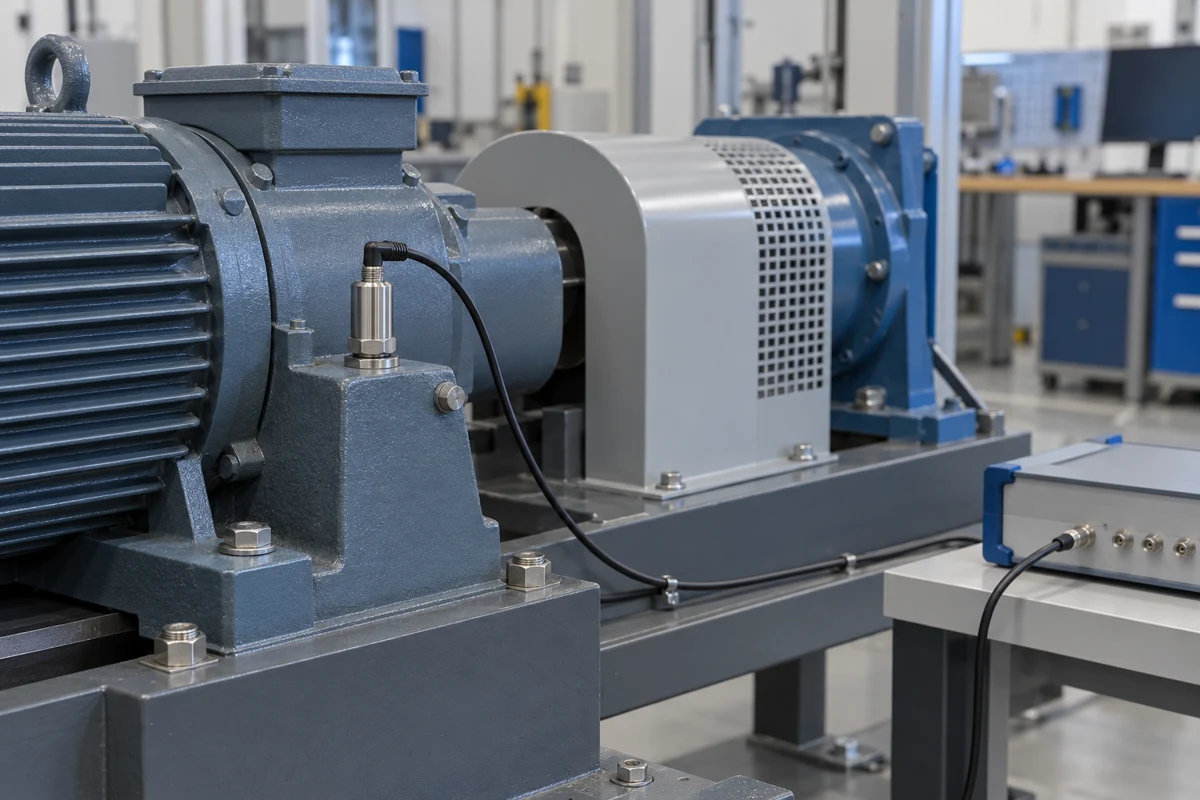
A compaction accelerometer supplies a measured vibration signal from the roller to an acquisition channel. Purchasing it requires an agreed mounting point and axis, a compatible sensor-to-recorder connection, and calibration information that lets the instrument convert the waveform into acceleration.
Housed IEPE acceleration transducers and their installation accessories for measuring vibratory-roller response. The 3-axis accelerometer page covers bare MEMS ICs; Vibration sensor covers the wider machinery-monitoring transducer category. Wired machine vibration monitoring systems and complete compaction meters include processing equipment beyond this component enquiry.
Tie each acceleration channel to a roller direction
Ranasinghe and co-authors’ 2023 intelligent-compaction analyzer study records vertical and horizontal drum-response channels using IEPE accelerometers. Its acquisition system, temperature sensing and positioning are separate parts of the platform. The paper also reports that a general acceptable correlation between compaction values and road-material density had yet to be demonstrated. [1]
Define the roller, sensor location, bracket and measured directions on an installation drawing. Mark the positive direction of each channel and record how it relates to the machine when the roller changes travel direction. Supply the sensor assembly, cable and axis-to-input map together.
A replacement enquiry should identify the existing transducer and recorder, including channel configuration and sensitivity units. If the offered assembly changes the number of axes or connector arrangement, obtain a complete revised channel assignment before accepting it.
The sensor’s output is an input to a compaction-measurement method. Agree separately which processing algorithm and material acceptance tests the project uses. Keep the transducer calibration record with the system configuration and trial data.
02
Match excitation and bias before scaling the waveform
Wilcoxon’s IEPE manual describes a piezoelectric element with an internal amplifier: the vibration signal rides on a DC bias and the measurement path uses AC coupling. Check the required constant-current excitation against the receiving instrument. [2]
Digilent’s IEPE measurement guide lists the MCC 172 input as ±5 V, with 4 mA source current and 23 V compliance voltage. These are different instrument properties. Match them to the selected sensor’s output, excitation and bias limits; the input signal range is not a direct sensor supply instruction. [3]
The same guide warns that clipping can introduce harmonic-like frequencies in an FFT. Review the maximum expected waveform with the available input and sensor headroom before treating a new spectral peak as roller behavior. [3]
Obtain the complete pin assignment, cable specification and channel setup from the equipment supplier. Commission a replacement through the configured recorder, retaining the raw waveform, sensitivity setting, units and evidence that the chosen operating range is covered.
03
Qualify the mounted transducer and cable as an assembly
Wilcoxon shows that the attachment method changes mounted resonance and usable response. Its manual recommends stud/screw mounting for permanent harsh-environment installations and explains the need for the specified surface preparation and torque. It also addresses shielding and ground-loop paths. [2]
Specify the sensing element, internal conditioning and protective housing as identifiable features of the offered assembly. Piezoelectric construction needs its own element and amplifier documentation; an enclosure drawing should identify its mounting face, sealing and connector. Request material declarations for that assembly.
For the roller installation, agree bracket geometry, clearance, cable support and service access with the machine supplier. Record the attachment method and the permissible installation procedure. Retain the assembled response evidence, rather than relying on the transducer’s unmounted specification alone.
Transducer characteristic
Information for this roller installation
Measurement range, g
Peak acceleration range for each measured axis, with expected compaction and transient signals identified.
Frequency response, Hz
Usable amplitude/phase band and tolerance with the proposed attachment and acquisition settings.
Sensitivity, mV/g
Individual channel calibration value, reference conditions and units used in recorder scaling.
Accuracy
Separate sensitivity uncertainty, nonlinearity, transverse response and installation contributions.
Operating temperature, °C
Continuous transducer and cable ratings at the actual mounting position.
Temperature sensitivity
Declared sensitivity variation across the required thermal range and its reference condition.
Shock survival, g
Survival test pulse shape, duration and acceptance criterion, separate from calibrated measuring range.
Housing material
Body/base material, surface treatment, sealing construction and machine-contact interface.
Sensing element
Offered piezoelectric design and axis arrangement, identified by model documentation.
Electrical interface
IEPE signal and excitation requirements, output bias and recorder coupling arrangement.
Current, mA
Required excitation and the available current from the selected acquisition channel.
Connection
Connector type, pinout, cable length and mating parts included in the delivery.
Protection class
Declared ingress rating with its required connector, cable and assembled sealing condition.
Mounting
Attachment drawing, thread or fixture, approved torque and installation instructions.
Mass, g
Transducer and attached mounting hardware masses, identified separately.
Service life
Supplier’s supported life/recalibration statement for the proposed duty and environment.
Temperature exposure
Storage, starting and transient thermal limits distinguished from continuous operation.
Humidity
Permitted moisture/condensation exposure and connector protection for outdoor service.
Operating vibration
Permissible continuous exposure and measurement performance under the stated test conditions.
Non-operating shock
Transport/handling survival declaration with its test conditions and inspection requirement.
Supply compatibility
Sensor excitation limits and instrument compliance checked with the complete cable/input arrangement.
04
Retain channel identity when a sensor is replaced
Build the delivery file around the installed measurement point: transducer model and serial number, axis map, calibration certificate, cable/connector drawing, mounting record and recorder configuration.
Ask the measurement-system supplier to define the acceptance stimulus and expected recorded response for each channel. Capture the configuration and result before and after a replacement. Include how the instrument identifies an unusable channel and how affected compaction records are handled.
Keep operating conditions alongside the test record: roller setting, measured directions, mounting arrangement and acquisition configuration. Agree the party responsible for approving the installed sensing chain and the separate party responsible for accepting the compacted material.
05
Roller acceleration-channel enquiry
Paste it into your enquiry below or into an email to a maker, then replace every bracket.
Machine: [roller model, compaction application and existing measurement instrument]
Point: [mounting drawing, axes, polarity, bracket and cable route]
Signal: [required acceleration range and band, sensitivity units, recorder input and configuration]
Connection: [IEPE excitation, bias/output limits, pinout, cable and assembled environmental protection]
Delivery: [transducer and mounting parts, calibration/serial records, installation procedure and commissioning waveform]
Responsibility: [system scaling approval, replacement procedure and separate material acceptance method]
Include the roller measurement point and the receiving instrument with the enquiry so that the transducer, mounting and channel connection can be quoted together.
Sourcing Accelerometer Sensor from China?
Tell us your specification and target quantity — we will match it against
manufacturer records and come back with the factories that fit.
Explore company information and manufacturing capabilities, then discuss the scope of your project with a relevant supplier.
Share this page
Compiled and source-reviewed by the CNFX editorial team.
Each manufacturer above links to the page on that company's own website where the product is listed, with the date we checked it. How we source and review
· Page last updated 24 October 2026
Buyer questions
Does the acceleration transducer alone provide a density acceptance result?
The cited compaction study separates sensing from platform processing and discusses the unresolved general correlation with material density. Define the project’s acceptance method separately. [1]
Does an input range specify the IEPE excitation voltage?
Digilent lists input range, source current and compliance voltage as separate properties. Match all of them to the sensor’s requirements and bias limits. [3]
Can a different attachment method change the measured response?
Wilcoxon’s mounting comparison shows different resonance and usable response for the attachment methods. Qualify the installed sensor and fixture together. [2]
Sources and evidence scope
Sources checked 2026-10-24T00:54:40+08:00. A research platform supplies the compaction context; the sensor manual and acquisition guide address installation and electrical compatibility.