Industry-Verified Manufacturing Data (2026)

Actuator (if automated)

Based on aggregated insights from multiple verified factory profiles within the CNFX directory, the standard Actuator (if automated) used in the Machinery and Equipment Manufacturing sector typically supports operational capacities ranging from standard industrial configurations to heavy-duty production requirements.

Technical Definition & Core Assembly

A canonical Actuator (if automated) is characterized by the integration of Motor/Drive Unit and Gearbox/Transmission. In industrial production environments, manufacturers listed on CNFX commonly emphasize Aluminum Alloy construction to support stable, high-cycle operation across diverse manufacturing scenarios.

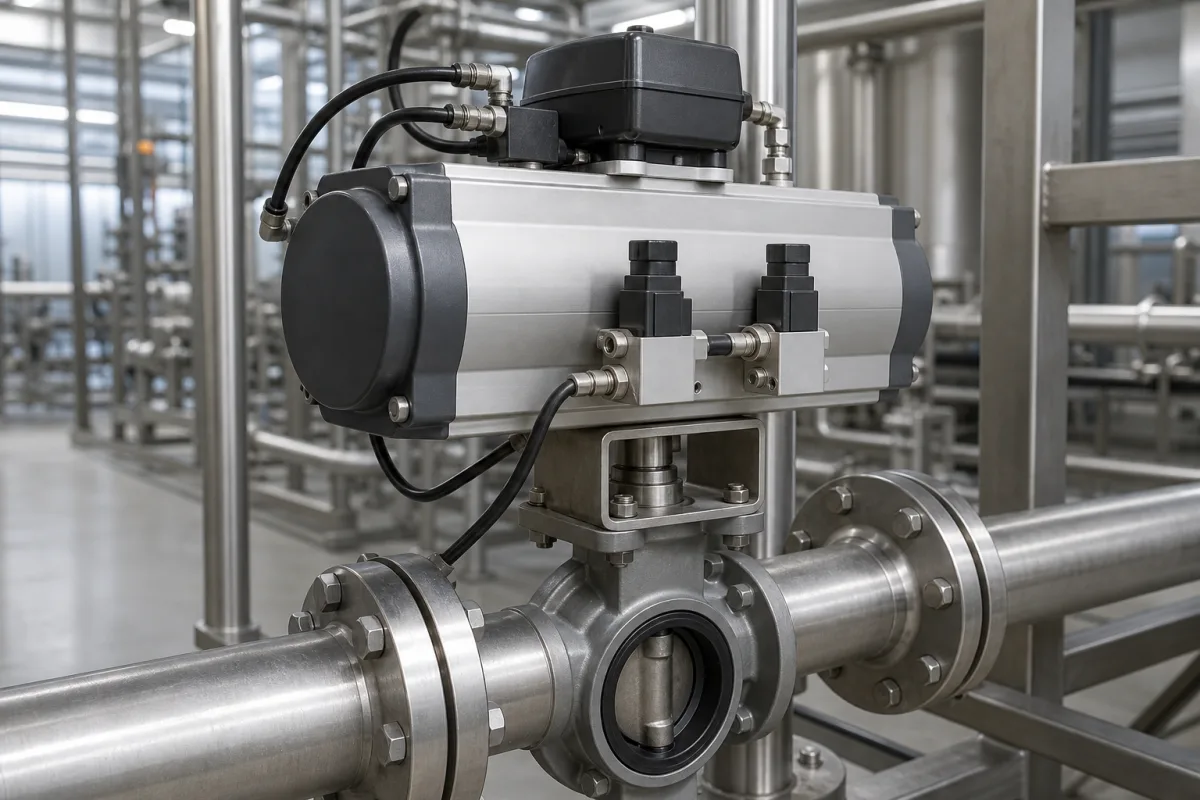
An automated actuator is a device that converts energy into motion to operate a valve, enabling remote or automated control of fluid flow.
Product Specifications

Technical details and manufacturing context for Actuator (if automated)

Definition
Within the Apex Valve system, the actuator (if automated) serves as the automated driving mechanism that precisely controls the opening, closing, or modulation of the valve. It receives control signals (e.g., electrical, pneumatic, or hydraulic) and translates them into the mechanical force required to position the valve's internal components, such as the disc or plug, thereby regulating the flow of liquids, gases, or slurries through the pipeline.
Working Principle
The actuator operates by receiving an external control signal (e.g., 4-20mA electrical current, 3-15 psi pneumatic pressure, or digital command). This signal energizes its internal mechanism—such as an electric motor, pneumatic piston, or hydraulic cylinder—which then generates linear or rotary motion. This motion is transferred via a stem or shaft to the valve's closure member, moving it to the desired position (open, closed, or throttled) to control flow.
Common Materials
Aluminum Alloy, Stainless Steel, Engineering Plastics
Technical Parameters
  • The torque output of the actuator, which must be sufficient to overcome the valve's operating torque under specified pressure conditions. (Nm) Customizable
Components / BOM
  • Motor/Drive Unit
    Converts electrical, pneumatic, or hydraulic energy into mechanical motion.
    Material: Copper Windings, Steel Laminations, Aluminum Housing
  • Gearbox/Transmission
    Amplifies torque and reduces speed from the motor to match valve requirements.
    Material: Hardened Steel, Brass
  • Output Shaft/Stem Adapter
    Connects the actuator's drive to the valve stem, transferring torque or thrust.
    Material: Stainless Steel
  • Position Feedback Sensor
    Measures and reports the actual position of the valve for control and monitoring.
    Material: Plastic, Potentiometer/Encoder Elements
  • Control Board/Module
    Processes input signals, manages actuator logic, and interfaces with control systems.
    Material: FR4 PCB, Electronic Components
  • Housing
    Protects internal components from environmental factors like dust, moisture, and corrosion.
    Material: Aluminum Alloy, Polycarbonate
Engineering Reasoning
0.5-25 bar
28 bar (400 psi) maximum pressure rating
Design Rationale: Yield strength of 316 stainless steel actuator housing (205 MPa) exceeded at 28 bar internal pressure
Risk Mitigation (FMEA)
Trigger Solenoid coil insulation breakdown at 180°C
Mode: Electrical short circuit causing actuator lock
Strategy: Class H insulation (180°C rated) with thermal cutoff at 165°C
Trigger Piston seal wear exceeding 0.5 mm radial clearance
Mode: Fluid bypass causing 15% pressure drop across actuator
Strategy: PTFE composite seals with 0.1 mm wear sensors and scheduled replacement at 0.3 mm

Industry Taxonomies & Aliases

Commonly used trade names and technical identifiers for Actuator (if automated).

Applied To / Applications

This component is essential for the following industrial systems and equipment:

Industrial Ecosystem & Supply Chain DNA

Complementary Systems
Downstream Applications
Specialized Tooling

Application Fit & Sizing Matrix

Operational Limits
pressure: Up to 600 psi (41 bar)
flow rate: Dependent on valve sizing, typically 0-1000 GPM
temperature: -40°C to 150°C
slurry concentration: Up to 30% solids by weight
Media Compatibility
✓ Water and aqueous solutions ✓ Oil and hydrocarbon fluids ✓ Compressed air and inert gases
Unsuitable: Highly corrosive acids (e.g., concentrated sulfuric acid)
Sizing Data Required
  • Valve torque/force requirement (Nm or lbf)
  • Required actuation speed (seconds for 90° rotation or full stroke)
  • Available power supply (voltage, phase, and current)

Reliability & Engineering Risk Analysis

Failure Mode & Root Cause
Seal degradation and leakage
Cause: Exposure to incompatible fluids, excessive temperatures beyond design limits, or abrasive contaminants leading to seal hardening, cracking, or extrusion.
Actuator stalling or sluggish movement
Cause: Internal contamination (e.g., particulates in hydraulic fluid or air supply), mechanical binding due to misalignment or worn bearings, or insufficient supply pressure/flow.
Maintenance Indicators
  • Audible hissing or grinding noises during operation indicating air leaks, internal damage, or bearing failure
  • Visible fluid leaks (hydraulic oil, pneumatic moisture, or lubricant) around seals, fittings, or the actuator body
Engineering Tips
  • Implement proactive contamination control: use high-quality filters in fluid/pneumatic systems, ensure clean, dry air supply, and follow strict flush procedures after maintenance.
  • Conduct regular alignment checks and lubrication: verify actuator alignment with the driven load to prevent side-loading, and adhere to manufacturer-recommended lubrication intervals and specifications.

Compliance & Manufacturing Standards

Reference Standards
ISO 5211:2017 (Industrial valves - Part-turn actuator attachments) ANSI/ISA-75.05.01-2000 (Control Valve Sizing Equations) DIN EN 15714-3:2009 (Industrial valves - Actuators - Part 3: Pneumatic part-turn actuators for industrial valves - Basic requirements)
Manufacturing Precision
  • Bore diameter: +/-0.02mm
  • Shaft runout: 0.05mm maximum
Quality Inspection
  • Pressure testing (leakage and burst pressure)
  • Functional cycle testing (endurance and repeatability)

Factories Producing Actuator (if automated)

Verified manufacturers with capability to produce this product in China

✓ 97% Supplier Capability Match Found

P Procurement Specialist from Canada Feb 20, 2026
★★★★★
"Reliable performance in harsh Machinery and Equipment Manufacturing environments. No issues with the Actuator (if automated) so far."
Technical Specifications Verified
T Technical Director from United States Feb 17, 2026
★★★★★
"Testing the Actuator (if automated) now; the technical reliability results are within 1% of the laboratory datasheet."
Technical Specifications Verified
P Project Engineer from United Arab Emirates Feb 14, 2026
★★★★★
"Impressive build quality. Especially the technical reliability is very stable during long-term operation."
Technical Specifications Verified
Verification Protocol

“Feedback is collected from verified sourcing managers during RFQ (Request for Quote) and factory evaluation processes on CNFX. These reports represent historical performance data and technical audit summaries from our B2B manufacturing network.”

5 sourcing managers are analyzing this specification now. Last inquiry for Actuator (if automated) from Thailand (12m ago).

Supply Chain Compatible Machinery & Devices

Hydraulic Press

Industrial machine using hydraulic pressure to compress, form, or assemble materials

Explore Specs →
Heavy-Duty CNC Plasma Cutting Machine

Industrial machine for precision metal cutting using plasma arc technology

Explore Specs →
Automated Assembly Line System

Integrated production system for sequential component assembly operations

Explore Specs →
Automated Powder Coating System

Integrated industrial system for applying dry powder coatings to metal substrates.

Explore Specs →

Frequently Asked Questions

What materials are used in automated actuators for durability?

Our automated actuators feature aluminum alloy for lightweight strength, stainless steel for corrosion resistance, and engineering plastics for wear-resistant components, ensuring long-term reliability in industrial environments.

How does the position feedback sensor improve actuator performance?

The position feedback sensor provides real-time data on valve position, enabling precise control, automated adjustments, and system monitoring for optimal fluid flow management and preventive maintenance.

What components are included in the actuator BOM for machinery applications?

The bill of materials includes: control board/module for automation logic, gearbox/transmission for torque conversion, housing for protection, motor/drive unit for power, output shaft/stem adapter for valve connection, and position feedback sensor for accuracy.

Can I contact factories directly on CNFX?

CNFX is an open directory, not a transaction platform. Each factory profile provides direct contact information and production details to help you initiate direct inquiries with Chinese suppliers.

Get Quote for Actuator (if automated)

Request technical pricing, lead times, or customized specifications for Actuator (if automated) directly from verified manufacturing units.

Your business information is encrypted and only shared with verified Actuator (if automated) suppliers.

Thank you! Your message has been sent. We'll respond within 1–3 business days.

Need to Manufacture Actuator (if automated)?

Connect with verified factories specializing in this product category

Add Your Factory Contact Us
Previous Product
Actuator (if applicable)
Next Product
Actuator (Manual or Automated)