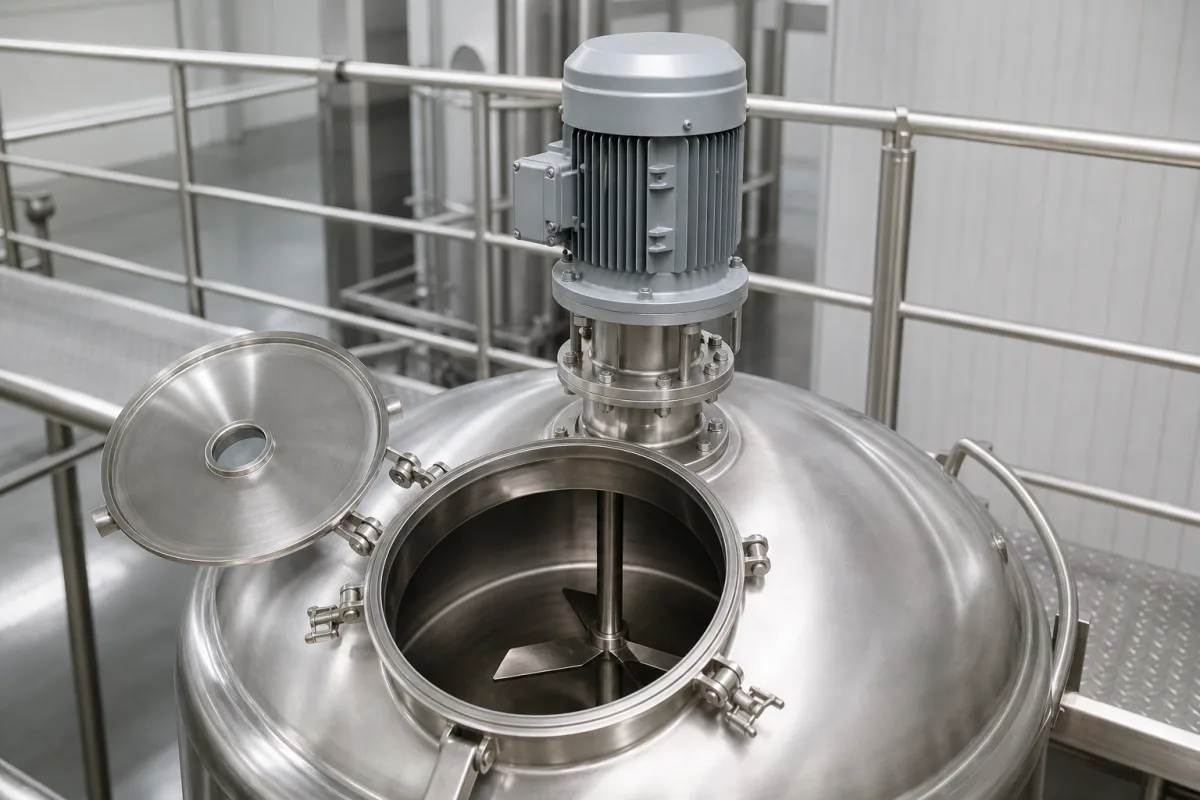
Agitator for a product collection tank that is filled and drawn down: the minimum liquid cover over the impeller, stopping before the tank drains, and placing the impeller for the lowest level
Agitators for tanks that fill and empty · the liquid level the impeller needs above it, when to stop on drawdown, impeller height and spacing for the lowest level, and what kills the drive in a part-full tank
A product collection or holding tank is never at one level: it fills from the process, is held, then is pumped out. The agitator on it, a vertical shaft with a propeller or pitched-blade impeller driven from a motor on the top head, works only while there is enough liquid above the impeller. Below that, the flow pattern changes, a vortex reaches the blades, air is drawn in and the shaft starts to vibrate. Choosing this agitator is therefore as much about the levels it will see, and when it is switched off, as about power and speed.
Top-entry and clamp- or flange-mounted agitators on collection, receiving and holding tanks whose level rises and falls: minimum liquid cover over the impeller, switch-off level and interlocks on drawdown, impeller off-bottom height and spacing for the lowest operating level, shaft angle on unbaffled tanks, critical-speed lockout and loads from density changes and steady bearings. Ribbon agitators for dry powders are covered on the Ribbon blender agitator page; hygienic food-tank agitators with their seals and finishes on the Top-entry hygienic agitator for food mixing tanks page; shaft trains sized against critical speed and deflection on the Agitator assembly (shaft train) page; impeller types and power on the Chemical reactor agitator blade page; tank sizing, baffles and power number on the Mixing vessel (agitated mixing tank) for liquids page; closed impellers for pumps on the Impeller with a front shroud page.
CNFX editorial research · Sources checked October 13, 2026 · 4 sources
Liquid cover over the impeller: one impeller diameter, and the agitator off before the tank is pumped out
Three agitator makers state the cover rule in slightly different terms, and one goes further:
The makers differ on what to do while the tank empties: Neptune and Dynamix give a level (one diameter of cover) below which to stop, while Admix asks for the agitator to be off for the whole drawdown, interlocked with the outlet valve or pump. [1][2][3] Ask the agitator supplier which of the two its design assumes before writing the tank's control sequence.
A 2012 NJIT doctoral study by Shilan Motamedvaziri, using flat-bottomed baffled vessels of 5, 12, 20 and 170 L with a single disk turbine, found a critical impeller submergence ratio (Sb/D) below which the flow pattern changes to an upward single loop, power and pumping numbers drop, solids cannot be suspended at any speed, mixing time jumps, and a vortex forms that eases air entrainment; impeller flooding was seen only after this regime set in and the vortex reached the impeller disk. The critical submergence was not affected by agitation speed, so running faster does not recover it. [4]
Editorial calculation with example values (not from any source): in a 1.2 m diameter tank with a 0.3 m impeller set 0.3 m off the bottom, one diameter of cover puts the stop level at 0.6 m. That leaves π/4 × 1.2² × 0.6 = 0.68 m³ that cannot be stirred while it is pumped out, half of the 1.36 m³ held when the tank is filled to a depth equal to its diameter.
Maker and document
What it says about level and drawdown
Neptune, JG/JD clamp-mount mixer manual
Propellers must be submerged while mixing or damage could occur; at the end of a mixing period turn the mixer off before the tank is drained, when the liquid is one propeller diameter above the lower propeller. [1]
Dynamix, MMX utility mixer manual
Fluid level at least one impeller diameter above the impeller for proper mixing; avoid running in air; avoid extended operation with the level at or near the bottom impeller; vortexing, aeration and excess vibration may occur if the level is too close to the impeller. [2]
Admix, Tech Tip TT-201
'No mixer is designed to run during drawdown'; it recommends a control that shuts the mixer off automatically when the tank outlet valve opens or the transfer pump starts. [3]
Give the supplier the tank's maximum, normal and lowest operating levels, how it is emptied (pump or gravity) and whether the product must stay mixed while it drains; agree the switch-off level or interlock.
02
Impeller height and spacing for the lowest level: at least one diameter off the bottom, two diameters between propellers, shaft 5–15° off vertical
Running at low level pushes buyers to fit the impeller lower, and Admix sets a floor on that: 'an impeller should never be installed any closer than one impeller diameter off bottom', with severe deflection, motor overload and early bearing failure as the result of going closer. It adds that other impeller types can be retrofitted for low-level duty. [3]
The NJIT study found that lowering the impeller's off-bottom clearance widened the range of levels over which the vessel could be operated effectively. [4] The two sources point in opposite directions for a tank that must mix down to a low level: the research favours a lower impeller, and Admix limits how low it may go; take both to the agitator supplier. [4][3]
Where two impellers are fitted, Neptune spaces its propellers at least two propeller diameters apart, and Dynamix's start-up checklist asks that impellers be spaced for both the maximum and minimum liquid levels. [1][2] Editorial calculation: with the lower impeller one diameter off the bottom and the upper one two diameters above it, the upper impeller sits three diameters up and needs liquid to four diameters before it has one diameter of cover; below that only the lower impeller is properly covered.
For clamp-mounted mixers on open tanks, Neptune sets the shaft 5° to 15° off vertical and pointed 20° to 30° right of the centre line, to produce top-to-bottom turnover; moving it left increases swirl and vortex, which helps wet light powders but lowers mixing efficiency, and Neptune advises against running continuously with extreme vortexing. [1]
State impeller type and diameter, the number of impellers, their heights above the bottom, and the tank's lowest mixed level; for a clamp-mounted unit, the mounting position and shaft angle.
03
What overloads a collection-tank agitator: critical speed under a VFD, heavier product, dry steady bearings and settled solids
Admix's tech tip lists conditions that damage top-entry agitators in service, four of which arise when a collection tank's contents or level change:
Critical speed: Admix advises asking the maker for the critical speed before changing speed with a variable-frequency drive, and locking out a band of 20 % on either side of it. [3]
Density: power draw scales with specific gravity, and Admix's own example is a 2 HP mixer drawing 1.7 HP at SG 1.0 that draws 1.7 × 1.3 = 2.21 HP, and is overloaded, when the product's SG rises to 1.3. [3]
Steady bearings: bottom steady bearings of PTFE or Rulon must be submerged to run; Admix names running them dry as a cause of drag and motor failure. [3] Editorial note: in a tank that is pumped low, the steady bearing at the bottom of the shaft is the first part to come out of the liquid.
Settled solids: Dynamix says the impeller cannot be buried in settled solids at start-up and that solids must be fluidised first, with an air hose, recirculating pump or a stick; heavier materials should be added gradually at the centre while the mixer runs, not dumped. [2] Admix adds that flooding a tank for cleaning calls for a lower seal or an air-gap pedestal that keeps cleaning solution out of the drive. [3]
List the product's specific gravity range and solids content, any VFD speed range, whether a bottom steady bearing is fitted, and how the tank is cleaned.
04
What to send for a collection-tank agitator
Paste it into your enquiry below or into an email to a maker, then replace every bracket.
Tank: [diameter; straight side; bottom shape; baffles]
Levels: [maximum; normal; lowest mixed level; how emptied]
Product: [viscosity; specific gravity range; solids and settling]
Impeller: [type; diameter; number; heights off bottom]
Drive: [power; speed or VFD range; mounting: flange, clamp, angle]
Controls: [switch-off level or interlock with outlet valve/pump]
Service: [steady bearing; cleaning method; seal]
Explore company information and manufacturing capabilities, then discuss the scope of your project with a relevant supplier.
Share this page
Compiled and source-reviewed by the CNFX editorial team.
Each manufacturer above links to the page on that company's own website where the product is listed, with the date we checked it. How we source and review
· Page last updated 13 October 2026
Buyer questions
How much liquid must be above an agitator impeller?
Dynamix and Neptune both use one impeller (propeller) diameter: Dynamix as the minimum for proper mixing, Neptune as the level at which to switch off while draining. [2][1]
Can an agitator run while the tank is being emptied?
Admix says no mixer is designed to run during drawdown and recommends interlocking the mixer off when the outlet valve opens or the transfer pump starts; Neptune says to turn it off when the level reaches one propeller diameter above the lower propeller. [3][1]
Why does mixing fail at low liquid level?
An NJIT study found a critical impeller submergence below which the flow pattern changes, power and pumping numbers drop, solids cannot be suspended at any speed, and a vortex draws in air; speed did not change the critical submergence. [4]
Sources and what still needs a direct check
Sources checked 2026-10-13. Four sources from four publishers: Neptune's installation and operation manual for its JG gear-drive and JD direct-drive clamp-mount mixers; Dynamix Agitators' MMX utility mixer manual; Admix's Tech Tip TT-201 on top-entry mixers; and the abstract of a 2012 New Jersey Institute of Technology doctoral dissertation on mixing in partially filled stirred vessels.