Industry-Verified Manufacturing Data (2026)

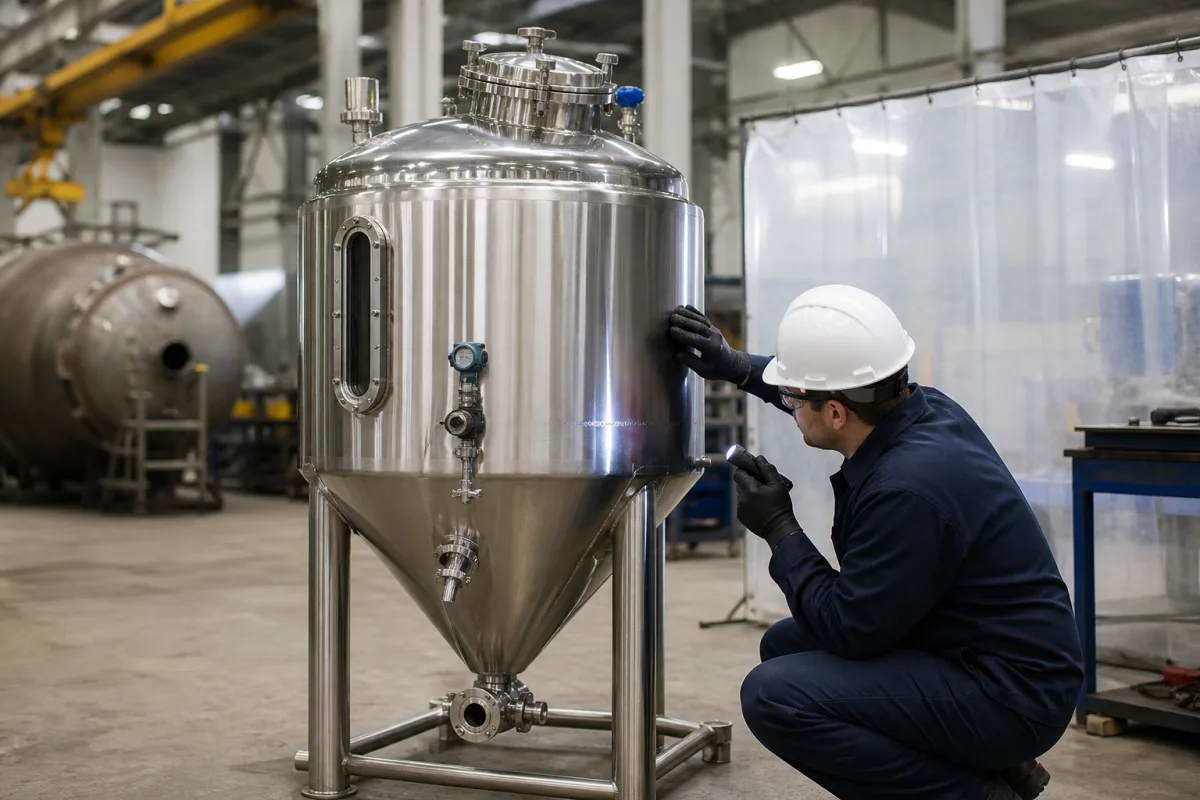
Product Collection Tank

Based on aggregated insights from multiple verified factory profiles within the CNFX directory, the standard Product Collection Tank used in the Chemical Manufacturing sector typically supports operational capacities ranging from standard industrial configurations to heavy-duty production requirements.

Technical Definition & Core Assembly

A canonical Product Collection Tank is characterized by the integration of Tank Shell/Body and Inlet Nozzle/Port. In industrial production environments, manufacturers listed on CNFX commonly emphasize Stainless Steel (e.g., 316L) construction to support stable, high-cycle operation across diverse manufacturing scenarios.

A storage vessel designed to collect and temporarily hold purified solvent products in an automated solvent recovery and purification system.
Product Specifications

Technical details and manufacturing context for Product Collection Tank

Definition
The Product Collection Tank is a critical component within an Automated Solvent Recovery and Purification System, serving as the final receiving vessel for the purified solvent product. It is strategically positioned downstream of the purification and separation units to safely contain the recovered solvent before it is transferred for further use, packaging, or distribution. The tank ensures product integrity by providing a controlled, often inert, environment to prevent contamination or degradation.
Working Principle
The tank operates as a passive or actively monitored storage vessel. Purified solvent flows into the tank via an inlet port, typically controlled by a valve. The tank holds the liquid product, which may be agitated or kept under a specific atmosphere (e.g., nitrogen blanket) to maintain purity. Level sensors monitor fill status, and the product is discharged through an outlet port, often via a pump, for downstream processes.
Common Materials
Stainless Steel (e.g., 316L), Glass-Lined Steel, Hastelloy
Technical Parameters
  • Total volumetric capacity of the Product Collection Tank (Liters (L)) Per Request
Components / BOM
  • Tank Shell/Body
    Primary containment structure for the collected solvent product.
    Material: Stainless Steel
  • Inlet Nozzle/Port
    Entry point for purified solvent from upstream purification units.
    Material: Stainless Steel
  • Outlet Nozzle/Port with Valve
    Discharge point for product transfer, controlled by a manual or automated valve.
    Material: Stainless Steel
  • Level Sensor
    Monitors the fill level of the tank to prevent overfilling and indicate status.
    Material: Sensor-specific (e.g., ceramic, stainless steel)
  • Pressure Relief Device
    Safety device (e.g., rupture disc, relief valve) to protect the tank from over-pressurization.
    Material: Stainless Steel
  • Manway/Cleaning Port
    Access hatch for internal inspection, maintenance, and cleaning.
    Material: Stainless Steel
  • Agitator/Stirrer
    Optional mixing device to homogenize the collected product or maintain suspension.
    Material: Stainless Steel
Engineering Reasoning
0.1-2.0 bar gauge pressure, 20-80°C temperature, 50-95% fill level
3.5 bar internal pressure (yield strength threshold), 120°C thermal degradation point, 0% or 100% fill level sensor failure
Design Rationale: Von Mises yield criterion exceeding 250 MPa at 3.5 bar internal pressure for 316L stainless steel, Arrhenius degradation kinetics above 120°C for polypropylene linings, capacitive level sensor dielectric constant shift at boundary conditions
Risk Mitigation (FMEA)
Trigger Pressure relief valve mechanical seizure due to polymer deposition
Mode: Tank overpressure exceeding 3.5 bar causing permanent deformation
Strategy: Dual redundant pressure relief valves with staggered setpoints (2.8 bar primary, 3.2 bar secondary) and quarterly mechanical cycling protocol
Trigger Electrochemical corrosion at weld seams from chloride ion concentration exceeding 25 ppm
Mode: Through-wall pitting corrosion leading to solvent leakage at 0.5 mm/year penetration rate
Strategy: Post-weld electropolishing to Ra 0.4 μm surface finish and cathodic protection system maintaining -0.85 V vs Ag/AgCl reference electrode

Industry Taxonomies & Aliases

Commonly used trade names and technical identifiers for Product Collection Tank.

Applied To / Applications

This component is essential for the following industrial systems and equipment:

Industrial Ecosystem & Supply Chain DNA

Complementary Systems
Downstream Applications
Specialized Tooling

Application Fit & Sizing Matrix

Operational Limits
pressure: Full vacuum to 10 bar
flow rate: Up to 50 m³/h
temperature: -20°C to 150°C
slurry concentration: Up to 30% solids by weight
Media Compatibility
✓ Purified acetone ✓ Distilled ethanol ✓ Recycled isopropyl alcohol
Unsuitable: Concentrated sulfuric acid or other strong oxidizing agents
Sizing Data Required
  • Required storage volume (m³)
  • Maximum batch processing rate (kg/h)
  • Required residence time (hours)

Reliability & Engineering Risk Analysis

Failure Mode & Root Cause
Corrosion-induced wall thinning
Cause: Chemical attack from collected fluids, especially acidic or alkaline substances, leading to material degradation and loss of structural integrity.
Crack propagation at weld seams
Cause: Cyclic stress from repeated filling/emptying cycles, thermal expansion/contraction, or vibration, causing fatigue cracks to initiate and grow at welded joints.
Maintenance Indicators
  • Visible weeping or seepage at tank seams or connections indicating loss of containment
  • Abnormal audible hissing or dripping sounds suggesting leaks or structural stress
Engineering Tips
  • Implement routine ultrasonic thickness testing to monitor wall thinning and schedule proactive repairs before failure occurs
  • Install vibration dampeners and ensure proper tank supports to minimize stress concentrations at critical weld points

Compliance & Manufacturing Standards

Reference Standards
ISO 11439:2013 (Gas cylinders - High pressure cylinders for the on-board storage of natural gas as a fuel for automotive vehicles) ASME BPVC Section VIII Division 1 (Rules for Construction of Pressure Vessels) EN 13445-3:2021 (Unfired pressure vessels - Part 3: Design)
Manufacturing Precision
  • Wall Thickness: +/-5% of nominal thickness
  • Overall Height: +/-3 mm per meter of height
Quality Inspection
  • Hydrostatic Pressure Test (to 1.5 times design pressure)
  • Ultrasonic Thickness Testing (for wall thickness verification)

Factories Producing Product Collection Tank

Verified manufacturers with capability to produce this product in China

✓ 97% Supplier Capability Match Found

T Technical Director from Canada Jan 10, 2026
★★★★★
"Standard OEM quality for Chemical Manufacturing applications. The Product Collection Tank arrived with full certification."
Technical Specifications Verified
P Project Engineer from United States Jan 07, 2026
★★★★☆
"Great transparency on the Product Collection Tank components. Essential for our Chemical Manufacturing supply chain. (Delivery took slightly longer than expected, but technical support was excellent.)"
Technical Specifications Verified
S Sourcing Manager from United Arab Emirates Jan 04, 2026
★★★★★
"The Product Collection Tank we sourced perfectly fits our Chemical Manufacturing production line requirements."
Technical Specifications Verified
Verification Protocol

“Feedback is collected from verified sourcing managers during RFQ (Request for Quote) and factory evaluation processes on CNFX. These reports represent historical performance data and technical audit summaries from our B2B manufacturing network.”

13 sourcing managers are analyzing this specification now. Last inquiry for Product Collection Tank from Poland (1h ago).

Supply Chain Compatible Machinery & Devices

Automated Batch Crystallization System

Automated system for controlled crystallization of chemical compounds in batch processes.

Explore Specs →
Automated pH Monitoring and Dosing System

Automated system for continuous pH monitoring and chemical dosing in process streams.

Explore Specs →
Automated Powder Dispensing and Blending System

Automated system for precise dispensing and homogeneous blending of powdered chemicals.

Explore Specs →
Automated Solvent Recovery and Purification System

Automated system for recovering and purifying industrial solvents.

Explore Specs →

Frequently Asked Questions

What materials are available for the Product Collection Tank?

The tank is available in Stainless Steel (e.g., 316L), Glass-Lined Steel, and Hastelloy to suit different chemical compatibility and corrosion resistance requirements in solvent recovery systems.

What safety features are included in the tank design?

Standard safety features include a pressure relief device, along with components like level sensors and secure inlet/outlet valves with nozzles, ensuring safe operation in automated solvent purification processes.

How is the tank capacity and connection size specified?

Capacity is specified in liters (L), and connection sizes for inlet/outlet are in inches. Design pressure (bar) and temperature (°C) are also customizable based on your system requirements.

Can I contact factories directly on CNFX?

CNFX is an open directory, not a transaction platform. Each factory profile provides direct contact information and production details to help you initiate direct inquiries with Chinese suppliers.

Get Quote for Product Collection Tank

Request technical pricing, lead times, or customized specifications for Product Collection Tank directly from verified manufacturing units.

Your business information is encrypted and only shared with verified Product Collection Tank suppliers.

Thank you! Your message has been sent. We'll respond within 1–3 business days.

Need to Manufacture Product Collection Tank?

Connect with verified factories specializing in this product category

Add Your Factory Contact Us
Previous Product
Process Pump
Next Product
Product Screening System