Industry-Verified Manufacturing Data (2026)

Linear Transport Module

Based on aggregated insights from multiple verified factory profiles within the CNFX directory, the standard Linear Transport Module used in the Machinery and Equipment Manufacturing sector typically supports operational capacities ranging from standard industrial configurations to heavy-duty production requirements.

Technical Definition & Core Assembly

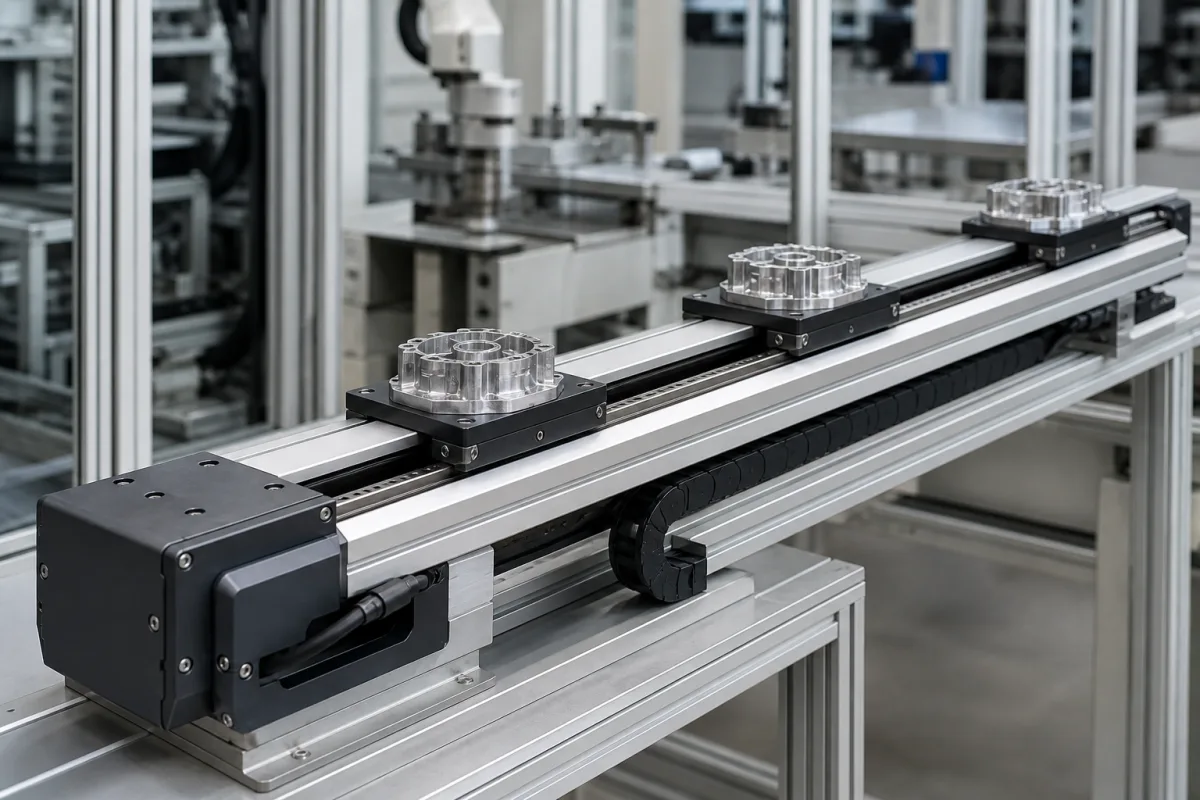
A canonical Linear Transport Module is characterized by the integration of Linear Guide Rail and Carriage/Slider. In industrial production environments, manufacturers listed on CNFX commonly emphasize Aluminum alloy (frame/rails) construction to support stable, high-cycle operation across diverse manufacturing scenarios.

A precision linear motion component that transports components along a defined path within an automated feeding system.
Product Specifications

Technical details and manufacturing context for Linear Transport Module

Definition
The Linear Transport Module is a critical component of the Automated Component Feeding System, responsible for moving parts, components, or materials along a straight, controlled path between stations such as feeders, assembly points, or inspection areas. It ensures precise positioning and reliable transfer to maintain system throughput and accuracy.
Working Principle
Typically utilizes a linear actuator (e.g., belt drive, ball screw, or linear motor) guided by rails or profiles. A controller commands the actuator to move a carriage or platform along the axis, enabling programmable start/stop positions, speeds, and accelerations for synchronized material handling.
Common Materials
Aluminum alloy (frame/rails), Steel (guide rails/bearings), Engineering plastic (carriage/sliders)
Technical Parameters
  • Stroke length (travel distance) (mm) Customizable
Components / BOM
  • Linear Guide Rail
    Provides a low-friction, precision path for the carriage to slide along
    Material: Hardened steel
  • Carriage/Slider
    Moves along the rail and provides mounting points for the transported load
    Material: Aluminum alloy with polymer bearings
  • Drive Mechanism (e.g., Belt & Pulley)
    Converts rotary motor motion into linear motion of the carriage
    Material: Timing belt (rubber/fiber), aluminum/steel pulleys
  • Servo/Stepper Motor
    Provides controlled power for precise movement and positioning
    Material: Steel, copper, magnets
Engineering Reasoning
0.1-2.0 m/s linear velocity, 0.01-0.05 mm positioning accuracy, 5-40 N continuous thrust force
Linear guide rail wear exceeding 0.1 mm clearance, ball screw backlash exceeding 0.02 mm, motor winding temperature exceeding 155°C
Design Rationale: Hertzian contact stress exceeding 2.1 GPa at ball/raceway interface causes plastic deformation; thermal expansion coefficient mismatch (steel: 11.5 μm/m·K vs aluminum: 23.1 μm/m·K) creates binding forces exceeding 150 N at 80°C delta-T
Risk Mitigation (FMEA)
Trigger Contaminant particle >15 μm diameter entering recirculating ball path
Mode: Ball screw jamming at 0.5 m/s velocity, motor overcurrent trip at 8.5 A (175% rated)
Strategy: IP65-rated bellows seal with 0.3 MPa positive air purge, magnetic particle filter with 10 μm absolute rating
Trigger Lubricant viscosity drop from ISO VG68 to <VG32 at 60°C operating temperature
Mode: Linear guideway stick-slip oscillation at 0.2 m/s, position error accumulation of 0.15 mm over 1 m travel
Strategy: Synthetic ester-based grease with viscosity index >200, automatic lubrication system with 0.05 ml/cycle at 8-hour intervals

Industry Taxonomies & Aliases

Commonly used trade names and technical identifiers for Linear Transport Module.

Applied To / Applications

This component is essential for the following industrial systems and equipment:

Industrial Ecosystem & Supply Chain DNA

Complementary Systems
Downstream Applications
Specialized Tooling

Application Fit & Sizing Matrix

Operational Limits
pressure: Atmospheric to 2 bar
other spec: Max load capacity: 50 kg, Max speed: 2 m/s, Positioning accuracy: ±0.1 mm
temperature: -10°C to +80°C
Media Compatibility
✓ Small mechanical components ✓ Electronic assemblies ✓ Plastic injection molded parts
Unsuitable: High-viscosity slurry or abrasive particulate environments
Sizing Data Required
  • Required travel length (mm)
  • Maximum payload mass (kg)
  • Required positioning repeatability (mm)

Reliability & Engineering Risk Analysis

Failure Mode & Root Cause
Bearing wear and seizure
Cause: Inadequate lubrication, contamination ingress, or misalignment leading to increased friction and eventual failure.
Belt or chain degradation
Cause: Excessive tension, environmental exposure (moisture, chemicals), or abrasive wear from particulate contamination.
Maintenance Indicators
  • Unusual grinding or squealing noises during operation
  • Visible misalignment, excessive vibration, or irregular movement patterns
Engineering Tips
  • Implement a proactive lubrication schedule using manufacturer-recommended lubricants and monitor contamination levels.
  • Regularly inspect and adjust tension and alignment, and ensure environmental controls (e.g., seals, enclosures) to protect from contaminants.

Compliance & Manufacturing Standards

Reference Standards
ISO 3408-1:2006 (Ball screws - Part 1: Vocabulary and designation) ANSI/B11.19-2019 (Performance Requirements for Safeguarding) DIN 1025-1 (Hot-rolled I-beams - Part 1: Dimensions, mass, static values)
Manufacturing Precision
  • Linear positioning accuracy: +/-0.01mm per 300mm travel
  • Parallelism of guide rails: 0.02mm over full length
Quality Inspection
  • Laser interferometer measurement for positioning accuracy
  • Coordinate Measuring Machine (CMM) verification of geometric tolerances

Factories Producing Linear Transport Module

Verified manufacturers with capability to produce this product in China

✓ 93% Supplier Capability Match Found

S Sourcing Manager from Germany Mar 01, 2026
★★★★★
"As a professional in the Machinery and Equipment Manufacturing sector, I confirm this Linear Transport Module meets all ISO standards."
Technical Specifications Verified
P Procurement Specialist from Brazil Feb 26, 2026
★★★★☆
"Standard OEM quality for Machinery and Equipment Manufacturing applications. The Linear Transport Module arrived with full certification. (Delivery took slightly longer than expected, but technical support was excellent.)"
Technical Specifications Verified
T Technical Director from Canada Feb 23, 2026
★★★★★
"Great transparency on the Linear Transport Module components. Essential for our Machinery and Equipment Manufacturing supply chain."
Technical Specifications Verified
Verification Protocol

“Feedback is collected from verified sourcing managers during RFQ (Request for Quote) and factory evaluation processes on CNFX. These reports represent historical performance data and technical audit summaries from our B2B manufacturing network.”

11 sourcing managers are analyzing this specification now. Last inquiry for Linear Transport Module from Poland (48m ago).

Supply Chain Compatible Machinery & Devices

Hydraulic Press

Industrial machine using hydraulic pressure to compress, form, or assemble materials

Explore Specs →
Heavy-Duty CNC Plasma Cutting Machine

Industrial machine for precision metal cutting using plasma arc technology

Explore Specs →
Automated Assembly Line System

Integrated production system for sequential component assembly operations

Explore Specs →
Automated Powder Coating System

Integrated industrial system for applying dry powder coatings to metal substrates.

Explore Specs →

Frequently Asked Questions

What materials are used in the linear transport module construction?

The module features an aluminum alloy frame and rails for lightweight durability, steel guide rails and bearings for precision movement, and engineering plastic for the carriage and sliders to reduce friction and noise.

What drive mechanisms are compatible with this linear transport module?

This module is designed to work with belt and pulley drive systems, typically powered by servo or stepper motors for precise control in automated feeding applications.

What industries commonly use this type of linear transport module?

Primarily used in machinery and equipment manufacturing for automated assembly lines, packaging systems, material handling, and any application requiring precise linear component transport.

Can I contact factories directly on CNFX?

CNFX is an open directory, not a transaction platform. Each factory profile provides direct contact information and production details to help you initiate direct inquiries with Chinese suppliers.

Get Quote for Linear Transport Module

Request technical pricing, lead times, or customized specifications for Linear Transport Module directly from verified manufacturing units.

Your business information is encrypted and only shared with verified Linear Transport Module suppliers.

Thank you! Your message has been sent. We'll respond within 1–3 business days.

Need to Manufacture Linear Transport Module?

Connect with verified factories specializing in this product category

Add Your Factory Contact Us
Previous Product
Linear Track
Next Product
Liner