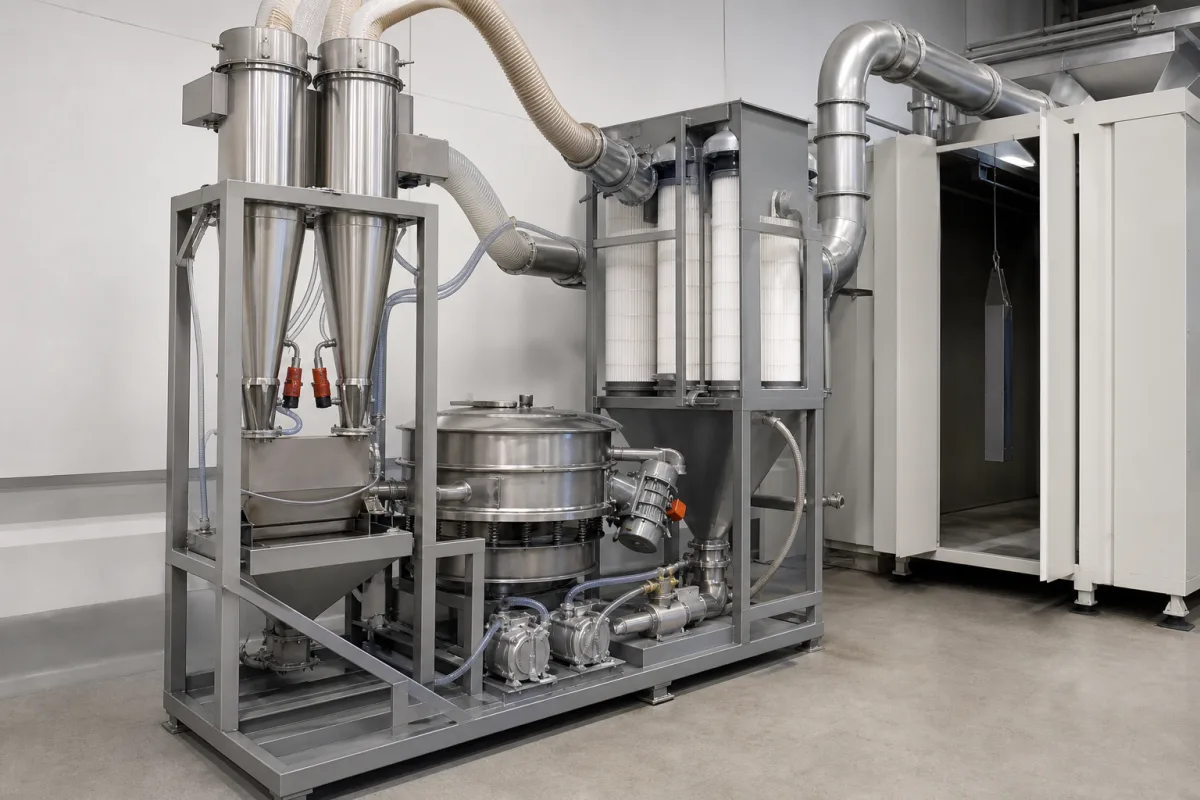
Powder recovery unit for coating booths: cyclone separation, reclaim sieving without fused powder, and the cartridge after-filter
The cyclone, reclaim sieve and after-filter that return booth overspray to the guns · a 100–400 µm sieve fed by a second small cyclone, a cyclone hopper that unclamps for colour change, a perforated plate with 2–20 mm holes that stops powder fusing on the sieve, and cartridge after-filters stated at over 99.99 % separation
Powder that misses the part is not waste until the recovery unit decides it is. Booth exhaust air carries it to a cyclone, which separates powder from the air into a hopper; from there it is conveyed to a sieve that takes out lumps and dirt, and back to the fluidised hopper that feeds the guns. Air leaving the cyclone still carries fines, so a filter follows. The unit's design decides how much powder comes back, how clean it is, and how long a colour change takes.
Powder recovery and reclaim units beside powder coating booths: cyclone separators, intermediate hoppers, reclaim sieves, transfer pumps and cartridge after-filters, and how they are arranged for recycling and colour change. Complete automatic powder coating lines, booth extraction against the explosion limit, earthing, guns and curing are covered on the Automated powder coating system page; pneumatic conveying of bulk powders on the Pneumatic conveyor for powders and granules page.
CNFX editorial research · Sources checked October 13, 2026 · 3 sources
Cyclone, side-mounted sieve and detachable hopper: Nordson's recovery and recycling layout
Nordson's European patent EP 0 165 815 B1 describes a recovery and recycling apparatus in which booth exhaust air laden with powder enters the top of a cyclone horizontally; the separated powder falls into an intermediate storage chamber, a transfer hose carries it to a sieve device beside the cyclone, and sieved powder drops into a reusable powder reservoir, which can be a fluidised feeder hopper from which a pump supplies the guns. [1]
The patent sets its aim against earlier designs: one placed the sieve beside the cyclone but made no provision for quick colour change, and another required the cyclone body itself to be replaced to change colour. [1]
Element
As the patent describes it
Sieve device
A second, smaller cyclone separates powder from its transport air above a sieve chamber whose sieve member is, for example, a 100 to 400 micron mesh [1]
Intermediate chamber
Detachably clamped to the cyclone base, so a replacement chamber, or the same one cleaned, lets one cyclone serve a different colour [1]
Sieve position
Offset to the side of the cyclone axis to keep overall height low enough for a low-ceilinged plant; it can sit next to the guns and serve more than one cyclone [1]
Module
Sieve, intermediate chamber, reservoir and transfer pump can form one unit on a wheeled mounting moved away from the cyclone [1]
Ask which sieve mesh is fitted for your powder, how the cyclone hopper is removed for colour change, and whether the sieve module can serve more than one cyclone.
02
Slowing the powder before the sieve: a perforated plate with 2–20 mm holes
SAMES Technologies' European patent EP 1 065 003 B1 starts from a fault in cyclone-and-sieve recovery: the air and powder mixture moves fast in the narrow lower part of the cyclone, strikes the sieve grid at high speed and rubs on it, and the heat can melt the powder or partly or fully cure it on the upper face of the sieve. [2]
The plate cuts the tangential speed of the mixture so that it reaches the sieve at low, almost zero, speed and no notable heating occurs. [2]
Editorial calculation: an annulus from R/2 to R is 1 − (1/2)² = 75 % of the area of a disc sieve, so the clogging SAMES describes takes three quarters of the screen out of use.
Feature
Value in the patent
Clogged zone on a disc sieve of radius R
An annulus between R/2 and R, which the patent says is not rare [2]
Perforated plate position
Between cyclone and sieve, parallel to the sieve grid, 0.5–30 cm above it [2]
Perforation diameter
2–20 mm, well above the largest powder particle, of the order of 100 microns [2]
Plate material
Low friction against powder, such as polyethylene or PTFE; or electrically conductive to drain tribo-electric charge [2]
Perforated area
Whole plate, or only an outer annulus of a disc [2]
Ask how the recovered powder is slowed before the sieve and how often the sieve has to be cleaned of fused powder.
03
After the cyclone: cartridge after-filters stated at over 99.99 %
Gema describes after-filter units installed after its MonoCyclones, with self-cleaning cartridges reaching over 99.99 % separation efficiency, and single-colour filter units with the same stated efficiency from which powder can be recirculated straight to the guns. For manual and small automatic lines it lists filter units with conical cartridges cleaned by a manually activated jet. [3]
Gema also lists a switching device that combines the recovery efficiency of a single-colour filter with the quick colour change of a cyclone, and says the MonoCyclone design reduces pressure loss. [3]
Editorial calculation: at 99.99 % separation, 0.01 % of the powder reaching the after-filter passes it, that is 0.1 g in every 1 kg that leaves the cyclone with the air.
Ask for the after-filter's stated separation efficiency and test basis, the cartridge cleaning method, and whether filter powder is returned to the guns or discarded.
04
Information for a powder recovery unit quotation
Paste it into your enquiry below or into an email to a maker, then replace every bracket.
Booth: [type; extraction air volume; number of guns]
Powder: [chemistry; particle size; colours per shift]
Recovery: [cyclone or direct filter; colour change time target]
Sieve: [mesh; location; capacity]
After-filter: [cartridge type; stated efficiency; cleaning]
Return: [to fluidised hopper or box feed; pump type]
Explore company information and manufacturing capabilities, then discuss the scope of your project with a relevant supplier.
Share this page
Compiled and source-reviewed by the CNFX editorial team.
Each manufacturer above links to the page on that company's own website where the product is listed, with the date we checked it. How we source and review
· Page last updated 13 October 2026
Buyer questions
What sieve mesh is used on reclaimed powder?
Nordson's recovery patent gives a 100 to 400 micron mesh as an example, under a small cyclone that separates the transport air. [1]
Why does powder fuse onto a reclaim sieve?
SAMES explains that powder leaving the cyclone hits and rubs the sieve at high speed and the heat can melt or cure it, clogging an annulus between R/2 and R. [2]
How is the powder slowed before the sieve?
SAMES places a perforated plate with 2–20 mm holes 0.5–30 cm above the sieve to cut the mixture's tangential speed. [2]
How efficient is a cartridge after-filter?
Gema states over 99.99 % separation efficiency for its self-cleaning cartridge after-filters. [3]
Sources and what still needs a direct check
Sources checked 2026-10-13. Recovery layout and sieve mesh from a Nordson patent; sieve protection from a SAMES Technologies patent, both on the EPO publication server; after-filter efficiency from Gema's product page.