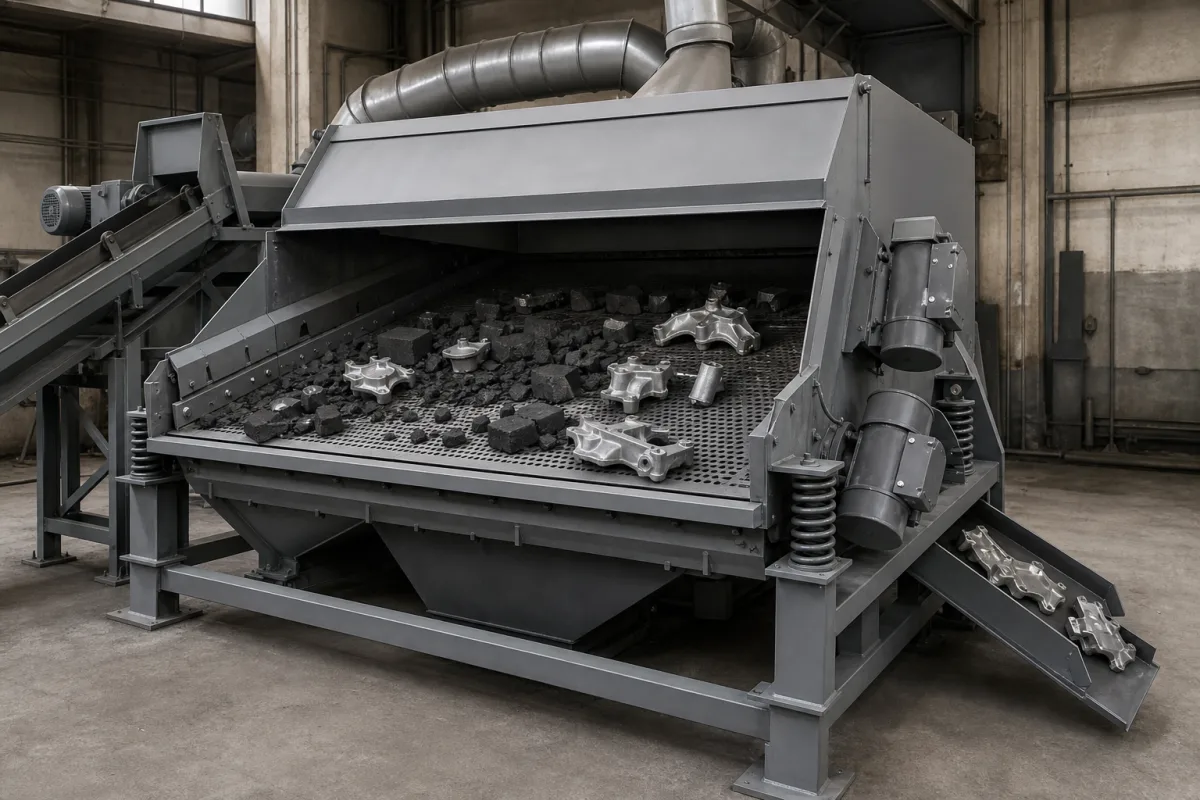
Vibrating shakeout grids and units that free castings from sand moulds · Where shakeout sits after pouring and cooling, sand return to reclamation, dust from shakeout (EPA factors), hoods with scrubbers or fabric filters, and silica exposure limits
A foundry shakeout unit is the vibrating grid or deck that receives cooled sand moulds after casting and shakes the mould and core sand away from the castings. The sand drops through for cleaning and reuse, the castings move on to cleaning and finishing, and the dust raised must be captured. Ask three things first: what mould sizes, weights and casting types it must handle, how sand and castings are separated and conveyed away, and how the dust and silica exposure will be controlled.
Vibrating shakeout grids, decks and units for green sand and other sand moulds in iron, steel and non-ferrous foundries, with their hoods, sand return and casting discharge. Moulding machines (see sand molding machine), sand reclamation plants, shot blasting and casting cleaning equipment, and oilfield shale shakers are outside this page except where compared.
CNFX editorial research · Sources checked October 12, 2026 · 4 sources
US EPA's AP-42 Section 12.10 (Gray Iron Foundries) describes the casting and finishing sequence: molten iron is tapped into a ladle or directly into moulds; in larger, more mechanised foundries the filled moulds are conveyed automatically through a cooling tunnel, then placed on a vibrating grid to shake the mould sand and core sand loose from the casting. Used sand from shakeout is recycled and cleaned to remove clay and carbonaceous build-up, screened and reused to make new moulds. [1]
Editorial note: give the supplier the mould (flask or flaskless) sizes and gross weights, the casting weights and fragility, cycle rate from the moulding line, and where sand and castings must be delivered, so it can size the grid area and vibration and the conveyors on each side.
General Kinematics describes its two-mass vibratory shakeouts for high-production moulding lines at capacities of 30 to 300 tons per hour for gray, ductile or malleable iron. Each unit is sized to give the casting retention time needed to break down the sand without excessive casting batter; variable frequency drives vary the G-force applied, and an isolation system lets the deck be inclined or declined to hold castings for the retention time a part needs. The drive sits on a separate exciter mass isolated from the deck's impact, with sealed vibrator motors instead of V-belts, pivoted motor bases, couplings and large bearings, and the design compensates for changing load. [3]
Editorial calculation: at 300 tons per hour (US short tons, about 272 t/h), a line casting 20 moulds per minute handles about 227 kg of sand, iron and flask per mould on average (272,000 ÷ 1,200). The mould rate is an assumed example; confirm whether a supplier's rating counts sand plus castings or castings alone. [3]
Give the supplier the moulding process and mould type (flask or flaskless, green sand or chemically bonded), mould dimensions and gross weight, casting weight range and fragility, moulds per hour, mould temperature at shakeout, sand and core removal required, sand return conveyor and reclamation interface, casting discharge, hood and exhaust connection, noise limits, foundation and isolation, and maintenance access.
02
Capture shakeout dust and control silica exposure
AP-42 states that a significant quantity of particulate is generated during casting shakeout, and that these fugitive emissions are controlled by high-energy scrubbers or fabric filters. Its emission factor for uncontrolled shakeout particulate is 1.6 kg per megagram (tonne) of gray iron produced (rating E); its particle size table gives about 70% of this mass below 10 µm, or about 1.12 kg/Mg as PM-10. [1]
OSHA's respirable crystalline silica standard for general industry (29 CFR 1910.1053) prohibits employee exposure above 50 µg/m³ as an 8-hour time-weighted average, requires exposure assessment for employees exposed at or above the action level, and requires engineering and work practice controls to reduce exposure to or below the limit unless the employer shows they are not feasible, with respirators used only where those controls are not sufficient or during certain tasks. [2]
Editorial calculation: at 1.6 kg/Mg, a foundry pouring 10,000 tonnes of iron a year would generate about 16 tonnes of particulate at shakeout before control, of which about 11 tonnes would be PM-10; ask the supplier for the hood capture design and the exhaust flow it assumes. [1]
03
Give the sand-to-metal ratio and mould type, not only tonnage
Carrier Vibrating Equipment, a vibratory equipment maker, states that its foundry shakeouts "can be used for sand-to-metal ratios as low as 5:1 and as high as 60:1", that the provided controls accommodate unlimited recipes, and that its "Delta-Phase® Shakeout" lets the operator manage the castings' conveying speed and retention time on the deck. It lists adjustable speed and angle of vibration for green sand and no-bake moulds, "No Bake & Green Sand Shakeouts" in flasked and flaskless configurations, and a vibrating barrel design in which castings move through a rotating sand bed. [4]
The ratio sets how much sand the shakeout has to remove for each tonne of castings, so two lines with the same casting output can load a shakeout very differently. A tonnage rating such as General Kinematics' 30 to 300 tons per hour [3] does not say whether it counts sand plus castings or castings alone. Give each supplier your sand-to-metal ratio, mould type (green sand or no-bake, flasked or flaskless) and casting weights, and ask what ratio the quoted capacity assumes.
Carrier states that shakeouts "often feed directly into sand screening and reclamation" [4], and AP-42 describes used sand from shakeout being returned for reuse [1]. AP-42 also calls shakeout a significant particulate source [1], and 29 CFR 1910.1053 sets the US limit for respirable crystalline silica [2]; ask the supplier how the sand-to-metal ratio was used to size the sand return conveyor and the dust hood as well as the deck.
Editorial calculation: at a 5:1 ratio each tonne of castings comes with 5 t of sand, and at 60:1 with 60 t, a twelvefold difference in sand to remove for the same casting output. [4]
Item
Carrier Vibrating Equipment (as published)
General Kinematics (already cited)
Sand-to-metal ratio
5:1 to 60:1
—
Capacity
—
30 to 300 tons per hour (gray, ductile or malleable iron)
Retention control
Delta-Phase®: conveying speed and retention time managed by the operator
Deck incline or decline via isolation system; sized retention time
Vibration adjustment
Adjustable speed and angle of vibration
Variable frequency drives vary G-force
Mould types
Green sand and no-bake; flasked and flaskless
High-production moulding lines
Maintenance points named
Screening deck, isolators, vibration drives
Sealed vibrator motors, pivoted motor bases, couplings, bearings
Values are from Carrier Vibrating Equipment's shakeouts page; no capacity table was published there.
04
From cooling tunnel to fabric filter: the equipment around a shakeout grid
Capacity, sand-to-metal ratio, retention time and exhaust volume for a shakeout order
The only published figures here are General Kinematics' 30–300 tons per hour for iron castings and Carrier's 5:1 to 60:1 sand-to-metal range, and they come from two different makers; ask for capacity at your own sand-to-metal ratio.
1 company lists this product among what they make. Company figures are quoted from each
company's own website; every card states where the relationship came from.
Changzhou Number One Machinery Co., Ltd.
Manufacturing site to be confirmed for the order
Lists the SCD shakeout and cooling drum, which combines vibratory shakeout, sand cooling and casting cooling.
Product scope checked 2026-10-12
Product page on own website · profile compiled by CNFX from public sources
Explore company information and manufacturing capabilities, then discuss the scope of your project with a relevant supplier.
Share this page
Compiled and source-reviewed by the CNFX editorial team.
Each manufacturer above links to the page on that company's own website where the product is listed, with the date we checked it. How we source and review
· Page last updated 13 October 2026
Buyer questions
What does a foundry shakeout do?
Moulds are placed on a vibrating grid that shakes mould and core sand loose from the castings; the sand is recycled (EPA AP-42 12.10). [1]
How much dust does shakeout produce?
AP-42 gives 1.6 kg of particulate per tonne of gray iron uncontrolled, about 70% below 10 µm. [1]
What silica limit applies at shakeout in the US?
OSHA's 29 CFR 1910.1053 sets 50 µg/m³ (8-hour TWA) and requires engineering and work practice controls first. [2]
What capacity do two-mass shakeouts handle?
General Kinematics lists 30 to 300 tons per hour for gray, ductile or malleable iron, with variable-frequency drives to adjust G-force. [3]
What sand-to-metal ratio can a foundry shakeout handle?
Carrier Vibrating Equipment states its shakeouts can be used for sand-to-metal ratios as low as 5:1 and as high as 60:1, with adjustable speed and angle of vibration for green sand and no-bake moulds. [4]
Sources and what still needs a direct check
Sources checked 2026-10-12. AP-42 Section 12.10 is US EPA emission-factor guidance (1995 version; E-rated factors are of low reliability); 29 CFR 1910.1053 is a US federal workplace rule.