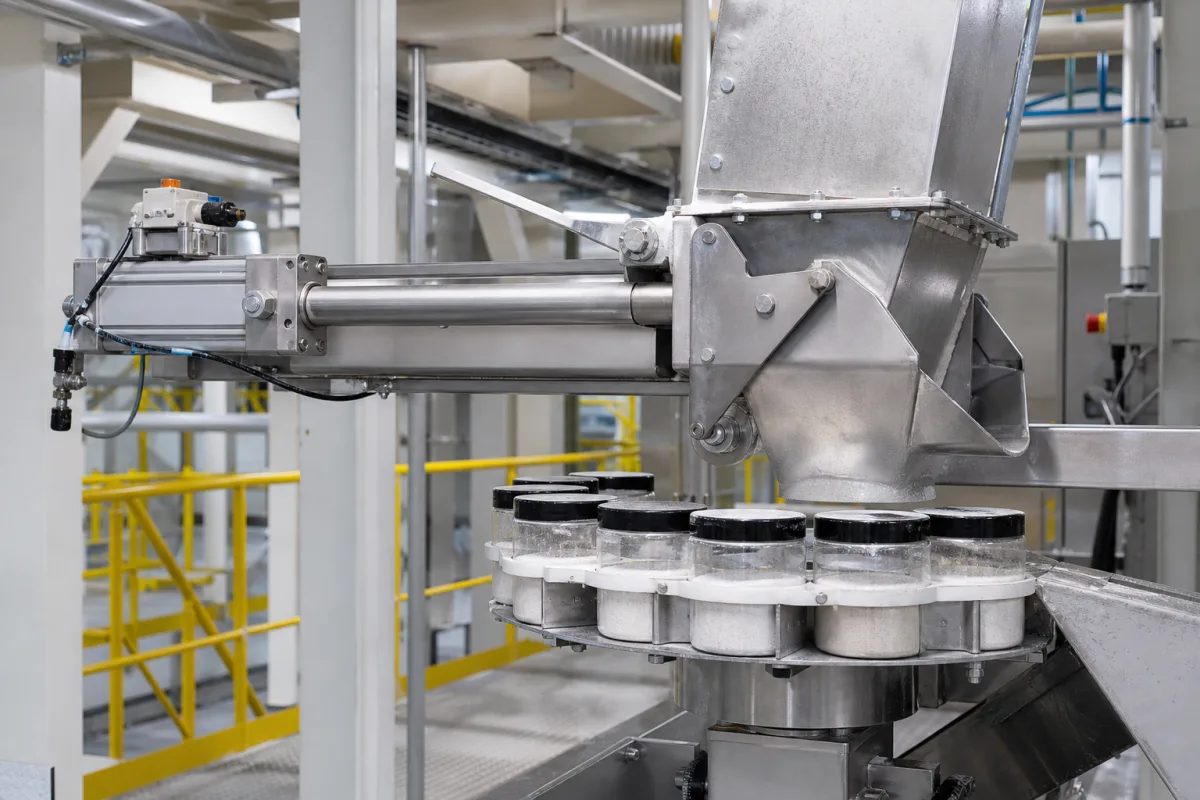
Automated sampler for bulk solids (cross-stream, cross-belt and bucket cutters)
Bulk-solids sampling · cutter aperture three times top size, cutter speed limits, falling-stream versus cross-belt cutters
An automated sampler for bulk solids is a mechanical cutter that passes through a falling stream at a transfer point, or sweeps across a moving conveyor belt, at set intervals and delivers each increment to a chute or sample container. Ask three things first: how wide the cutter opening is relative to the largest particles, how fast and how evenly the cutter crosses the stream, and whether the stream is sampled in free fall or on the belt.
Automatic mechanical samplers that cut increments from falling streams or moving belts of coal, ores, minerals, powders and other bulk solids and deliver them to sample containers. Steam- or CIP-sterilisable valves that draw liquid samples from pharmaceutical, biotech and dairy processes are covered on the Sterile (aseptic) sampling valve page. Laboratory autosamplers for spectrometers and chromatographs are outside this page.
CNFX editorial research · Sources checked October 12, 2026 · 6 sources
The IEA Clean Coal Centre's review of coal sampling standards (2014) lists design criteria for cross-stream cutters: cut a complete cross-section of the stream, keep the aperture plane normal to the stream's mean trajectory, run at constant speed not exceeding 0.6 m/s, make the cutter aperture at least three times the coal top size and wide enough to prevent bridging, keep the opening edges parallel, and sample the stream in free fall. [1]
For sampling devices the review cites ISO 18283 for an opening of at least three times the nominal top size with a minimum dimension of 30 mm, and notes that the cutter needs capacity for the increment mass at the maximum flow rate. As an example of scale, it says an increment from a conveyor carrying 500 t/h of coal could weigh 100–150 kg. [1]
Editorial calculation: for a 50 mm top size, three times top size gives an aperture of at least 150 mm; for a 5 mm powder or fine coal, 3 × 5 = 15 mm, so the 30 mm minimum governs. [1]
Cleary and Robinson of CSIRO, modelling cross-stream cutters with three-dimensional discrete element simulation (2008), report that their results broadly support the rule of an aperture at least three times the nominal top size, but do not support the rule that the aperture must increase if cutter speed exceeds 0.6 m/s. [2]
Give the supplier the material, nominal top size, bulk density, flow rate, stream width and depth, transfer-point layout, increment mass and number of increments per lot, and how the sample is to be collected.
02
Set cutter speed and choose falling-stream or cross-belt cutting
The IEA review prefers a sampler that cuts the full width of a falling stream; where that is not possible, a cross-belt cutter traverses the belt in a rotary motion and its back plate pushes the increment off. For cross-belt cutters it lists parallel lips cutting at 90° to the belt centre-line, a complete cut in one continuous pass at uniform velocity of at least 1.5 times belt velocity, an aperture at least three times the nominal top size, and a belt profile matched to the cutter arc. [1]
The review contrasts cutter speeds of less than 0.6 m/s under ISO 18283 with 0.46 m/s (18 inches/s) under ASTM D2013. [1] Multotec, which has made cross-stream samplers under licence to Siebtechnik since 1987, lists a uniform cutter speed of preferably 0.45 m/s and cutters customised for dry ore and slurry streams. [3]
Editorial calculation: with an assumed belt speed of 3 m/s, the 1.5 × rule requires a cross-belt cutter moving at least 4.5 m/s, far above the 0.6 m/s ceiling for falling-stream cutters, so the two cutter types are specified to different speed rules. [1]
JWII's cross-stream cutter runs on a double-rail carriage above the flow at a constant speed of up to 0.6 m/s, for belts 500–2,500 mm wide; its bucket sampler passes the cutter twice through the falling material at up to 0.6 m/s; and its cross-belt sampler rotates a counter-weighted cutter through 360° perpendicular to the belt. [4][5]
03
Compare sampler types
The IEA review names cutter-chute, cutter-bucket and swing-arm cross-stream cutters, and cross-belt cutters for retrofit to existing conveyors. [1]
Type
How it cuts
Speed rule cited
Cross-stream cutter (falling stream)
Cutter on a carriage crosses the free-falling stream. [4]
Constant, ≤ 0.6 m/s (ISO 18283) or 0.46 m/s (ASTM D2013). [1]
Bucket sampler
Bucket passes twice through the stream, then empties to outlet. [5]
Increment mass, cut interval, wear materials and bias testing for a bulk-solids sampler
Sampling accuracy is a bias and precision result for the whole system, and the CSIRO simulations show aperture and cutter speed affect bias, so ask for the bias test method rather than a single percentage. [2]
Field
What it means and published values
Ask the supplier for
Sampling volume (mL)
Increment size; set by aperture and stream flow; 100–150 kg cited for a 500 t/h coal belt. [1]
Increment mass and container volume.
Sampling interval (min)
Time or tonnage between cuts.
Interval range and trigger.
Operating pressure (MPa)
Air supply for pneumatic actuators, where used.
Air pressure and consumption.
Operating temperature (°C)
Material and ambient range.
Range.
Power supply (V AC)
Drive motor supply.
Voltage, phases, frequency.
Power consumption (W)
Drive and controls.
Rated power.
Ingress protection
Rating of motors and controls in dusty areas.
IP rating per item.
Material
Housing and carriage in AISI 304/316 or painted carbon steel; Hardox wear plate. [4]
Wetted and wear materials.
Connection size
Inlet and outlet chute flanges.
Flange sizes.
Weight (kg)
Installed mass.
Mass for support steel.
Sampling accuracy (%)
Bias and precision of the sampling system; aperture and speed rules affect bias. [2]
Bias test method and results.
Control signal (mA)
Interface to plant control.
Signal type and I/O.
06
Send the material, stream and sample data together
Paste it into your enquiry below or into an email to a maker, then replace every bracket.
Material: [type; nominal top size; bulk density; moisture]
Stream: [flow t/h; belt width and speed or falling-stream size]
Cutter: [aperture; speed; type]
Sampling: [increment mass; increments per lot; interval]
Collection: [chute; collector; container count]
Site: [power; air; dust and IP; materials]
Standard: [ISO, ASTM or other method to follow]
Explore company information and manufacturing capabilities, then discuss the scope of your project with a relevant supplier.
Share this page
Compiled and source-reviewed by the CNFX editorial team.
Each manufacturer above links to the page on that company's own website where the product is listed, with the date we checked it. How we source and review
· Page last updated 13 October 2026
Buyer questions
How wide should the cutter opening be?
The IEA review of coal sampling standards gives at least three times the top size, and cites ISO 18283 for a minimum of 30 mm. [1]
How fast should a cross-stream cutter move?
Constant and not above 0.6 m/s per the criteria the IEA review lists; it cites 0.46 m/s under ASTM D2013. [1]
Is the 0.6 m/s rule supported by modelling?
A CSIRO discrete element study supported the three-times aperture rule but not the rule to enlarge the aperture above 0.6 m/s. [2]
Sources and what still needs a direct check
Sources checked 2026-10-12. The IEA Clean Coal Centre review summarises ISO and ASTM sampling standards; the CSIRO study (via OSTI) tests their cutter rules by simulation; Multotec and JWII are sampler makers describing their own equipment.