Industry-Verified Manufacturing Data (2026)

Automatic Sealing Mechanism

Based on aggregated insights from multiple verified factory profiles within the CNFX directory, the standard Automatic Sealing Mechanism used in the Machinery and Equipment Manufacturing sector typically supports operational capacities ranging from standard industrial configurations to heavy-duty production requirements.

Technical Definition & Core Assembly

A canonical Automatic Sealing Mechanism is characterized by the integration of Sealing Actuator and Seal Gripper/Chuck. In industrial production environments, manufacturers listed on CNFX commonly emphasize Stainless Steel (AISI 304/316) construction to support stable, high-cycle operation across diverse manufacturing scenarios.

A mechanical or electromechanical device that automatically creates and maintains a secure, leak-proof seal on kegs or barrels during the filling process.

Product Specifications

Technical details and manufacturing context for Automatic Sealing Mechanism

Definition
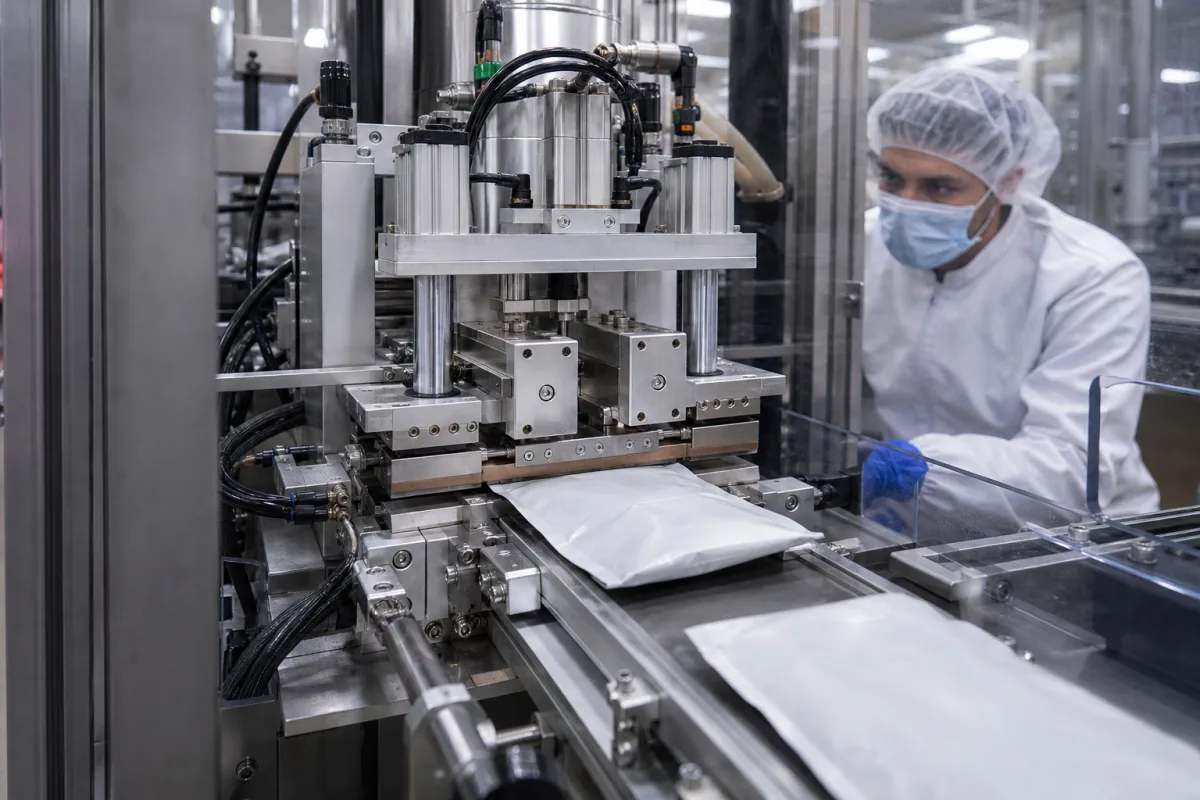
The Automatic Sealing Mechanism is a critical sub-component of an Automated Kegging and Barrel Filling System. Its primary role is to ensure a perfect, hermetic seal is applied to the container opening immediately after filling, without manual intervention. This prevents product loss, contamination, and oxidation, and is essential for maintaining beverage quality, carbonation levels, and shelf life. It operates in precise coordination with the filling head and conveyance system.
Working Principle
The mechanism typically positions a sealing element (e.g., a bung, cap, or plug) onto the container's opening. It then applies controlled force—via pneumatic, hydraulic, or servo-electric actuators—to seat the seal correctly. Sensors may verify proper seal placement and pressure before the container is released from the station. The process is triggered automatically by the system's control unit upon completion of the fill cycle.
Common Materials
Stainless Steel (AISI 304/316), Food-Grade Silicone/EPDM, Anodized Aluminum
Technical Parameters
  • Sealing force range and actuator stroke length. (mm) Standard Spec
Components / BOM
  • Sealing Actuator
    Provides the linear or rotational force to press the seal into place.
    Material: Stainless Steel
  • Seal Gripper/Chuck
    Holds and positions the bung or cap accurately over the container opening.
    Material: Anodized Aluminum
  • Force Sensor
    Monitors the applied sealing force to ensure it is within the specified range.
    Material: Stainless Steel Housing
Engineering Reasoning
0.5-6.0 bar
8.2 bar differential pressure
Design Rationale: Elastomer seal extrusion through clearance gaps exceeding 0.15 mm at 8.2 bar, following Hooke's Law deformation limit where σ = Eε with E=7.5 MPa for food-grade silicone
Risk Mitigation (FMEA)
Trigger Pneumatic supply pressure drop below 4.0 bar
Mode: Incomplete seal compression resulting in 0.02 mm residual gap
Strategy: Dual-redundant pressure regulators with 0.1 bar deadband control
Trigger Sealing surface contamination exceeding 50 μm particulate accumulation
Mode: Increased friction coefficient from μ=0.15 to μ=0.45 causing 120% torque overload
Strategy: Integrated 360° air-knife cleaning at 3.5 bar with 5 μm filtration

Industry Taxonomies & Aliases

Commonly used trade names and technical identifiers for Automatic Sealing Mechanism.

Industrial Ecosystem & Supply Chain DNA

Complementary Systems
Downstream Applications
Specialized Tooling

Application Fit & Sizing Matrix

Operational Limits
pressure: 0 to 6 bar
flow rate: Up to 200 L/min
temperature: -10°C to 80°C
slurry concentration: Up to 30% solids by weight
Media Compatibility
✓ Beer/Wort ✓ Carbonated Beverages ✓ Food-Grade Liquids
Unsuitable: Abrasive Slurries with >30% solids
Sizing Data Required
  • Keg/Barrel Diameter
  • Filling Line Speed
  • Required Seal Pressure

Reliability & Engineering Risk Analysis

Failure Mode & Root Cause
Seal face wear and scoring
Cause: Inadequate lubrication, contamination from process media (particles, solids), or misalignment causing uneven pressure distribution on sealing surfaces.
Spring or bellows fatigue failure
Cause: Cyclic thermal expansion/contraction, vibration-induced stress cycling, or corrosion from aggressive chemicals leading to material degradation and loss of sealing force.
Maintenance Indicators
  • Visible leakage of process fluid around the seal housing or drip points, indicating compromised sealing integrity.
  • Abnormal high-pitched squealing or grinding noises during operation, suggesting excessive friction, dry running, or component contact.
Engineering Tips
  • Implement condition-based monitoring with vibration analysis and temperature sensors to detect early signs of misalignment, wear, or overheating before catastrophic failure.
  • Establish a preventive maintenance schedule for seal flush systems to ensure clean, cool lubrication flow, and use compatible seal materials resistant to specific process chemicals and temperatures.

Compliance & Manufacturing Standards

Reference Standards
ISO 9001:2015 Quality Management Systems ANSI/ASME B46.1-2019 Surface Texture DIN EN 1092-1 Flanges and their joints
Manufacturing Precision
  • Sealing Surface Flatness: ≤0.05mm
  • Actuation Force Consistency: ±2% of nominal value
Quality Inspection
  • Helium Leak Test for hermetic sealing
  • Dimensional Verification with CMM (Coordinate Measuring Machine)

Factories Producing Automatic Sealing Mechanism

Verified manufacturers with capability to produce this product in China

✓ 92% Supplier Capability Match Found

S Sourcing Manager from United States Feb 25, 2026
★★★★★
"Impressive build quality. Especially the technical reliability is very stable during long-term operation."
Technical Specifications Verified
P Procurement Specialist from United Arab Emirates Feb 22, 2026
★★★★☆
"As a professional in the Machinery and Equipment Manufacturing sector, I confirm this Automatic Sealing Mechanism meets all ISO standards. (Delivery took slightly longer than expected, but technical support was excellent.)"
Technical Specifications Verified
T Technical Director from Australia Feb 19, 2026
★★★★★
"Standard OEM quality for Machinery and Equipment Manufacturing applications. The Automatic Sealing Mechanism arrived with full certification."
Technical Specifications Verified
Verification Protocol

“Feedback is collected from verified sourcing managers during RFQ (Request for Quote) and factory evaluation processes on CNFX. These reports represent historical performance data and technical audit summaries from our B2B manufacturing network.”

12 sourcing managers are analyzing this specification now. Last inquiry for Automatic Sealing Mechanism from India (25m ago).

Supply Chain Compatible Machinery & Devices

Heavy-Duty CNC Plasma Cutting Machine

Industrial machine for precision metal cutting using plasma arc technology

Explore Specs →
Automated Assembly Line System

Integrated production system for sequential component assembly operations

Explore Specs →
Automated Powder Coating System

Integrated industrial system for applying dry powder coatings to metal substrates.

Explore Specs →
Centrifugal Pump Impeller

Rotating component that transfers energy to fluid in centrifugal pumps.

Explore Specs →

Frequently Asked Questions

What materials are used in the automatic sealing mechanism to ensure food safety?

The mechanism uses AISI 304/316 stainless steel for structural components, food-grade silicone or EPDM for sealing elements, and anodized aluminum for lightweight parts, all compliant with food industry standards.

How does the automatic sealing mechanism maintain consistent seal quality during high-speed filling?

It utilizes a force sensor to monitor sealing pressure, a precision seal gripper/chuck for alignment, and a sealing actuator that automatically adjusts to ensure uniform, leak-proof seals on every keg or barrel.

Can this automatic sealing mechanism be integrated into existing filling line equipment?

Yes, it's designed for seamless integration with standard keg and barrel filling machinery. The modular BOM components (force sensor, gripper, actuator) allow for flexible retrofitting or new installation.

Can I contact factories directly on CNFX?

CNFX is an open directory, not a transaction platform. Each factory profile provides direct contact information and production details to help you initiate direct inquiries with Chinese suppliers.

Get Quote for Automatic Sealing Mechanism

Request technical pricing, lead times, or customized specifications for Automatic Sealing Mechanism directly from verified manufacturing units.

Your business information is encrypted and only shared with verified Automatic Sealing Mechanism suppliers.

Thank you! Your message has been sent. We'll respond within 1–3 business days.

Need to Manufacture Automatic Sealing Mechanism?

Connect with verified factories specializing in this product category

Add Your Factory Contact Us
Previous Product
Automated Transfer System
Next Product
Automatic Tool Changer