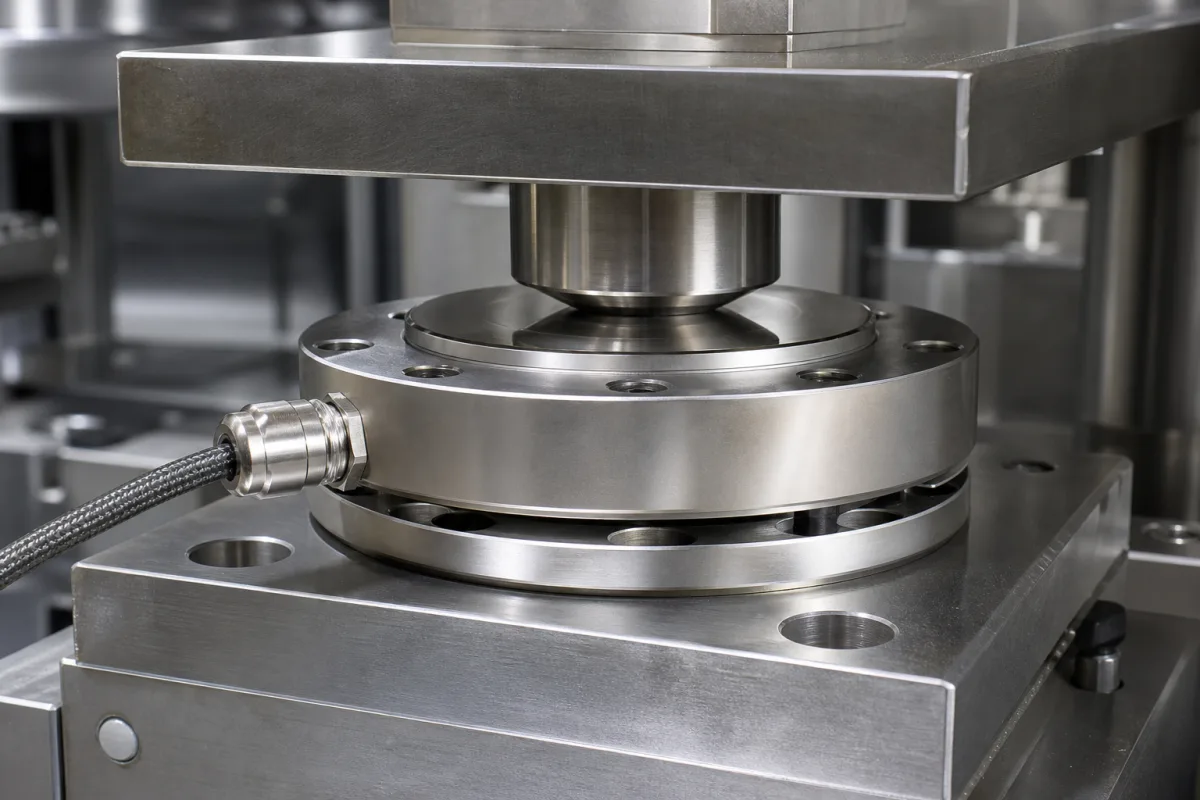
Force measurement · Capacity, rated output, error terms and temperature effects
A force sensor turns a tension or compression force into an electrical signal. Ask three things first: the rated capacity, direction and mounting, how much signal and error you can accept, and whether the force is static or fast-changing.
Strain-gauge force sensors and load cells (column, spoke, button, S-type, beam and multi-axis) used in machines, test rigs and process weighing, with a note on piezoelectric force sensors. Torque transducers, pressure sensors and complete scales are outside this page.
CNFX editorial research · Sources checked October 12, 2026 · 4 sources
A&D, a weighing equipment maker, defines rated capacity as the largest load a load cell can measure while meeting its specifications, and rated output, also called span, as the difference between no load and rated load, which A&D says “is generally expressed in output per excitation voltage (mV/V)”. Safe load limit is the load beyond rated capacity that causes no permanent damage. [1]
Manyyear's MLC400 compression load cell series, for example, lists 0.5 t to 1,200 t capacity, 1.0 or 2.0 mV/V rated output, 9–12 V DC excitation, 700 Ω input and output resistance and IP65 to IP68 versions. [2]
Editorial calculation: at 10 V excitation, a 2.0 mV/V cell gives 2.0 × 10 = 20 mV at rated load, and a 1.0 mV/V cell gives 10 mV. [2] Check that the amplifier or indicator resolves the force steps you need from that signal.
Give the supplier the force range, tension or compression, the mounting and load introduction, side loads, the required error, the temperature range, the signal or amplifier, and whether the force is static or dynamic.
02
Check error terms and temperature effects
A&D defines nonlinearity as the largest deviation from a straight line between zero and rated output on increasing load, hysteresis as the largest difference between increasing and decreasing load, and repeatability as the largest difference for the same load; it notes that OIML judges nonlinearity and hysteresis together against an error limit. Temperature effects on zero and on rated output are drifts with ambient temperature, and the compensated range is where the specifications apply. [1]
The MLC400 series lists 0.05–0.1% FS nonlinearity and hysteresis, 0.03–0.1% FS repeatability, creep of 0.03–0.1% FS over 10 minutes, a −10 to +40 °C compensated range and 0.05% FS per 10 °C temperature effect on both zero and span. [2]
Editorial calculation: a 30 °C swing with 0.05% FS/10 °C on zero gives 3 × 0.05 = 0.15% FS of zero drift; on a 10 t cell that is about 15 kg. [2] Re-zeroing before each measurement, or a cell with a lower coefficient, reduces this.
For fast force, Brans lists a piezoelectric tension and compression sensor from 1 to 60 kN with 2–3.5 pC/N output, natural frequency above 10 kHz, and nonlinearity, hysteresis and repeatability each of 1% FS or less; it describes this for dynamic and fatigue testing. [3]
03
Compare what suppliers offer
Suppliers linked to this page list load cells, force sensors and multi-axis force/torque sensors. [4][2]
GALOCE lists miniature, force-washer, tension-compression, rope-tension, load-pin and three- and six-axis force sensors, and a spoke-type GSS406 cell rated 5–2,000 kN with 2.0 ± 0.2 mV/V and IP65; Manyyear lists button, tension and compression force cells; Brans lists column, donut, pancake and piezoelectric sensors; HAIBO, Labirinth, Mavin, Zhihe and Zhimin list beam, S-type, button and column load cells; Heli, Chengzhou and Hanwei list six-axis force/torque sensors; Zero Instrument lists strain-gauge and piezoelectric force sensors. [4][2][3]
04
Trace the sensor components
This is a functional reference built from the sources cited; it is not one maker's parts list.
Part
Role
Fix in the order
Spring element
Deforms in proportion to force; e.g. alloy or stainless steel. [2]
Fill the specification fields with values for your application
A force sensor quotation needs values for your force and system. The table explains each field, gives published values where a reviewed source states them, and says what to obtain from the supplier.
Explore company information and manufacturing capabilities, then discuss the scope of your project with a relevant supplier.
Share this page
Compiled and source-reviewed by the CNFX editorial team.
Published product pages show what a company offers, not tested performance. Confirm the legal seller, factory and scope for your order. How we source and review
· Page last updated 13 October 2026
Buyer questions
What does 2 mV/V mean on a load cell?
It is the rated output per volt of excitation; at 10 V excitation a 2 mV/V cell gives about 20 mV at rated load. [1][2]
What is the difference between nonlinearity and hysteresis?
Nonlinearity is deviation from a straight line on increasing load; hysteresis is the difference between increasing and decreasing load at the same force. [1]
When should I use a piezoelectric force sensor?
For fast dynamic force; one supplier's piezoelectric sensor lists natural frequency above 10 kHz and charge output in pC/N. [3]
Sources and what still needs a direct check
Sources checked 2026-10-12. A&D is a weighing equipment maker explaining load cell terms. Manyyear, Brans and GALOCE are suppliers listed on this page; their values are catalogue figures.