Editorial Technical Reference

Carriage / Flying Frame

This page explains how Carriage / Flying Frame is classified within Machinery and Equipment Manufacturing. Technical values and manufacturer relationships are research references; confirm the current specification and supplier evidence for each order.

Technical Definition & Core Assembly

A moving frame assembly that transports material or tools during cutting operations.
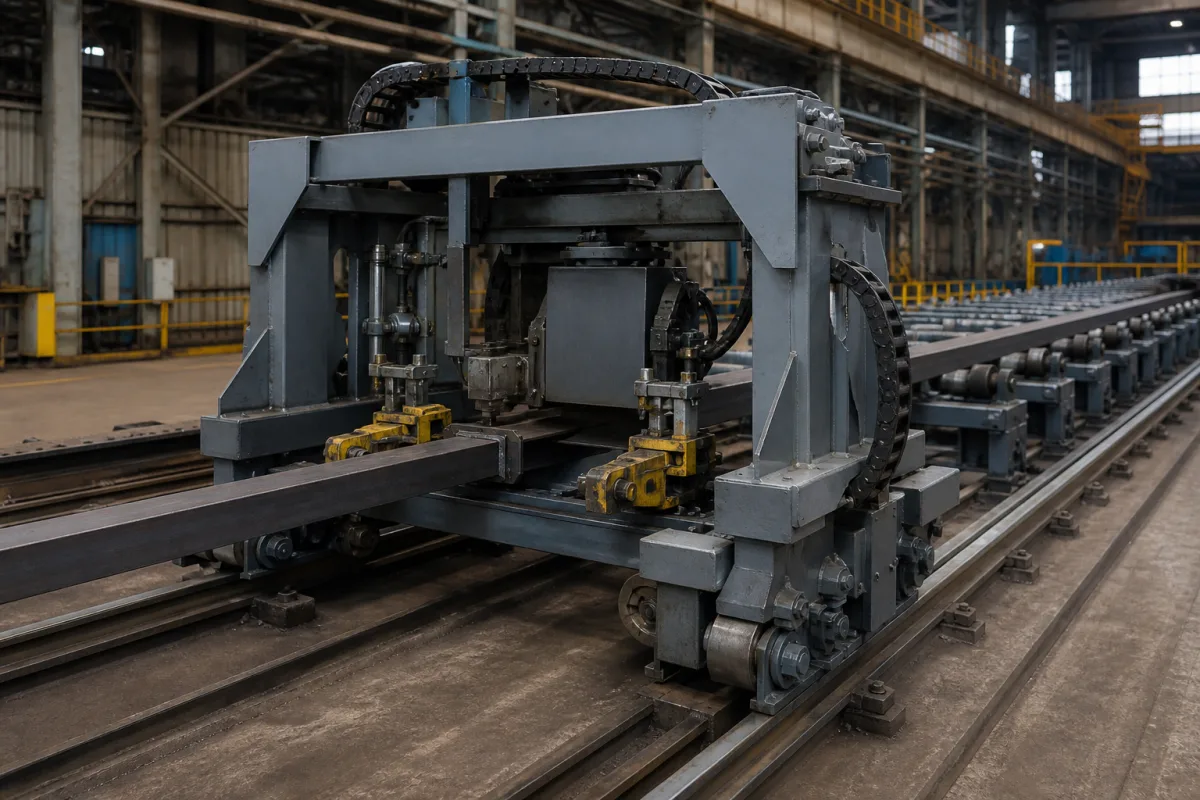
Carriage / Flying Frame in a manufacturing environment
Representative product image. Confirm appearance and specifications with the manufacturer.

Product Specifications

Technical details and manufacturing context for Carriage / Flying Frame

Definition
The carriage or flying frame is a critical component within cutting systems that provides precise linear motion to position cutting tools or hold workpieces. It typically moves along rails or guides to enable accurate cutting paths and patterns. This component is used in machinery such as plasma cutters, waterjet cutters, laser cutters, and CNC routers, where it carries either the cutting torch or the workpiece across the cutting area. The carriage is designed to maintain stability and rigidity while moving, ensuring that the cutting process remains accurate and repeatable. It is typically constructed from aluminum alloy or steel, with the frame material often specified as Q235B steel, though stainless steel may be optional. The carriage is available in various configurations to accommodate different load capacities, travel speeds, and positioning accuracies. Key parameters include a load capacity of 500–2000 kg, a travel speed of 0.5–5 m/min (adjustable via VFD), positioning accuracy of ±0.05 mm under no-load conditions, and repeatability of ±0.02 mm for high-precision cutting. The drive power ranges from 1.5–5.5 kW, and the supply voltage is 380 V AC ±10% (three-phase, 50/60 Hz). The operating temperature range is -10°C to 50°C, with the note that lubricants may thicken below -10°C. The ingress protection rating is IP54–IP65, suitable for dusty environments. The rail width matches linear guides of 18–55 mm, and the weight without load is 150–600 kg. These values are reference ranges and must be confirmed for the specific model and application. Always verify model-specific values and standards with the legal manufacturer or supplier.
Working Principle
The carriage/flying frame operates by converting rotational motion from motors into linear movement through mechanical transmission systems such as ball screws, belts, or rack-and-pinion mechanisms. The motor drives the transmission, which moves the carriage along rails or guides. The control system regulates the motor speed and position to achieve the desired cutting path. The carriage maintains stability and precision while carrying cutting tools or materials across the cutting area. The design ensures minimal deflection and vibration, which is critical for accurate cutting. The system may include features like linear guides, bearings, and lubrication systems to reduce friction and wear. The carriage is typically driven by a servo or stepper motor, with the drive power ranging from 1.5 to 5.5 kW. The travel speed is adjustable via a variable frequency drive (VFD) to suit different cutting requirements. The positioning accuracy and repeatability are maintained through precise control and mechanical rigidity.
Common Materials
Aluminum alloy, Steel
Technical Parameters
ParameterTypical rangeNotes & selection driver
Load Capacity500–2000 kgMaximum load per carriage
Travel Speed0.5–5 m/minAdjustable via VFD
Positioning Accuracy±0.05 mmUnder no-load conditionsISO 230-2
Repeatability±0.02 mmFor high-precision cuttingISO 230-2
Drive Power1.5–5.5 kWDepends on load and speed
Supply Voltage380 ±10% V ACThree-phase, 50/60 HzIEC 60038
Operating Temperature-10–50 °CBelow -10°C lubricants may thicken
Ingress ProtectionIP54–IP65IP65 for dusty environmentsIEC 60529
Rail Width18–55 mmMatches linear guideGB/T 11264
Frame MaterialQ235BSteel; optional stainlessGB/T 700
Weight150–600 kgWithout load

Ranges are indicative industry figures for RFQ preparation, not a supplier commitment. Confirm every value and standard with the legal manufacturer before ordering.

Components / BOM
  • Guide Rails Part
    Provide smooth linear guidance for carriage movement
    Material: Hardened steel
  • Carriage Plate Part
    Main structural platform that supports cutting tools or workpieces
    Material: Aluminum alloy
  • Drive Mechanism
    Converts motor rotation into linear carriage movement
    Material: Steel
  • Bearings and Lubrication System Optional
    Cut friction and wear on long-stroke carriages that are ordered with them.

Application & selection

Application Fit & Sizing Matrix

Operational Limits
pressure: Atmospheric to 0.5 bar gauge
other spec: Max payload: 500 kg, Max speed: 2 m/s, Positioning accuracy: ±0.1 mm
temperature: -20°C to 80°C
Media Compatibility
✓ Sheet metal panels ✓ Composite materials ✓ Plastic sheets
Unsuitable: High-vibration environments with unsecured loads
Sizing Data Required
  • Maximum workpiece dimensions (LxWxH)
  • Required positioning accuracy
  • Cycle time requirements

Risk, maintenance & compliance

Reliability & Engineering Risk Analysis

Failure Mode & Root Cause
Structural fatigue cracking
Cause: Cyclic loading from repeated start-stop operations and vibration-induced stress concentrations at weld joints or material transitions
Bearing seizure or excessive wear
Cause: Inadequate lubrication, contamination ingress (dust/moisture), or misalignment leading to uneven load distribution and overheating
Maintenance Indicators
  • Visible cracks or deformation in structural members, especially at connection points
  • Abnormal grinding, screeching, or knocking sounds during operation indicating bearing failure or component interference
Engineering Tips
  • Implement regular vibration analysis and thermal imaging inspections to detect early-stage bearing degradation and alignment issues before catastrophic failure
  • Establish a preventive lubrication program with contamination control measures, using condition-based monitoring rather than fixed intervals to optimize maintenance timing

Indicative industry ranges for design and RFQ preparation. Confirm the exact figures and applicable standard with the manufacturer before specifying.

Compliance & Manufacturing Standards

Applicable Standards
ISO 2768-1: General tolerances for linear and angular dimensions ANSI B4.1: Preferred Limits and Fits for Cylindrical Parts

Quoted from the published standard.

Manufacturing Precision
  • Bore diameter: +/-0.02mm
  • Flatness of mounting surfaces: 0.1mm
Quality Inspection
  • Dye Penetrant Test for surface crack detection
  • Coordinate Measuring Machine (CMM) verification of dimensional accuracy
Technical documentation
Request current drawings, revision history, and a signed specification sheet.
Manufacturing capability
Verify equipment lists, process limits, capacity, and representative production evidence.
Inspection readiness
Confirm test methods, calibrated equipment, sampling plans, and traceable reports.
Supplier transparency
Check the legal entity, factory address, ownership, certifications, and direct contacts.

Compare the published product scope and source details, then include your specifications and quantity in an enquiry.

Manufacturers of Carriage / Flying Frame

Manufacturer profiles associated with Carriage / Flying Frame.

Sourcing Carriage / Flying Frame from China?
Tell us your specification and target quantity — we will match it against manufacturer records and come back with the factories that fit.
Request manufacturers We manufacture this

Explore company information and manufacturing capabilities, then discuss the scope of your project with a relevant supplier.

Buyer enquiry

Request manufacturing insight for Carriage / Flying Frame

Ask for use case, specification boundaries, supplier type, and RFQ preparation information for this product.

Where it goes
Straight to the CNFX editorial desk, and to the manufacturer if this product is linked to a claimed profile. Nothing is broadcast to a supplier list.
Your details stay here
We do not sell or rent enquiry data, and we do not add you to a mailing list. Used only to answer this request.
No commission, no middleman
CNFX is a directory. We take no cut of any order and never negotiate on a supplier's behalf.
What to include
Share your product specifications, quantity, destination and target delivery date.

Your business information is used only to process this request.

Thank you! Your message has been sent. We'll respond within 1–3 business days.
Sorry, we couldn't send your message. Please try again, or email us at [email protected].

Frequently Asked Questions

What is the typical load capacity of a carriage/flying frame?

The load capacity is typically in the range of 500–2000 kg, but this depends on the specific model and configuration. Always verify the exact capacity with the manufacturer for your application.

What materials are used for the carriage frame?

The frame is commonly made of aluminum alloy or steel. The steel grade is often Q235B, but stainless steel may be optional. Confirm the material specification with the supplier.

What is the positioning accuracy of the carriage?

Under no-load conditions, the positioning accuracy is ±0.05 mm, and repeatability is ±0.02 mm for high-precision cutting. These values are reference ranges and should be verified for the specific model.

What are the electrical requirements for the carriage drive?

The drive power ranges from 1.5 to 5.5 kW, and the supply voltage is 380 V AC ±10% (three-phase, 50/60 Hz). Ensure your facility meets these requirements and confirm with the manufacturer.

Related equipment

Applied To / Applications

This component is essential for the following industrial systems and equipment:

Industrial Ecosystem & Supply Chain Structure

Industry Taxonomies & Aliases

Commonly used trade names and technical identifiers for Carriage / Flying Frame.

Data Basis

Editorial classification, named public sources where available, and source-reviewed manufacturer records.

Preliminary Technical Classification
This page supports structured research, RFQ preparation, and supplier evaluation. It does not replace buyer-led supplier qualification, standards review, or technical approval.

Need to Manufacture Carriage / Flying Frame?

Compare manufacturer profiles with relevant product and process capability.

Previous Product
Z-axis Ram/Spindle
Last Product
Get QuotesChat