Industry-Verified Manufacturing Data (2026)

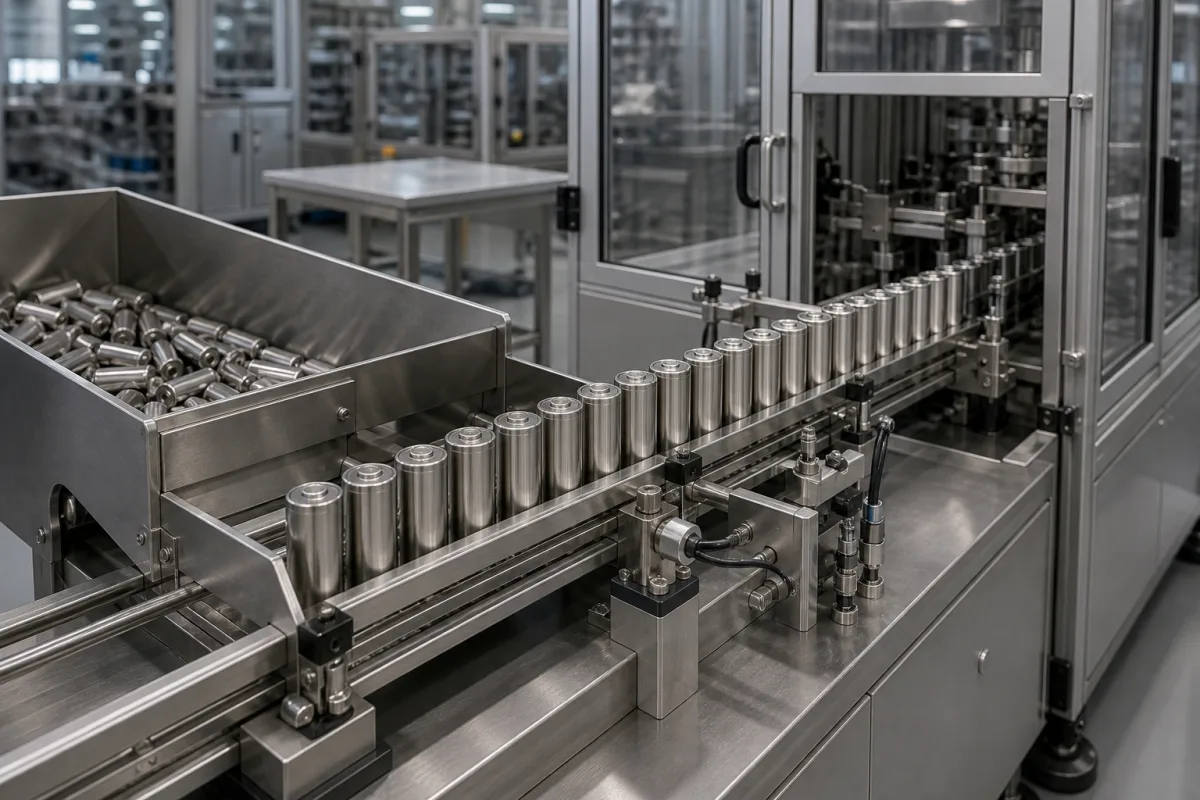
Cell Feeder/Input Conveyor

Based on aggregated insights from multiple verified factory profiles within the CNFX directory, the standard Cell Feeder/Input Conveyor used in the Machinery and Equipment Manufacturing sector typically supports operational capacities ranging from standard industrial configurations to heavy-duty production requirements.

Technical Definition & Core Assembly

A canonical Cell Feeder/Input Conveyor is characterized by the integration of Drive Motor and Conveyor Belt/Roller Bed. In industrial production environments, manufacturers listed on CNFX commonly emphasize Stainless Steel (AISI 304/316) construction to support stable, high-cycle operation across diverse manufacturing scenarios.

A conveyor system component that feeds and transports cells into an automated sorting station.
Product Specifications

Technical details and manufacturing context for Cell Feeder/Input Conveyor

Definition
The Cell Feeder/Input Conveyor is a critical component of the Automated Cell Sorting Station, responsible for the controlled introduction and transportation of cell samples from the loading point to the initial processing or sorting area. It ensures a consistent, regulated flow of material into the system for subsequent analysis and separation.
Working Principle
The conveyor typically operates using a motor-driven belt, roller, or vibratory mechanism. It receives cell samples (often in containers, on slides, or within a fluid stream) from an upstream process or manual loading zone and transports them at a controlled speed and alignment into the detection or sorting zone of the Automated Cell Sorting Station.
Common Materials
Stainless Steel (AISI 304/316), Food-Grade/Medical-Grade Polymer Belting
Technical Parameters
  • Conveyor width and length dimensions to accommodate standard sample carriers or fluidic paths. (mm) Per Request
Components / BOM
  • Drive Motor
    Provides the mechanical power to move the conveyor belt or rollers.
    Material: Steel housing, copper windings
  • Conveyor Belt/Roller Bed
    The surface upon which cell samples are transported; designed for cleanliness and sample integrity.
    Material: Stainless steel rollers or FDA-approved polymer belt
  • Frame/Chassis
    Provides structural support and alignment for all conveyor components.
    Material: Powder-coated steel or stainless steel
Engineering Reasoning
0.5-2.0 m/s linear velocity, 0.1-1.0 kN belt tension, 0-60°C ambient temperature
Belt tension exceeding 1.2 kN causes permanent deformation, linear velocity below 0.3 m/s causes cell jamming, ambient temperature above 70°C degrades polymer components
Design Rationale: Exceeding yield strength of belt material (typically 15-25 MPa for polyurethane), thermal expansion coefficient mismatch (steel frame: 12×10⁻⁶/°C vs polymer belt: 80×10⁻⁶/°C), static friction coefficient dropping below 0.4 at high temperatures
Risk Mitigation (FMEA)
Trigger Misalignment exceeding 0.5 mm/m between conveyor frame and sorting station entry
Mode: Cell trajectory deviation causing collision with station walls
Strategy: Laser alignment system with 0.1 mm precision and automatic frame adjustment actuators
Trigger Electrostatic charge accumulation exceeding 10 kV on polymer belt surface
Mode: Cell adhesion to belt causing feed interruption
Strategy: Integrated ionizing blower system maintaining surface potential below 500 V

Industry Taxonomies & Aliases

Commonly used trade names and technical identifiers for Cell Feeder/Input Conveyor.

Applied To / Applications

This component is essential for the following industrial systems and equipment:

Industrial Ecosystem & Supply Chain DNA

Complementary Systems
Downstream Applications
Specialized Tooling

Application Fit & Sizing Matrix

Operational Limits
pressure: Atmospheric operation only, no pressure rating required
flow rate: Up to 500 cells/minute (configurable)
temperature: 0°C to 50°C (32°F to 122°F)
vibration tolerance: ≤ 0.5g at 10-100 Hz
slurry concentration: Up to 20% solids by volume
Media Compatibility
✓ Pharmaceutical cell suspensions ✓ Biological culture media ✓ Food-grade particulate slurries
Unsuitable: Corrosive chemical environments (pH < 4 or > 10)
Sizing Data Required
  • Cell size/diameter range (μm)
  • Required throughput (cells/hour)
  • Upstream/downstream equipment interface dimensions

Reliability & Engineering Risk Analysis

Failure Mode & Root Cause
Belt misalignment and tracking failure
Cause: Worn or damaged idler rollers, improper tensioning, material buildup on pulleys, or structural misalignment leading to belt edge damage and premature wear
Bearing seizure in drive or tail pulley assemblies
Cause: Contamination from dust/abrasive materials, inadequate lubrication, moisture ingress, or excessive loading causing overheating and eventual catastrophic failure
Maintenance Indicators
  • Abnormal squealing or grinding noises from drive components indicating bearing distress or belt slippage
  • Visible material spillage along conveyor path or excessive vibration suggesting misalignment, belt damage, or structural issues
Engineering Tips
  • Implement precision laser alignment for all pulleys and idlers during installation/maintenance, and establish routine infrared thermography inspections to detect abnormal bearing temperatures before failure
  • Install automatic belt tracking systems with immediate feedback loops, and use wear-resistant liners/coatings on high-abrasion areas while maintaining strict contamination control through effective sealing and filtration

Compliance & Manufacturing Standards

Reference Standards
ISO 3409:2017 (Conveyor belts - Electrical conductivity) ANSI/CEMA 402-2003 (Belt Conveyors) DIN 22101 (Continuous conveyors - Belt conveyors for bulk materials)
Manufacturing Precision
  • Belt tracking alignment: +/- 3 mm
  • Roller concentricity: 0.05 mm TIR
Quality Inspection
  • Non-destructive testing (NDT) for weld integrity
  • Dimensional verification with laser alignment

Factories Producing Cell Feeder/Input Conveyor

Verified manufacturers with capability to produce this product in China

✓ 92% Supplier Capability Match Found

P Project Engineer from United States Feb 06, 2026
★★★★★
"Standard OEM quality for Machinery and Equipment Manufacturing applications. The Cell Feeder/Input Conveyor arrived with full certification."
Technical Specifications Verified
S Sourcing Manager from United Arab Emirates Feb 03, 2026
★★★★★
"Great transparency on the Cell Feeder/Input Conveyor components. Essential for our Machinery and Equipment Manufacturing supply chain."
Technical Specifications Verified
P Procurement Specialist from Australia Jan 31, 2026
★★★★★
"The Cell Feeder/Input Conveyor we sourced perfectly fits our Machinery and Equipment Manufacturing production line requirements."
Technical Specifications Verified
Verification Protocol

“Feedback is collected from verified sourcing managers during RFQ (Request for Quote) and factory evaluation processes on CNFX. These reports represent historical performance data and technical audit summaries from our B2B manufacturing network.”

18 sourcing managers are analyzing this specification now. Last inquiry for Cell Feeder/Input Conveyor from UAE (1h ago).

Supply Chain Compatible Machinery & Devices

Automated Assembly Line System

Integrated production system for sequential component assembly operations

Explore Specs →
Automated Powder Coating System

Integrated industrial system for applying dry powder coatings to metal substrates.

Explore Specs →
Centrifugal Pump Impeller

Rotating component that transfers energy to fluid in centrifugal pumps.

Explore Specs →
High-Precision CNC Laser Cutting Machine

Computer-controlled industrial machine using focused laser beams to cut sheet metal with micron-level accuracy.

Explore Specs →

Frequently Asked Questions

What materials are used in this cell feeder conveyor?

Constructed with corrosion-resistant stainless steel (AISI 304/316) frames and food-grade or medical-grade polymer belting for hygienic, durable performance in sensitive environments.

How does this conveyor integrate with automated sorting stations?

The cell feeder conveyor is designed to seamlessly feed and transport cells into automated sorting systems, with adjustable speed controls and precise positioning for optimal sorting accuracy and workflow efficiency.

What maintenance does the conveyor system require?

Minimal maintenance is needed thanks to stainless steel construction and high-quality components. Regular cleaning of polymer belting and periodic inspection of the drive motor and roller bed ensure long-term reliability.

Can I contact factories directly on CNFX?

CNFX is an open directory, not a transaction platform. Each factory profile provides direct contact information and production details to help you initiate direct inquiries with Chinese suppliers.

Get Quote for Cell Feeder/Input Conveyor

Request technical pricing, lead times, or customized specifications for Cell Feeder/Input Conveyor directly from verified manufacturing units.

Your business information is encrypted and only shared with verified Cell Feeder/Input Conveyor suppliers.

Thank you! Your message has been sent. We'll respond within 1–3 business days.

Need to Manufacture Cell Feeder/Input Conveyor?

Connect with verified factories specializing in this product category

Add Your Factory Contact Us
Previous Product
Case Positioning Fixture
Next Product
Cement Conveyor