Industry-Verified Manufacturing Data (2026)

Feedback Interface (Encoder Input)

Based on aggregated insights from multiple verified factory profiles within the CNFX directory, the standard Feedback Interface (Encoder Input) used in the Machinery and Equipment Manufacturing sector typically supports operational capacities ranging from standard industrial configurations to heavy-duty production requirements.

Technical Definition & Core Assembly

A canonical Feedback Interface (Encoder Input) is characterized by the integration of Signal Conditioning Circuit and A/D Converter (if applicable). In industrial production environments, manufacturers listed on CNFX commonly emphasize PCB (Printed Circuit Board) construction to support stable, high-cycle operation across diverse manufacturing scenarios.

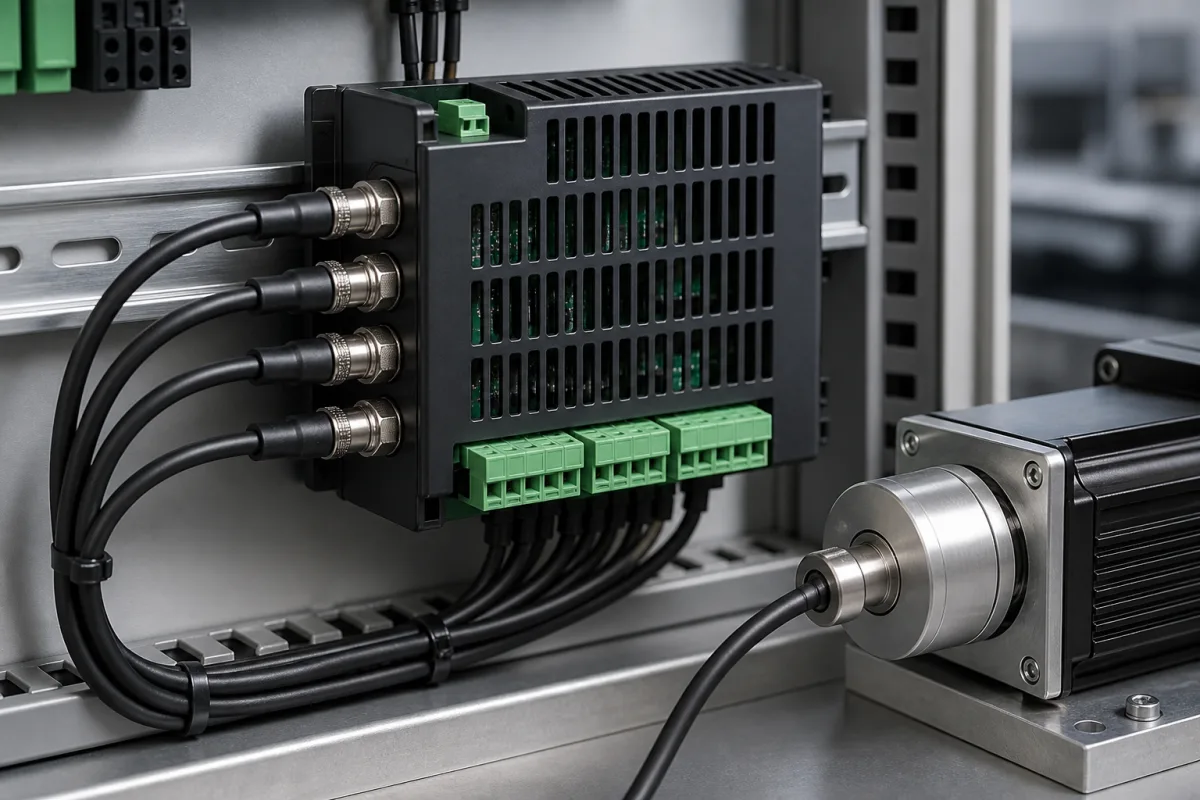
Interface component in CNC control systems that receives and processes position/speed feedback signals from rotary or linear encoders.
Product Specifications

Technical details and manufacturing context for Feedback Interface (Encoder Input)

Definition
A critical electronic interface within CNC control units that accepts analog or digital feedback signals from position/speed encoders, converts them to usable data formats, and transmits processed information to the controller for closed-loop motion control, ensuring precise machine tool positioning and velocity regulation.
Working Principle
Receives electrical signals (typically quadrature, sine/cosine, or serial data) from encoders measuring axis position/speed, performs signal conditioning (amplification, filtering, noise reduction), converts analog signals to digital data when needed, and transmits processed position/velocity information to the CNC controller via standardized communication protocols for real-time motion correction.
Common Materials
PCB (Printed Circuit Board), Electronic components (ICs, resistors, capacitors), Connector housing
Technical Parameters
  • Maximum input signal frequency supported by the interface (MHz) Customizable
Components / BOM
  • Signal Conditioning Circuit
    Amplifies, filters, and shapes raw encoder signals to eliminate noise and ensure signal integrity
    Material: Electronic components on PCB
  • A/D Converter (if applicable)
    Converts analog encoder signals to digital data for processing by the controller
    Material: Integrated circuit
  • Communication Interface
    Transmits processed feedback data to the CNC controller via standard protocols (e.g., Ethernet, fieldbus)
    Material: Communication IC and connectors
  • Power Supply Circuit
    Provides regulated power to interface components and may supply power to encoders
    Material: Voltage regulators and power components
Engineering Reasoning
0.5-5.0 V differential signal, 100 kHz-10 MHz frequency range, -40°C to +85°C ambient temperature
Signal amplitude below 0.3 V or above 5.5 V, common-mode voltage exceeding ±12 V, differential phase error >15°, temperature >90°C
Design Rationale: Electromagnetic interference coupling into differential signal lines, thermal expansion mismatch between IC package and PCB causing solder joint fatigue, dielectric breakdown in input protection diodes at >15 V transients
Risk Mitigation (FMEA)
Trigger Ground loop currents inducing >100 mV common-mode noise on encoder cables
Mode: Signal comparator false triggering causing position count errors
Strategy: Galvanic isolation with 2.5 kV rated optocouplers, twisted-pair shielding with 360° connector termination
Trigger ESD events exceeding 8 kV HBM on encoder input pins
Mode: Input protection diode avalanche breakdown creating low-impedance path
Strategy: TVS diodes with 6.8 V clamping voltage, series 100 Ω resistors before input buffer

Industry Taxonomies & Aliases

Commonly used trade names and technical identifiers for Feedback Interface (Encoder Input).

Applied To / Applications

This component is essential for the following industrial systems and equipment:

Industrial Ecosystem & Supply Chain DNA

Complementary Systems
Downstream Applications
Specialized Tooling

Application Fit & Sizing Matrix

Operational Limits
voltage: 5V DC ±5% or 24V DC ±10% depending on model
temperature: -10°C to +70°C operating, -40°C to +85°C storage
noise immunity: Minimum 500V/μs common mode rejection
signal frequency: Up to 1 MHz maximum input frequency
Media Compatibility
✓ Incremental quadrature encoder signals (A/B/Z) ✓ Absolute encoder serial protocols (SSI, BiSS, EnDat) ✓ Resolver/synchro analog signals
Unsuitable: High-voltage industrial environments (>600V AC) without proper isolation barriers
Sizing Data Required
  • Encoder signal type and protocol
  • Required resolution (bits or pulses per revolution)
  • Maximum operating speed (RPM or linear velocity)

Reliability & Engineering Risk Analysis

Failure Mode & Root Cause
Signal Degradation
Cause: Contamination of optical surfaces or electrical contacts leading to intermittent or weak signal transmission
Mechanical Wear
Cause: Excessive vibration or misalignment causing bearing failure or shaft deformation in rotary encoders
Maintenance Indicators
  • Inconsistent or erratic feedback readings during operation
  • Unusual grinding, clicking, or whining noises from the encoder housing
Engineering Tips
  • Implement regular cleaning protocols for optical/contact surfaces using manufacturer-approved solvents and methods
  • Ensure proper alignment and mounting with vibration-damping hardware, and monitor vibration levels with periodic checks

Compliance & Manufacturing Standards

Reference Standards
ISO 9001:2015 - Quality Management Systems ANSI/ASME B46.1 - Surface Texture DIN 32711 - Encoders for Rotating Shafts
Manufacturing Precision
  • Shaft Bore: +/-0.01mm
  • Mounting Surface Flatness: 0.05mm
Quality Inspection
  • IP67 Environmental Sealing Test
  • Signal Accuracy Verification Test

Factories Producing Feedback Interface (Encoder Input)

Verified manufacturers with capability to produce this product in China

✓ 94% Supplier Capability Match Found

P Procurement Specialist from United Arab Emirates Jan 27, 2026
★★★★★
"As a professional in the Machinery and Equipment Manufacturing sector, I confirm this Feedback Interface (Encoder Input) meets all ISO standards."
Technical Specifications Verified
T Technical Director from Australia Jan 24, 2026
★★★★★
"Standard OEM quality for Machinery and Equipment Manufacturing applications. The Feedback Interface (Encoder Input) arrived with full certification."
Technical Specifications Verified
P Project Engineer from Singapore Jan 21, 2026
★★★★★
"Great transparency on the Feedback Interface (Encoder Input) components. Essential for our Machinery and Equipment Manufacturing supply chain."
Technical Specifications Verified
Verification Protocol

“Feedback is collected from verified sourcing managers during RFQ (Request for Quote) and factory evaluation processes on CNFX. These reports represent historical performance data and technical audit summaries from our B2B manufacturing network.”

16 sourcing managers are analyzing this specification now. Last inquiry for Feedback Interface (Encoder Input) from UAE (1h ago).

Supply Chain Compatible Machinery & Devices

Hydraulic Press

Industrial machine using hydraulic pressure to compress, form, or assemble materials

Explore Specs →
Heavy-Duty CNC Plasma Cutting Machine

Industrial machine for precision metal cutting using plasma arc technology

Explore Specs →
Automated Assembly Line System

Integrated production system for sequential component assembly operations

Explore Specs →
Automated Powder Coating System

Integrated industrial system for applying dry powder coatings to metal substrates.

Explore Specs →

Frequently Asked Questions

What is the primary function of a feedback interface in CNC machinery?

The feedback interface receives and processes position and speed signals from encoders, converting them into digital data for the CNC controller to ensure precise motion control and positioning accuracy in manufacturing equipment.

What materials are typically used in manufacturing feedback interface components?

Standard materials include PCB (Printed Circuit Board) for the base, electronic components like ICs, resistors, and capacitors for signal processing, and connector housings for secure electrical connections in industrial environments.

How does the signal conditioning circuit improve encoder feedback accuracy?

The signal conditioning circuit filters, amplifies, and converts raw encoder signals to clean, standardized levels, reducing noise and interference to ensure reliable data transmission to the CNC controller for optimal machinery performance.

Can I contact factories directly on CNFX?

CNFX is an open directory, not a transaction platform. Each factory profile provides direct contact information and production details to help you initiate direct inquiries with Chinese suppliers.

Get Quote for Feedback Interface (Encoder Input)

Request technical pricing, lead times, or customized specifications for Feedback Interface (Encoder Input) directly from verified manufacturing units.

Your business information is encrypted and only shared with verified Feedback Interface (Encoder Input) suppliers.

Thank you! Your message has been sent. We'll respond within 1–3 business days.

Need to Manufacture Feedback Interface (Encoder Input)?

Connect with verified factories specializing in this product category

Add Your Factory Contact Us
Previous Product
Feedback Interface
Next Product
Feedback Processing Unit