Continuous tablet coating drums · tablets fed in at one end and coated on the way through a long perforated drum, throughput in kg/h, weir-set bed depth, spray zone along the drum, passes per tablet and solids per pass
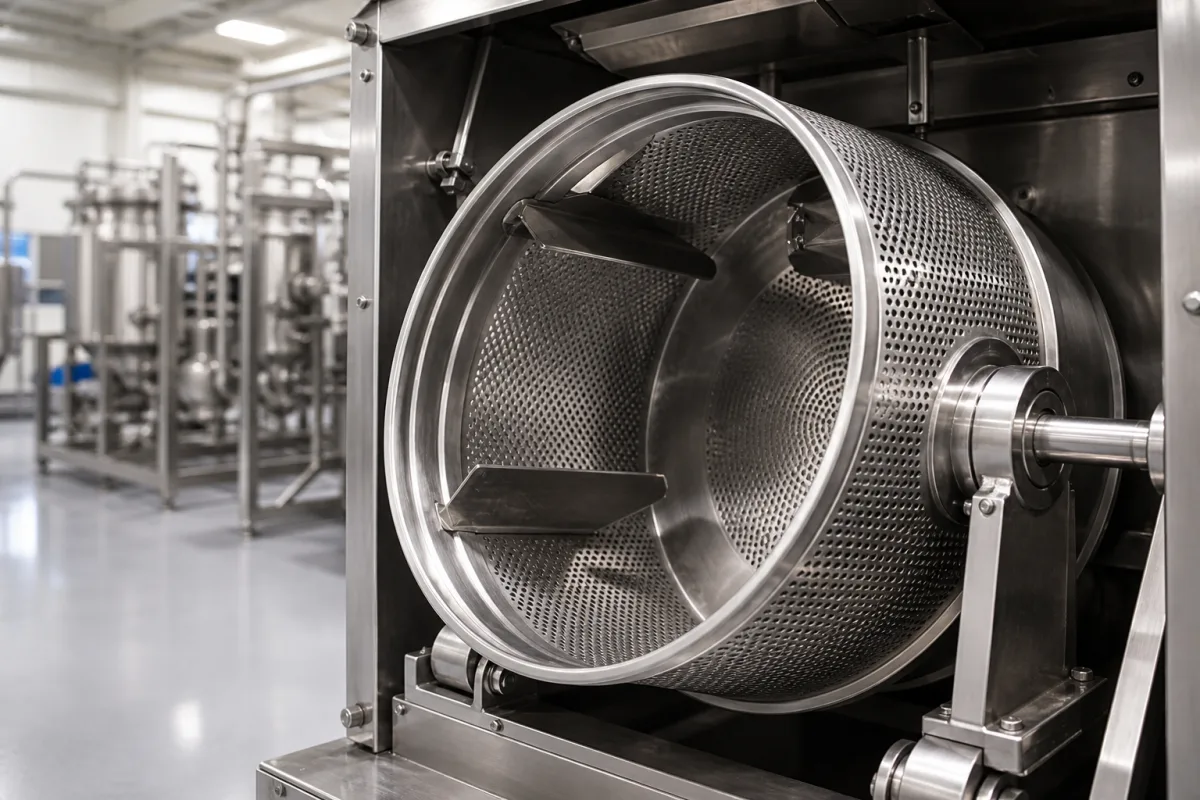
A coating drum here is the drum of a continuous tablet coater: a long, perforated, rotating drum that tablets enter at one end from a tablet press or feeder and leave at the other, coated by a row of spray guns along the drum while hot air dries them. Instead of a batch size it has a throughput in kg/h, and the weir at the discharge end sets how deep the bed runs. Ask three things first: what throughput and weight gain the line needs, how the bed depth and residence time are controlled, and how start-up and shut-down tablets are kept within specification.
Drums and drum modules of continuous and continuous-batch tablet film coaters, with their weirs, spray zone along the drum and throughput control. Batch perforated coating pans and exchangeable drum sets are covered on the Coating pan page; automated batch film coaters on the Automated pharmaceutical tablet coating system page; spray gun manifolds on the Tablet coating spray system page; complete batch and continuous pan coaters, sized by pan charge, drying air and spray rate, are covered on the Pharmaceutical tablet coating machine (pan coater) page; rotary drums for coating fertiliser granules are outside this page.
Start with your task
01
O'Hara Technologies builds Fastcoat continuous coaters for "75, 500 and 1200 kilograms per hour nominal throughput" and says continuous coating "requires a shallower tablet bed, which leads to less product damage" and "allows tablets to pass under the anti-bearding spray nozzles at a higher frequency". Its features include "automatically adjustable tablet bed depth via patented weir system", automated bed tilting, Zero Waste start-up and shut-down, 316L product contact surfaces, two peristaltic solution pumps and aqueous or solvent designs, and it can also run as an automated batch coater, so that batch size "is determined by time instead of the physical size of the coating pan". [1]
IMA's Croma continuous coater moves tablets "in a continuous flow through a rotating perforated drum" swept by hot air and past spray guns; each Croma module has an average throughput range of 30-80 kg/h depending on achievable weight gain, spray rate, polymer content and tablet shape, and higher throughput or weight gain is reached by combining modules. IMA reports that raising throughput and so lowering residence time did not affect the final surface appearance in its trials. [2]
Give the coater maker the tablet throughput from the press, tablet size, shape and friability, target weight gain and coating suspension solids, aqueous or solvent coating, how the coater is fed and discharged, start-up and shut-down handling, and whether it must also run in batch mode.
02
A Colorcon presentation at PQRI compares a 60-inch batch pan with a 24-inch continuous pan (data from Mancoff, 1998): the continuous pan has a 100 × 3 inch spray zone against 36 × 3 inches, turns at 12 rpm against 5, holds 3,000 tablets in the spray zone against 1,080, exposes 905,000 tablets a minute against 340,000, and with 100 kg in the pan against 350 kg gives 0.28 minutes between passes against 2.57, 35.3 passes per tablet against 13.2, and 0.11 mg of solids per pass against 0.30. At 1% weight gain and 13% solids sprayed at 0.8 kg/min, the batch pan needs 34 minutes of coating while the continuous pan delivers 624 kg/h. [3]
Editorial check of those figures: 0.8 kg/min × 13% ÷ 1% = 10.4 kg/min, or 624 kg/h of tablets; and 350 kg × 1% ÷ 13% ÷ 0.8 kg/min ≈ 34 minutes for the batch pan, to which the presentation adds 20 minutes for loading, heating, cooling and unloading. [3]
03
| Item | Published value | Source |
|---|---|---|
| Nominal throughput | 75, 500, 1,200 kg/h (O'Hara FCC sizes). | [1] |
| Throughput per module | 30-80 kg/h (IMA Croma). | [2] |
| Bed depth control | Patented adjustable weir. | [1] |
| Spray zone | 100 × 3 in on a 24-in continuous pan. | [3] |
| Passes per tablet | 35.3 continuous vs 13.2 batch. | [3] |
| Solids per pass | 0.11 mg continuous vs 0.30 mg batch. | [3] |
04
Paste it into your enquiry below or into an email to a maker, then replace every bracket.
Throughput: [kg/h from press; range] Tablets: [size; shape; friability] Coating: [weight gain; solids; aqueous or solvent] Bed: [weir control; residence time] Operation: [start-up and shut-down; batch mode] Integration: [feed; discharge; controls] Quantity: [coaters]
Manufacturer profiles associated with Coating Drum.
Explore company information and manufacturing capabilities, then discuss the scope of your project with a relevant supplier.
Tablets flow through it at a set throughput instead of being loaded as a batch; batch pans and exchangeable drums are on the Coating pan page. [1] [2]
O'Hara builds continuous coaters for 75, 500 and 1,200 kg/h; IMA's Croma modules run 30-80 kg/h each. [1] [2]
O'Hara adjusts tablet bed depth automatically with a patented weir system. [1]
Colorcon's comparison gives 35.3 passes per tablet with 0.11 mg per pass in a continuous pan against 13.2 passes and 0.30 mg in a batch pan. [3]
Sources checked 2026-10-12. O'Hara Technologies and IMA publish their continuous coaters; Colorcon presented a batch-versus-continuous comparison at PQRI.
Ask for use case, specification boundaries, supplier type, and RFQ preparation information for this product.
Compare manufacturer profiles with relevant product and process capability.