Keeping a control network running through a broken cable
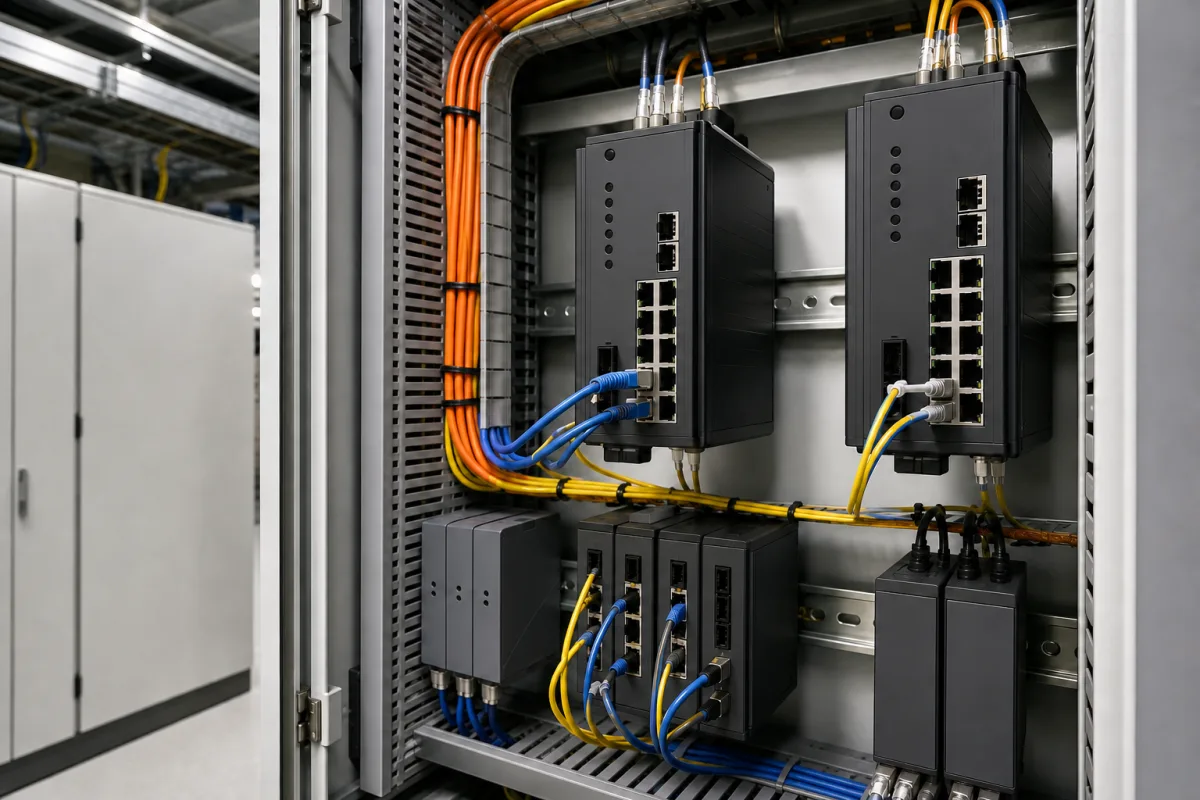
In a process control system the communication network links controllers, I/O, drives and operator stations through switches like the managed and unmanaged units in the illustrated cabinet. A single broken patch lead, fibre or switch should not stop the plant, and the redundancy method decides whether communication pauses for a fraction of a second or not at all. Siemens' PROFINET material describes ring redundancy with MRP and MRPD; ZHAW's network engineering institute and the IEC 62439-3 abstract describe PRP and HSR.
Covers redundancy of Ethernet-based control networks in process control systems: MRP ring redundancy and its reconfiguration time, MRPD for IRT traffic, PRP with two independent LANs, HSR rings, RedBoxes for single-port devices, and what each method asks of switches and end devices. Selecting the industrial Ethernet switches themselves (managed vs unmanaged, temperature range, EMC, power input) is on Industrial Network Switch (4740); protocol analysers for testing networks on Network Protocol Analyzer (288).
CNFX editorial research · Sources checked October 13, 2026 · 3 sources
Four ways to survive a single failure: from 200 ms to zero
The methods differ in whether the network has to reconfigure after a failure. MRP finds the break and opens a path; MRPD, PRP and HSR deliver every frame on two paths, so the receiver simply keeps the copy that arrives.
The 200 ms of MRP is the figure to set against the plant's tolerance: on that figure, a controller or I/O device set to declare a communication fault in less than 200 ms would trip during a ring recovery even though the ring repairs itself (editorial reading). The duplicated methods avoid that window at the cost of carrying every frame twice.
Method
Topology
Behaviour on a single failure
Stated limit
MRP (Media Redundancy Protocol)
Ring with one redundancy manager
Manager opens its blocked ring port; network recovery takes up to 200 ms
50 subscribers for the 200 ms figure (Siemens)
MRPD
Ring, PROFINET IRT traffic
Cyclic IRT frames sent in both directions; reconfiguration time of 0 ms possible
Max. 32 devices (Siemens)
PRP (Parallel Redundancy Protocol)
Two completely independent LANs, A and B, any topology
Every frame sent on both LANs; receiver keeps the first and discards the second
IEC 62439-3: seamless switchover, zero recovery time
HSR (High-availability Seamless Redundancy)
Ring of two-port nodes, or meshed multi-port nodes
Every frame sent both ways round the ring; receiver keeps the first
IEC 62439-3: seamless switchover, zero recovery time
Siemens gives 200 ms for 50 subscribers; recovery times for other device counts, switch types and protocol settings come from the switch maker.
02
An MRP ring: test frames from the manager, one blocked port, up to 200 ms to reopen it
Siemens describes MRP as the ring redundancy method of PROFINET applications, run by one redundancy manager in the ring.
In the illustrated cabinet, a ring would run through the two managed switches and onward over the fibre links at the top; one of them, or a controller, takes the manager role.
Siemens also shows segmenting a production network into cells joined by PN/PN couplers; a ring per cell keeps each ring within its device limit.
State
What the redundancy manager does
Ring intact
Sends test messages from each of its ring ports; while they arrive at the other port it knows the ring is closed, and keeps one ring port blocked so frames cannot circulate indefinitely
Break in the ring
Test messages stop arriving, so the manager opens the blocked port; devices beyond the break are reached the other way round
Recovery time
Network recovery (reconfiguration) up to 200 ms with 50 subscribers
With IRT (MRPD)
Cyclic IRT frames duplicated in both directions; devices receive the frame on both ring ports, so there is no remodelling time; max. 32 devices
Whether a device in the ring counts toward the limit, and the watchdog setting it needs to ride through a reconfiguration, should be confirmed in the controller and switch manuals.
03
PRP and HSR: every frame twice, nothing to reconfigure
ZHAW's Institute of Embedded Systems describes both as handling single network failures of cables, power supplies or switches without interruption; IEC 62439-3 standardises them with zero recovery time.
The costs follow from the frame handling. PRP doubles the network: with two completely independent LANs, every switch and cable exists twice, and each LAN carries the full traffic once (Editorial reading of ZHAW's description). In HSR, a multicast or broadcast frame goes all the way round in both directions before the sender removes it, so each ring link carries every such frame twice (Editorial calculation).
Existing single-port PLCs and I/O can join through a RedBox: they keep their one port, and ZHAW notes that they then appear to the other nodes as Virtual Dual Attached Nodes.
Item
PRP
HSR
Network
Two completely independent LANs (LAN_A, LAN_B) in parallel, topology free
One ring; frames travel both directions
End devices
Dual Attached Nodes (DANs) with one port on each LAN
Two-port nodes forward frames round the ring
Frame handling
Sent on both LANs; receiver accepts both and ignores the later copy
Sent both ways; unicast removed by the receiver, multicast and broadcast by the sender; receiver keeps the first copy; HSR frames carry an extra header
Single-port devices
RedBox connects them to both LANs; they appear as Virtual DANs; RedBox duplicates, filters and sends supervision frames for them
RedBox performs the HSR functions for the devices behind it
Implementation
Additional software layer or upstream hardware (RedBox)
HSR-capable nodes or RedBox
ZHAW describes the RedBox as also able to appear as an independent DAN for network management; check that the switch management system supports this.
04
What to state when specifying a redundant control network
Paste it into your enquiry below or into an email to a maker, then replace every bracket.
State the tolerable communication interruption for the controllers and I/O, the protocol (PROFINET RT or IRT, EtherNet/IP, Modbus TCP, IEC 61850 or other), device count per ring or segment, how many devices have one port, distances and fibre or copper per link, and cabinet temperature. Ask for the redundancy method supported (MRP manager or client, MRPD, PRP, HSR, RedBox), its recovery time at your device count, port counts, and how the switches report a broken ring or failed LAN.
2 companies list this product among what they make. Company figures are quoted from each
company's own website; every card states where the relationship came from.
GLSUN (Guilin GLSUN Science and Tech Group Co.,Ltd)
TBC
GLSUN lists optical switches, optical line protection equipment and modules, fibre bypass modules and fibre monitoring systems. Use in plant control networks and switchover times are not stated; TBC. Location TBC.
Chenmai describes the communication network as one of three parts of its sluice and pumping-station monitoring systems, carrying field data to the monitoring centre and remote control back. Network type and redundancy TBC; location TBC.
Explore company information and manufacturing capabilities, then discuss the scope of your project with a relevant supplier.
Share this page
Compiled and source-reviewed by the CNFX editorial team.
Each manufacturer above links to the page on that company's own website where the product is listed, with the date we checked it. How we source and review
· Page last updated 13 October 2026
Buyer questions
How fast does an MRP ring recover?
Siemens gives network recovery (reconfiguration) of up to 200 ms for an MRP ring with 50 subscribers. [1]
Is there a ring method without recovery time?
Yes. Siemens' MRPD sends cyclic IRT frames in both directions so a reconfiguration time of 0 ms is possible, with a maximum of 32 devices; HSR also sends every frame both ways round the ring. [1][2]
What does PRP need?
Two completely independent LANs, end devices with a port on each (DANs), or a RedBox for single-port devices; the receiver keeps the first copy of each frame and ignores the second. [2]
Which standard covers PRP and HSR?
IEC 62439-3:2021, which specifies both as redundancy protocols that give seamless switchover with zero recovery time when any network element fails. [3]
Sources and what still needs a direct check
Sources checked 2026-10-13. A Siemens PROFINET presentation for ring redundancy, a university network-engineering institute for PRP and HSR, and the IEC catalogue entry for IEC 62439-3.