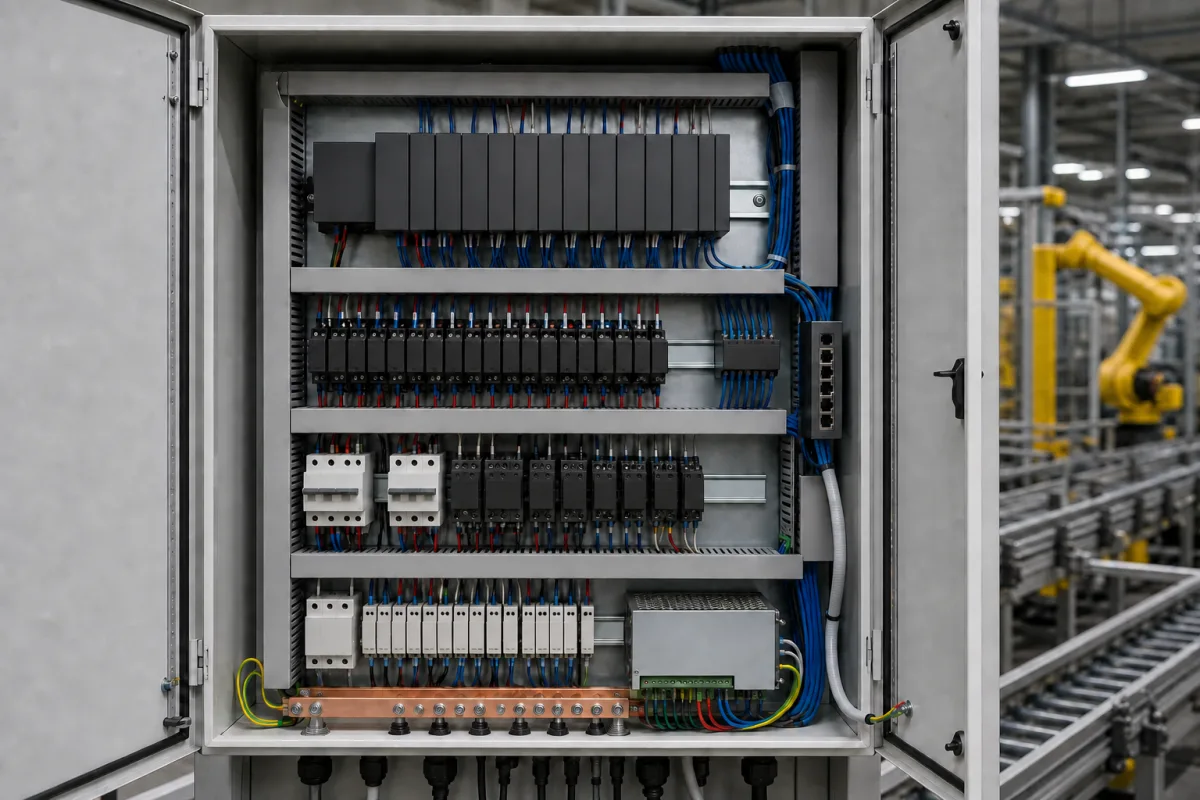
PLC control cabinet: controller mounting space and the 24 V DC control power behind it
The PLC end of a control cabinet · mounting space round the controller, heat per watt of electronics, and the 24 V DC supply and DC UPS that keep the CPU running
A PLC control cabinet is the panel built round a programmable controller: the CPU and its I/O modules on a DIN rail, the 24 V DC supply that powers them, and in some panels a DC UPS so the controller rides through a mains dip. The controller and its modules are open-type equipment, so the cabinet supplies their environment and their power. This page deals with that PLC end of the cabinet: how much space and surface the controller needs, what its DC power input demands, and how the 24 V supply and a battery buffer are chosen.
The controller end of a PLC cabinet: mounting space and orientation for the CPU and local I/O, heat-based sizing of an unventilated metal cabinet from the watts its controller and devices dissipate, the 24 V DC control supply, and DC UPS buffering of the controller. Wiring segregation, grounding and noise suppression inside PLC panels are covered on the PLC control panel page; IP rating, cooling equipment and short-circuit current rating for low-voltage control panels as a whole are covered on the Control cabinet page.
CNFX editorial research · Sources checked October 12, 2026 · 3 sources
Give the controller 25 mm at the sides and 50 mm above and below, low in the cabinet
For a CompactLogix 5480 controller mounted alone, Rockwell Automation's installation instructions require at least 25 mm (0.98 in) between the sides and the cabinet, 25 mm between the front of the controller and the cabinet, and 50 mm (1.96 in) above and below. They recommend mounting it near the bottom of the enclosure because the air is hotter at the top. [1]
The same instructions state that the controller accepts up to 31 local Compact 5000 I/O modules to its right, that the DIN rail must be horizontal once local I/O modules are fitted, and that the DIN rail should be secured to the mounting surface about every 200 mm. The controller is rated for 0 to 60 °C surrounding air, has no enclosure type rating (open style) and is intended for pollution degree 2 and overvoltage category II. [1]
To size a metal cabinet without active cooling, the instructions give A = 0.38Q / (1.80T − 1.10), where A is the exterior surface in m², Q the heat generated inside in watts and T the allowed rise of inside air over outside ambient in °C. Their worked example takes the controller's 72 W, a 60 °C rating and a 20 °C outside temperature (T = 40), giving a minimum surface of 0.386 m²; a 304.8 × 355.6 × 154.2 mm cabinet offers 0.4204 m² with all six sides counted. [1] The example warns that the cabinet must be larger if any side cannot transfer heat, if more equipment is added, or if the outside air is warmer than 20 °C. [1]
The supply's 31.2 W is an editorial calculation from Mean Well's typical efficiency (next section); a real panel adds the I/O modules, relays, drives and network switch to Q.
02
Size the 24 V DC supply for controller power, inrush and its own losses
The CompactLogix 5480 takes its module (MOD) power at 18 to 32 V DC, with a maximum power of 72 W, a typical current of 4 A, an inrush of 4 A for 15 ms, and a limit of 10 A drawn through the MOD power terminal block, which also passes power on to the I/O modules. [1] Field-side (SA) power for the I/O can be 0 to 32 V DC or 0 to 240 V AC; where the I/O needs both AC and DC, a field potential distributor separates the groups. [1]
As an example of a DIN-rail supply that can feed such a controller, Mean Well's NDR-240-24 delivers 24 V at 10 A (240 W), adjustable from 24 to 28 V, with 150 mVp-p maximum ripple and noise. It accepts 90 to 264 V AC or 127 to 370 V DC, has a typical efficiency of 88.5%, a typical inrush of 35 A at 230 V AC, a hold-up time of 28 ms at 230 V AC at full load, and works from −20 to +70 °C following a derating curve. [2] Overload protection limits current at 105 to 130% of rated power, and over-voltage protection on the 24 V model acts at 29 to 33 V. [2]
Editorial calculation: at full 240 W output and 88.5% efficiency the supply draws about 271.2 W and turns about 31.2 W into heat inside the cabinet; the controller's 72 W maximum is 30% of the supply's rating.
State the controller and I/O power per supply, the cabinet temperature at which the supply's derating curve is read, and whether the 24 V must survive mains interruptions longer than the supply's hold-up time.
03
Bridge mains dips beyond 28 ms with a DC UPS module and battery
The NDR-240's 28 ms hold-up covers a short dip only. [2] A DC UPS module sits between the 24 V supply and the load and switches to a battery when the DC bus falls. Mean Well's DR-UPS40 is rated 40 A on a 24 to 29 V DC bus, works with external 24 V batteries of 4, 7 or 12 Ah, and charges them at a typical 2 A. [3]
Its three relay outputs (rated 30 V DC, 1 A) can be wired into PLC inputs: DC BUS OK closes when the bus is between 21 and 29 V (±3%), BATTERY FAIL closes when the battery falls below 21.9 V (±3%) or fails the battery test, and BATTERY DISCHARGE closes while the battery is supplying the load. The module is 55.5 mm wide, works from −20 to +70 °C and mounts on TS35/7.5 or TS35/15 rail. [3]
Editorial calculation, ideal upper bound ignoring battery ageing, discharge losses and the 21.9 V cut-off: the controller's 72 W at 24 V is 3 A, so a 7 Ah battery could carry the controller alone for at most about 2.3 h; at the 2 A charge current, refilling 7 Ah takes at least 3.5 h. Real run time is shorter and should be taken from the battery maker's discharge data.
Use the BATTERY DISCHARGE contact to let the PLC program save data and bring the machine to a defined stop before the battery cut-off.
04
Data for a PLC control cabinet enquiry
Paste it into your enquiry below or into an email to a maker, then replace every bracket.
Controller: [make, family, CPU; number and type of local I/O modules]
Mounting: [DIN rail orientation; space available; clearances required by the controller maker]
24 V DC load: [controller, I/O, HMI, switch in W; inrush]
Supply: [input voltage; rating; redundancy]
Buffering: [ride-through time; DC UPS; battery Ah; status signals to PLC]
Cabinet: [ambient temperature range; IP rating; cooling allowed; list of devices with dissipation in W]
1 company lists this product among what they make. Company figures are quoted from each
company's own website; every card states where the relationship came from.
Sichuan Rongteng Automation Equipment Co., Ltd.
Manufacturing site to be confirmed for the order
Lists PLC control cabinets for gas and LNG plants among its automation control products, alongside soft-start and variable-frequency control cabinets.
Explore company information and manufacturing capabilities, then discuss the scope of your project with a relevant supplier.
Share this page
Compiled and source-reviewed by the CNFX editorial team.
Each manufacturer above links to the page on that company's own website where the product is listed, with the date we checked it. How we source and review
· Page last updated 13 October 2026
Buyer questions
How much space does a CompactLogix 5480 controller need in the cabinet?
At least 25 mm at the sides and front and 50 mm above and below, mounted near the bottom of the enclosure where the air is cooler. [1]
What does the controller ask of the 24 V supply?
18 to 32 V DC module power, up to 72 W, typical 4 A with 4 A inrush for 15 ms, and no more than 10 A through the MOD power terminal block. [1]
How much heat does a 240 W DIN-rail 24 V supply add?
Editorial calculation: about 31 W at full load, using Mean Well's typical 88.5% efficiency for the NDR-240-24. [2]
How can the PLC know it is running on battery?
A DC UPS module such as the DR-UPS40 has relay contacts for DC bus OK, battery fail and battery discharge that can be wired to PLC inputs. [3]
Sources and what still needs a direct check
Sources checked 2026-10-12. Clearance, heat sizing and controller power come from Rockwell Automation's CompactLogix 5480 installation instructions; the 24 V supply and DC UPS examples are Mean Well's NDR-240 and DR-UPS40 specifications. Values apply to the products named.