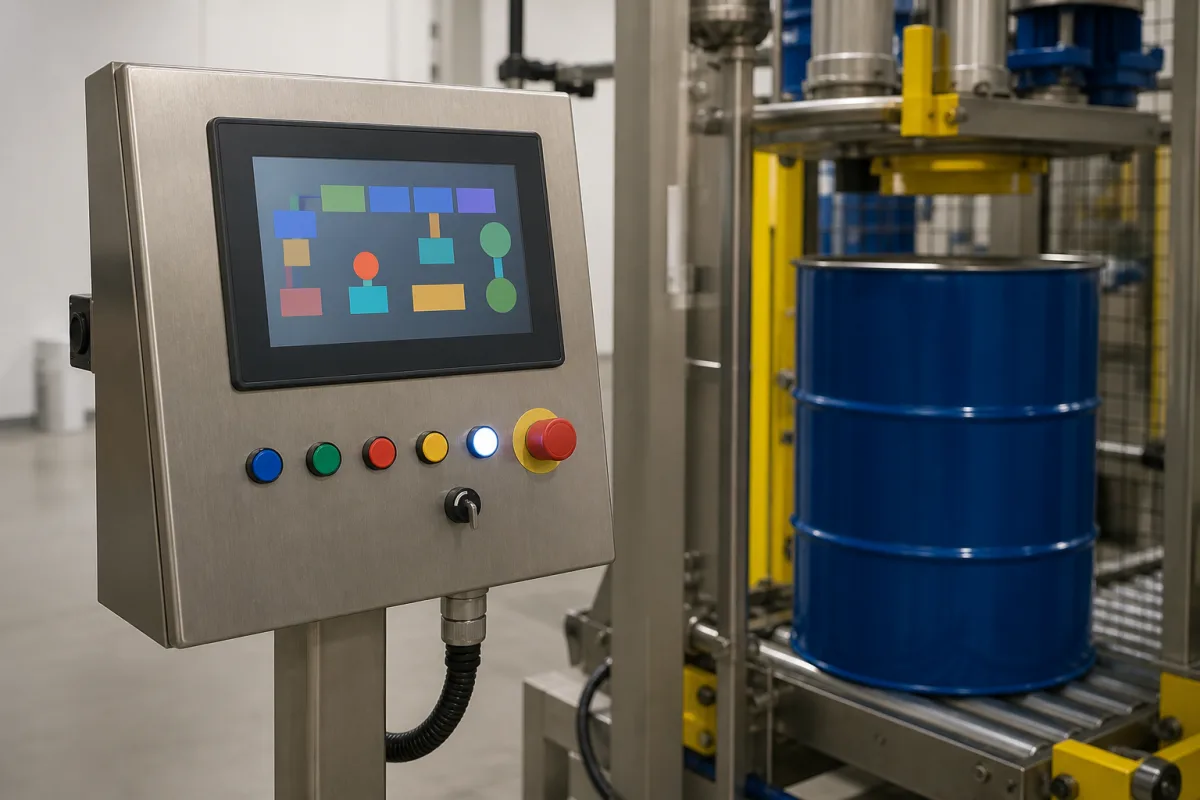
Local control panel at a single machine station: local-versus-central command, key or RFID mode selection, and actuator life on the panel
The pedestal or machine-side panel at one station of a line · who may command the station from where, how the operating mode is chosen and locked, and how many operations the key switch and buttons are rated for
A local control panel sits at the station it controls, so the person loading a drum, changing a seal head or clearing a jam can see the danger zone while pressing the button. That position raises three questions the line's main control desk does not: when the local panel has command, what happens to the commands from everywhere else; how the panel switches the station between automatic, setting and service modes and who is allowed to do it; and whether the key switch and buttons on it will last the number of operations the station will put through them. The answers below come from the EU Machinery Directive text, two Pilz product announcements and an Eaton data sheet.
Local (station-mounted) control panels on pedestals, frames or machine guards that command one station of a machine or line, such as a filling, closing or sealing station: the rule that one control position excludes the others, local operating-mode selection by lockable key switch or RFID key reader, and the mechanical ratings of the key switches, selector switches and pushbuttons fitted. Operator touch panels and text panels as such are covered on the Human-machine interface (HMI) page; support-arm and pedestal operating housings that combine a touch panel with an emergency stop on the HMI interface operator station page; stainless washdown terminals on the Stainless steel washdown HMI page; control-room consoles and pushbutton and pilot-light colours on the Control Console page; door-mounted displays on the Rear-mount HMI panel page; the pedestal box itself on the Operator-station mounting enclosure page; drum lid presses and closing-ring stations on the Sealing station for open-head drums page; alarm handling on the Control interface panel for process monitoring page.
CNFX editorial research · Sources checked October 13, 2026 · 4 sources
When the station panel takes command, every other control position must drop out except stop and emergency stop
A station with its own panel is also reachable from the line's main desk, an HMI elsewhere or a handheld unit. Annex I of the EU Machinery Directive 2006/42/EC, section 1.2.2, says that where there is more than one control position, the control system must be designed so that the use of one of them precludes the use of the others, except for stop controls and emergency stops. [1]
The same section asks that, from each control position, the operator can ensure no one is in the danger zones, or that starting is prevented while someone is there; where neither is possible, an acoustic and/or visual warning must be given before the machinery starts, and exposed persons must have time to leave the danger zone or prevent start-up. If necessary, control may be restricted to positions in one or more predetermined zones or locations. [1] A panel placed at the station, with a clear view of the drum or container under the head, is one way of meeting the first of these conditions; a panel on the far side of a guard is not.
Section 1.2.4.1 adds that each workstation must be fitted with a control device to stop some or all of the functions of the machinery, depending on the existing hazards, and section 1.2.4.4 requires that where machines are designed to work together, the stop controls, including emergency stops, can stop not only the machine itself but also related equipment if its continued operation may be dangerous. [1] For a station panel on a conveyor-fed line, that means deciding whether its stop halts only the station or the infeed conveyor as well.
Section 1.2.2 also says that when machinery has two or more operating positions, each position must be provided with all the required control devices without the operators hindering or putting each other into a hazardous situation. [1]
State on the order which functions the local panel may command, which remain with the central desk, how the transfer between local and remote is made and indicated, and which stop functions on the local panel reach upstream and downstream equipment.
02
Automatic, setting and service at the station: a lockable selector switch, or an RFID key that also says who may choose
Section 1.2.5 of Annex I requires machinery that can be used in more than one control or operating mode needing different protective measures to have a mode selector that can be locked in each position, each position clearly identifiable and corresponding to a single mode. The selected mode must override all others except the emergency stop. The selector may be replaced by another method that restricts certain functions to certain categories of operator. [1]
Where the station has to run with a guard removed or a protective device disabled, for example to set a closing head, the directive lists four things the selected mode must do at the same time: disable all other modes, allow hazardous functions only through controls requiring sustained action, allow them only under reduced-risk conditions while preventing hazards from linked sequences, and prevent hazardous functions being started by action on the machine's sensors. If these four cannot all be met, the selector must activate other protective measures that ensure a safe intervention zone, and the operator must be able to control the parts being worked on from the adjustment point. [1] The last sentence is the case for putting the selector and the hold-to-run controls on the local panel rather than at a remote desk.
Pilz's PITmode, announced in 2010, combined mode selection and access authorisation in one unit: the operator inserts an individually coded RFID transponder key and presses the pushbutton for the wanted mode, the evaluation device identifies the selected mode, and the RFID principle removes the mechanical wear of a key switch. [2]
Its 2019 modular successor, PITmode fusion, separates an RFID reader (PITreader) from a safe evaluation unit so that the reader can be built into an existing control console. Pilz says up to five safe operating modes can be defined, such as automatic, manual intervention under restricted conditions or service, with functionally safe mode selection and access permission up to PL d; keys can carry a password-protected company-specific signature, and permissions can be assigned to groups instead of individuals. [3]
List the modes the station needs (for example automatic, setting with guard open, cleaning, service), which operator groups may select each, whether a mechanical key switch or an RFID reader is wanted, and the performance level the mode selection must reach.
03
A key-operated switch is rated for 100,000 operations, a momentary pushbutton for 5 million: Eaton C22 figures for the devices on one panel
The devices on a local panel are not equally durable. Eaton's 22.5 mm C22 compact range, listed against IEC/EN 60947 and VDE 0660, gives different mechanical lives, operating frequencies and enclosure ratings for each actuator type on the same panel. [4]
The same sheet lists all these actuators at an AC-15 rated operational current of 1.5 A at 230 V and 4 A at 24 V, DC-13 3 A at 24 V, an open ambient range of –25 to 70 °C, and 30 g shock resistance (11 ms half-sine). For low-energy PLC inputs it gives statistically determined contact reliability of one failure in 17 × 10⁶ operations for a normally open contact and one in 0.9 × 10⁶ for a normally closed contact, at 17 V DC / 7 mA. [4]
Editorial calculation: a mechanical key switch used as the mode selector, switched 30 times a day (an example value: ten mode changes in each of three shifts), reaches the 100,000-operation rating after about 3,300 days, or roughly nine years; at 100 changes a day (also an example value) it reaches it in under three years. A momentary start button pressed 2,000 times a day (example value) would take about 6.8 years to reach 5 million. Figures from the Eaton C22 table. [4]
Editorial note: in this table the key-operated button is rated IP66 and the selector actuator IP65, while the pushbuttons and emergency stop are also rated IP69K; where the station is washed down, check the key switch and selector against the cleaning method, or consider a reader without a key slot such as the RFID approach described above. [4][2]
Ask the panel builder for the device maker's data on each actuator fitted: mechanical life, operating frequency, front IP rating and contact reliability at the PLC input current used.
04
Data the panel builder needs for one station
Paste it into your enquiry below or into an email to a maker, then replace every bracket.
Station: [machine and station; what is filled, closed or sealed]
Command: [functions on the local panel; functions kept at the central desk; local/remote transfer and indication]
Stops: [which equipment the local stop and emergency stop halt]
Modes: [list of modes; who may select each; key switch or RFID reader; performance level]
Devices: [display; pushbuttons; selector; key switch; emergency stop; expected operations per day]
Environment: [mounting on pedestal or guard; washdown; temperature; enclosure rating]
Interface: [PLC inputs and outputs; voltage; fieldbus]
Explore company information and manufacturing capabilities, then discuss the scope of your project with a relevant supplier.
Share this page
Compiled and source-reviewed by the CNFX editorial team.
Each manufacturer above links to the page on that company's own website where the product is listed, with the date we checked it. How we source and review
· Page last updated 13 October 2026
Buyer questions
Can a local control panel and the main control desk both start the same station?
Annex I, section 1.2.2 of the EU Machinery Directive says that where there is more than one control position, using one must preclude the use of the others, except for stop controls and emergency stops. [1]
Does the operating-mode selector on a local panel have to be a key switch?
Section 1.2.5 requires a selector lockable in each position but allows another selection method that restricts functions to categories of operator. Pilz's PITmode fusion does this with coded RFID keys, up to five modes and up to PL d. [1][3]
How long does a key switch on a control panel last?
Eaton's C22 data sheet rates its key-operated button at 0.1 × 10⁶ mechanical operations and at least 100 operations per hour, against 5 × 10⁶ for a momentary pushbutton. [4]
Sources and what still needs a direct check
Sources checked 2026-10-13. Four sources from three publishers: the text of Annex I of the EU Machinery Directive 2006/42/EC as published on legislation.gov.uk, for control positions, stopping and mode selection; two Pilz announcements published by Process Online, on the PITmode RFID mode selector (2010) and its modular PITmode fusion successor (2019); and Eaton's C22 compact pushbutton data sheet (catalogue CA04700001E), for device life, frequency, ratings and contact reliability.