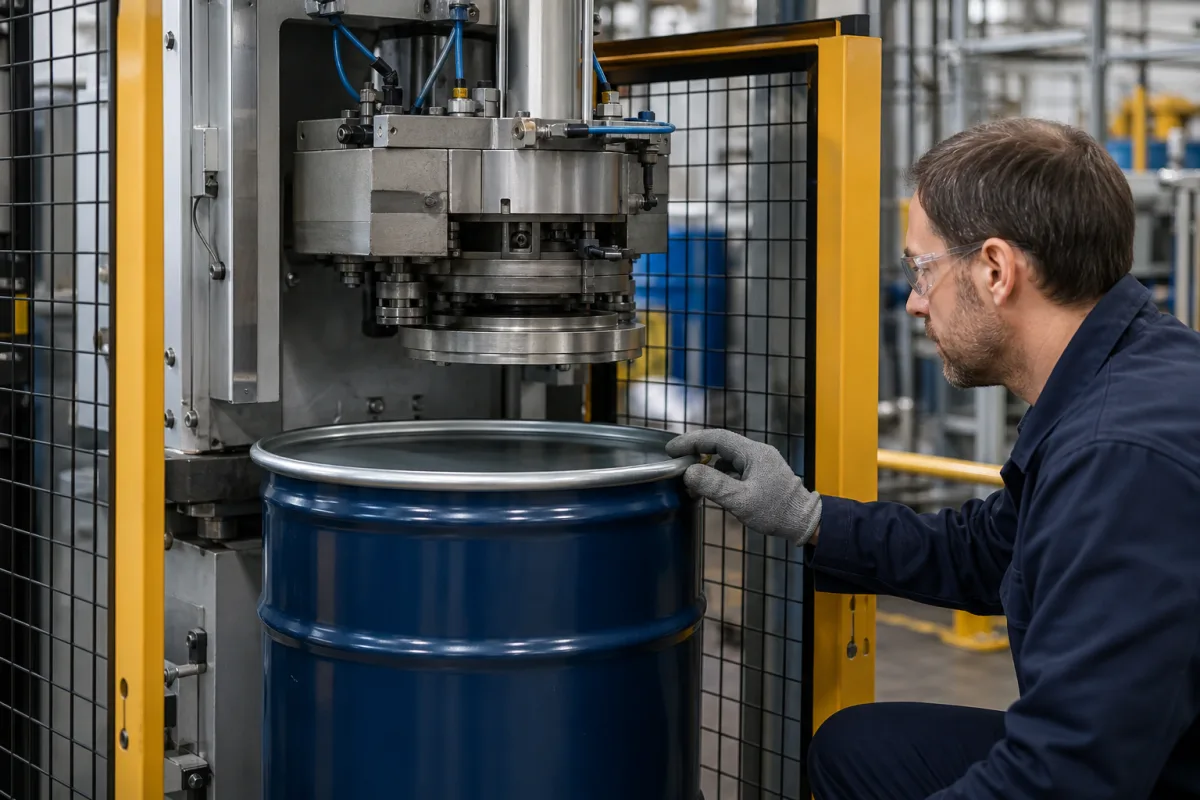
Sealing station for open-head drums: lid press and closing-ring station for removable-head steel drums
Closing removable-head steel drums · head compression before the ring goes on, ring-end gap of 1/8 to 1/4 in, bolt torque by ring type, and lever-lock rings
On a removable-head drum the lid is held by a split ring clamped round the rolled rim, and the gasket under the lid only seals if it is squeezed before that ring is tightened. A sealing station for these drums is a press that pushes the lid down onto the gasket, seats the ring in the right place round the lid-to-body joint, and holds everything compressed while the bolt or lever is closed. What it has to achieve is set by the drum maker's closing instructions, not by the machine builder.
Lid presses, head compressors and ring-placing stations that close removable-head (open-head) steel drums with bolt or lever-lock closing rings after filling, as a station in a line or as a stand-alone press. Filling lances, weighing and bung capping on complete lines are covered on the Automated chemical drum filling and sealing system page; heated sealing heads that weld film lids onto cups and trays are covered on the Sealing head for cup and tray lidding machines page. Drum manufacture, crimped pail lids and tight-head drum bung plugs are outside this page.
CNFX editorial research · Sources checked October 13, 2026 · 4 sources
Why the lid has to be pressed down before the closing ring can grip
Self Industries' US patent 5,533,316 (1996) explains the geometry: the drum's rolled rim, the uncompressed gasket and the lid together are taller than the cross-section of the split closing ring, so the ring cannot properly grasp lid and rim until the gasket is compressed. Placed by hand on an uncompressed head, the ring only lies beside the joint, and the patent reports conveyor vibration moving it above or below the joint on the way to the next station. [3]
The patented station mounts its working parts on a press plate driven vertically by a pneumatic cylinder. A press ring under the plate, sized to sit on the lid just inside its mating groove, pushes the lid down onto the gasket while ring expanders open the split ring held by magnets above it; pins then push one side of the ring down into place and the other side immediately after, and clamp levers squeeze the ring against lid and drum, drawing its ends together so a worker can fit the bolt. Optical sensors and escapement arms on the roller conveyor hold the next drum back until the sealed one has left the press, and sliding safety shields guard the worker positions. [3]
The patent's background gives one drum every 6 seconds as the arrival rate at the sealing area of a conveyor line, and notes that manual ring placement is too slow for that pace and needs more than one worker. Editorial calculation: one drum every 6 seconds is 3,600 ÷ 6 = 600 drums an hour, so press, ring placement and bolting all have to fit inside 6 seconds or be split across stations. [3]
The image shows a pneumatic press head over an open-head drum in a guarded cell. Ask whether the station only compresses the head, also places the ring, or also runs the bolt down, and what is left to the operator.
02
Ring-end gap, bolt torque and lever latching set by the drum maker
Mauser Packaging Solutions' closing instructions for UN 1A1/1A2 steel drums (MC/PAS-QA-101 Rev. 11, 2023) make the station mandatory for one ring type: on drums with 12-gauge forged-lug rings, a mechanical head-compressing device is required to get proper gasket compression, the bolt is tightened while the cover is being compressed, and drums closed without one may not perform to the certified level. For lighter rings with lugs, a head compressor is preferred, but tightening while tapping the ring all round with a non-sparking mallet is accepted. [1]
The two makers' bolt-ring rules differ: Mauser sets the closure by ring-end gap and uses torque only when the gap cannot be reached, while Skolnik's procedure, revised in 2006, uses stabilised torque as the closing requirement. A station that closes drums from more than one maker therefore needs the target for each drum type, not one setting. [1][2]
Editorial calculation: 1/8 in is about 3.2 mm and 1/4 in about 6.4 mm of ring-end gap; 55–60 ft-lb is about 75–81 N·m, 60–65 ft-lb about 81–88 N·m and 70–75 ft-lb about 95–102 N·m (1 ft-lb = 1.356 N·m). [1][2]
Skolnik also tells shippers to recheck closure torque after filling and before transport, because heating, cooling and gasket relaxation can leave a closure needing re-tightening, and states that any change to the closing method or closure components changes the packaging design type and invalidates its certification. [2]
Closure
Closing target
Source
Bolt ring with jam nut (Mauser)
Ring-end gap 1/4 in or less, aiming for 1/8 in, without bending the lugs; ends must not touch [1]
Mauser
Bolt ring over a poly liner bag (Mauser)
Gap 1/2 in or less, liner seated evenly over the curl [1]
Mauser
Fallback torque when the gap cannot be reached (Mauser, 55-gallon)
5/16 in bolt 7–9 ft-lb; 3/8 in bolt 12–16 ft-lb; 12-gauge forged-lug ring with 5/8 in bolt 60–65 or 70–75 ft-lb by manufacturing plant [1]
Mauser
Solid Seal bolt ring, 5/8 in bolt (Mauser)
Lugs meet with no gap, at least 30 ft-lb; nylon-patch bolts reused up to five times [1]
Mauser
Bolt ring (Skolnik)
Tighten while hammering the ring until torque stabilises at 55–60 ft-lb; ring ends must not touch [2]
Skolnik
Lever-lock ring
Mauser: side lever latch snapped in or top lever locked under its bar, eyelets sealed [1]; Skolnik: lever pulled closed slowly with tapping, then the lock engaged [2]
Mauser, Skolnik
For each drum type the station will close, obtain the maker's current closing instructions and set the press force, ring gap or torque target and lever check from them.
03
Closing instructions travel with the drum under 49 CFR 178.2(c)
Under 49 CFR 178.2(c), the maker certifying a UN or DOT packaging and each later distributor must tell the person receiving it which closures, gaskets and other components it needs to pass its performance tests, with procedures that give a consistent and repeatable means of closing it in the same way it was tested; written notifications are kept for at least one year. [4]
Mauser's instructions cite this rule and 49 CFR 173.22(a)(4), which places on the shipper the duty to see that the closing instructions are carried out, and ask that a printed copy be kept by the filler. They also call for torque wrenches on plugs and caps to be calibrated at least annually. [1] For a sealing station, the practical result is that its settings belong to the drum design being closed: the buyer should be able to show which instruction each recipe follows. [4]
04
Press, ring handling and checks to put in the station specification
Item
What to fix
Why
Head press
Stroke and force; press ring sized to sit inside the lid groove
Gasket must be compressed before the ring can grip [3]
Ring placement
Manual, magnet-held or automatic; bolt or lever rings
Drums and closures the sealing station must handle
Paste it into your enquiry below or into an email to a maker, then replace every bracket.
Drums: [maker; UN marking; size (55 gal / intermediate); liner bag yes/no]
Rings: [bolt with jam nut; bolt without jam nut; Solid Seal; lever-lock side or top]
Closing target: [ring gap; torque; maker instruction and revision]
Station: [head press only; ring placing; bolt running; cycle time per drum]
Line: [conveyor height; drum spacing; guarding; operator positions]
Records: [torque log; recheck before dispatch]
Explore company information and manufacturing capabilities, then discuss the scope of your project with a relevant supplier.
Share this page
Compiled and source-reviewed by the CNFX editorial team.
Each manufacturer above links to the page on that company's own website where the product is listed, with the date we checked it. How we source and review
· Page last updated 13 October 2026
Buyer questions
Why does an open-head drum need a lid press before the ring is closed?
Rim, uncompressed gasket and lid together are taller than the closing ring's section, so the ring cannot grip until the gasket is compressed, as the Self Industries patent explains; Mauser requires a head compressor for 12-gauge forged-lug rings. [3][1]
What ring-end gap should a bolt ring be closed to?
Mauser's instructions call for 1/4 in or less, aiming for 1/8 in, with ring ends not touching on jam-nut rings; 1/2 in or less over a liner bag. [1]
What torque does a drum bolt ring take?
It depends on the maker and ring: Skolnik tightens until torque holds at 55–60 ft-lb, while Mauser gives fallback torques from 7–9 ft-lb for 5/16 in bolts to 70–75 ft-lb for forged-lug rings. [2][1]
Who has to supply the closing instructions?
The packaging maker and each later distributor, under 49 CFR 178.2(c), with copies kept for at least one year. [4]
Sources and what still needs a direct check
Sources checked 2026-10-13. Two drum makers' closing instructions (Mauser Packaging Solutions, Skolnik Industries), a Self Industries patent on a lid-pressing and ring-placing station, and the US DOT packaging notification rule.