Industry-Verified Manufacturing Data (2026)

Control Unit / Safety Relay

Based on aggregated insights from multiple verified factory profiles within the CNFX directory, the standard Control Unit / Safety Relay used in the Machinery and Equipment Manufacturing sector typically supports operational capacities ranging from standard industrial configurations to heavy-duty production requirements.

Technical Definition & Core Assembly

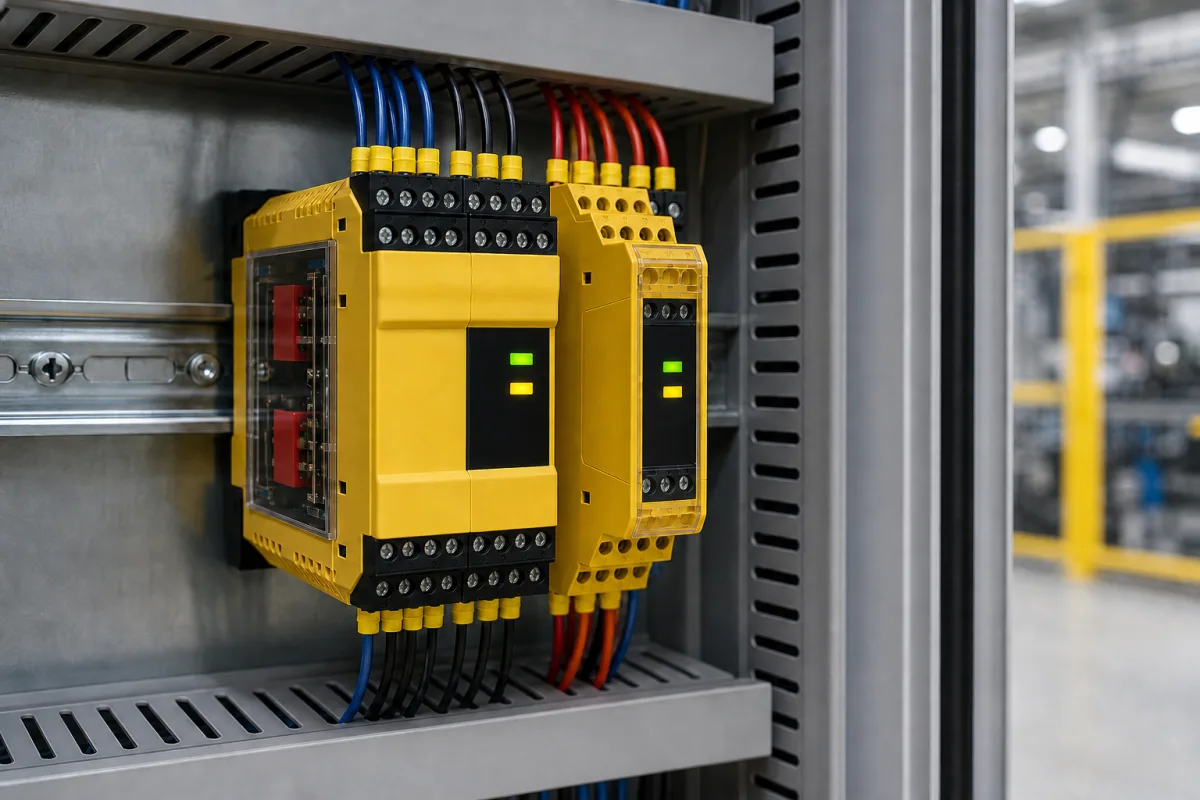
A canonical Control Unit / Safety Relay is characterized by the integration of Microprocessor and Safety Relay Contacts. In industrial production environments, manufacturers listed on CNFX commonly emphasize Printed Circuit Board construction to support stable, high-cycle operation across diverse manufacturing scenarios.

Electronic control module that processes signals from safety light curtains and initiates safety shutdowns when intrusions are detected.
Product Specifications

Technical details and manufacturing context for Control Unit / Safety Relay

Definition
A critical safety component within safety light curtain systems that receives and analyzes signals from the light curtain's emitter and receiver units. When the light curtain beam is interrupted, this unit processes the signal and triggers immediate shutdown of hazardous machinery through safety-rated relay outputs, ensuring operator protection in industrial environments.
Working Principle
The control unit continuously monitors the status of connected safety light curtains. When the infrared light beams are broken by an intrusion, the unit receives this signal, performs safety logic processing (including cross-checking redundant signals), and activates safety relay contacts to cut power to dangerous machinery within milliseconds, preventing accidents.
Common Materials
Printed Circuit Board, Electronic Components, Plastic Housing, Metal Contacts
Technical Parameters
  • Response time from intrusion detection to safety output activation (ms) Standard Spec
Components / BOM
  • Microprocessor
    Processes safety signals and executes safety logic
    Material: Silicon
  • Safety Relay Contacts
    Physically interrupts power to hazardous machinery
    Material: Silver Alloy
  • Status Indicators
    Visual display of system status and faults
    Material: LEDs and Plastic Lenses
  • Terminal Blocks
    Connection points for safety devices and power
    Material: Plastic and Brass
Engineering Reasoning
24 VDC ±10% (21.6-26.4 VDC), 0-40°C ambient temperature, 0-95% relative humidity non-condensing
Input voltage <18 VDC or >30 VDC, ambient temperature >60°C, contact bounce >5 ms duration
Design Rationale: Semiconductor junction thermal runaway at >125°C silicon temperature, dielectric breakdown at >500 VDC isolation voltage, contact welding at >10 A inrush current
Risk Mitigation (FMEA)
Trigger Electromagnetic interference from adjacent 480 VAC motor starters inducing >50 V/m field strength
Mode: False triggering of safety outputs during normal operation
Strategy: Shielded enclosure with 40 dB attenuation at 10-100 MHz, ferrite chokes on all I/O lines
Trigger Condensation accumulation on PCB due to 15°C/hour temperature cycling in unsealed enclosures
Mode: Surface leakage currents >1 mA between high-impedance sensor inputs
Strategy: Conformal coating meeting IPC-CC-830B Class 3, nitrogen-purged terminal compartments

Industry Taxonomies & Aliases

Commonly used trade names and technical identifiers for Control Unit / Safety Relay.

Applied To / Applications

This component is essential for the following industrial systems and equipment:

Industrial Ecosystem & Supply Chain DNA

Complementary Systems
Downstream Applications
Specialized Tooling

Application Fit & Sizing Matrix

Operational Limits
pressure: Not applicable (electronic module)
other spec: IP65 ingress protection, 24V DC nominal voltage (±10%), 2A max contact rating
temperature: -20°C to +60°C
Media Compatibility
✓ Industrial machinery safety circuits ✓ Automated production lines ✓ Robotic work cells
Unsuitable: Explosive atmospheres (ATEX zones) without additional certification
Sizing Data Required
  • Number of safety light curtain beams required
  • Response time requirement (typically <20ms)
  • Number of safety outputs needed for shutdown devices

Reliability & Engineering Risk Analysis

Failure Mode & Root Cause
Contact Welding/Fusion
Cause: Excessive inrush current from connected loads (e.g., solenoid valves, contactors) or frequent rapid cycling causing arcing and heat buildup at relay contacts, leading to material transfer and permanent sticking.
Coil Failure/De-energization
Cause: Voltage spikes/surges (transients) from the power supply or adjacent equipment degrading insulation, or sustained operation outside rated voltage/temperature ranges causing overheating and open/short circuits in the coil winding.
Maintenance Indicators
  • Audible chattering or buzzing from the relay enclosure during operation, indicating loose connections, contact arcing, or coil issues.
  • Visual signs of overheating: discoloration (browning/yellowing) of the relay housing or PCB, or a burnt odor near the unit.
Engineering Tips
  • Install a properly rated surge suppressor or RC snubber circuit across the relay coil and contacts to absorb voltage transients and reduce arcing, extending contact and coil life.
  • Implement periodic infrared thermography inspections during operation to detect abnormal heating at connections or components, allowing proactive intervention before failure.

Compliance & Manufacturing Standards

Reference Standards
ISO 13849-1: Safety of machinery - Safety-related parts of control systems ANSI/UL 508: Industrial Control Equipment DIN EN 60204-1: Safety of machinery - Electrical equipment of machines
Manufacturing Precision
  • Contact gap: +/-0.1mm
  • Coil resistance: +/-5% of nominal value
Quality Inspection
  • Dielectric strength test (high-pot test)
  • Functional safety test with simulated fault conditions

Factories Producing Control Unit / Safety Relay

Verified manufacturers with capability to produce this product in China

✓ 98% Supplier Capability Match Found

P Project Engineer from Singapore Jan 17, 2026
★★★★★
"Great transparency on the Control Unit / Safety Relay components. Essential for our Machinery and Equipment Manufacturing supply chain."
Technical Specifications Verified
S Sourcing Manager from Germany Jan 14, 2026
★★★★★
"The Control Unit / Safety Relay we sourced perfectly fits our Machinery and Equipment Manufacturing production line requirements."
Technical Specifications Verified
P Procurement Specialist from Brazil Jan 11, 2026
★★★★★
"Found 13+ suppliers for Control Unit / Safety Relay on CNFX, but this spec remains the most cost-effective."
Technical Specifications Verified
Verification Protocol

“Feedback is collected from verified sourcing managers during RFQ (Request for Quote) and factory evaluation processes on CNFX. These reports represent historical performance data and technical audit summaries from our B2B manufacturing network.”

6 sourcing managers are analyzing this specification now. Last inquiry for Control Unit / Safety Relay from UAE (1h ago).

Supply Chain Compatible Machinery & Devices

Heavy-Duty CNC Plasma Cutting Machine

Industrial machine for precision metal cutting using plasma arc technology

Explore Specs →
Automated Assembly Line System

Integrated production system for sequential component assembly operations

Explore Specs →
Automated Powder Coating System

Integrated industrial system for applying dry powder coatings to metal substrates.

Explore Specs →
Centrifugal Pump Impeller

Rotating component that transfers energy to fluid in centrifugal pumps.

Explore Specs →

Frequently Asked Questions

What safety standards does this control unit comply with?

This safety relay control unit is designed to comply with international safety standards including ISO 13849-1 (Performance Level d) and IEC 62061 (SIL 3), ensuring reliable safety function performance for machinery applications.

How does the control unit interface with safety light curtains?

The control unit receives signals from safety light curtains through dedicated input channels, processes intrusion detection via its microprocessor, and initiates immediate safety shutdowns through its relay contacts when beam interruptions are detected.

What maintenance is required for this safety control unit?

Regular functional testing is recommended according to safety standards. The unit features status indicators for diagnostics and requires no routine maintenance beyond visual inspection for damage and ensuring proper electrical connections at terminal blocks.

Can I contact factories directly on CNFX?

CNFX is an open directory, not a transaction platform. Each factory profile provides direct contact information and production details to help you initiate direct inquiries with Chinese suppliers.

Get Quote for Control Unit / Safety Relay

Request technical pricing, lead times, or customized specifications for Control Unit / Safety Relay directly from verified manufacturing units.

Your business information is encrypted and only shared with verified Control Unit / Safety Relay suppliers.

Thank you! Your message has been sent. We'll respond within 1–3 business days.

Need to Manufacture Control Unit / Safety Relay?

Connect with verified factories specializing in this product category

Add Your Factory Contact Us
Previous Product
Control Unit / Processor
Next Product
Control Unit/Display