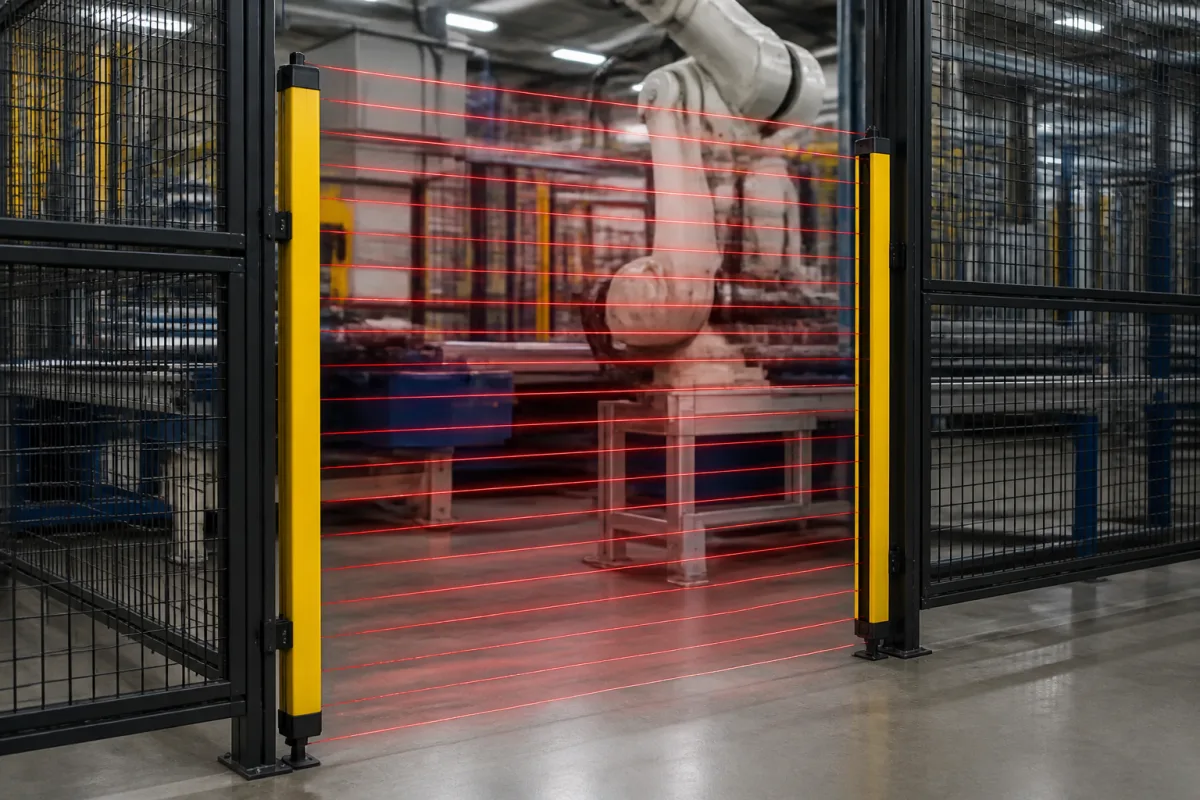
Safety light curtain for robot-cell access openings: body-detecting light grids with muting for material and a locked restart
Guarding the way into a robot cell · beam heights of 300 to 1,200 mm, S = 1,600 × T + 850 mm, reach-over allowances, muting for pallets and a restart that needs a person to press reset
Where a robot cell has an opening in its fence for people or for pallets, a light curtain across that opening replaces the door. It is there to detect a whole person walking in, not a finger reaching into a press, so it is laid out by beam heights above the floor and the distance a walking body covers while the robot stops. Two further jobs make or break it at a cell entrance: letting material through without letting people through, and making sure nobody inside can be overlooked when the robot restarts.
Safety light curtains and multi-beam light grids mounted across the access openings of robot cells and automated lines for whole-body access guarding, with muting for material passage, start/restart interlock and the extra guarding needed against reaching over or standing behind the protective field. Finger- and hand-resolution curtains at points of operation, and the response-time and resolution calculation for them, are covered on the Safety light curtains page; fences, mesh panels and fence heights round the cell on the Machine and robot cell safety guarding page; hinged guard doors with interlocks on the Hinged access door for machine guarding page; vehicle-mounted scanners and bumpers on the AGV on-board safety system page. Safety laser scanners and safety mats are outside this page.
CNFX editorial research · Sources checked October 13, 2026 · 3 sources
Beam heights for a walking body and the 1,600 mm/s plus 850 mm distance
Leuze's operating instructions for its MLD 300 and MLD 500 multiple light beam safety devices give beam heights recommended under EN ISO 13855 for access guarding: two beams 500 mm apart at 400 and 900 mm, three beams 400 mm apart at 300, 700 and 1,100 mm, and four beams 300 mm apart at 300, 600, 900 and 1,200 mm above the floor. A lowest beam at 400 mm is only permissible if the risk assessment allows it. [1] Telemecanique's XUSL catalogue lists the same heights for 2-, 3- and 4-beam devices. [2]
For these 2-, 3- and 4-beam devices both documents use S = K × T + C with K = 1,600 mm/s and C = 850 mm; for light curtains with a finer resolution, Telemecanique gives K = 2,000 mm/s and C = 8 (R − 14) mm, where R is the resolution in mm. [2][1] Leuze's worked example is a robot with a stopping time of 250 ms behind a sensor with a 10 ms response time and no extra interface: S = 1,600 mm/s × 0.26 s + 850 mm = 1,266 mm. Leuze adds that if regular inspections find longer stopping times, the extra time must be added. [1]
Leuze's transmitter-receiver pairs cover 0.5 to 50 m (20 to 70 m on its long-range models), and its transceivers 0.5 to 8 m for two beams and 0.5 to 6 or 8 m for three, which sets how wide an opening one pair can guard. [1]
The image shows a vertical light curtain across an opening in a mesh cell fence with a robot behind it. Ask for the beam count and heights, the measured stopping time of the robot from full speed, and the resulting distance from the curtain to the nearest point the robot can reach.
02
Reaching over the top beam: the extra C_RO distance
Where a person can reach over a vertical protective field, Leuze's manual reproduces the EN ISO 13855 table of additional distance C_RO, read from the height of the hazard and the height of the top beam. [1]
Editorial calculation: for Leuze's robot example (T = 0.26 s) with a 3-beam grid whose top beam is at 1,100 mm and a hazard at 1,400 mm, S_RO = 1,600 × 0.26 + 1,100 = 1,516 mm, which is 250 mm more than the 1,266 mm from the standard formula; the larger value applies. [1]
Telemecanique adds that where a light curtain's position leaves gaps, extra fixed or position-monitored guards or further curtains must stop people from reaching the hazard over the top, from beneath, from behind or from the side without breaking a beam, and from remaining between the hazard and the curtain. [2]
Leuze defines muting as properly suppressing the protective function for a time, for example while objects are transported through the field; it starts only automatically, from two independent muting signals, a muting lamp is lit throughout, and it ends when the sensors clear or when the muting timeout runs out. [1] OSHA's Technical Manual chapter on industrial robots defines muting as the deactivation of a presence-sensing safeguarding device during a portion of the robot cycle. [3]
Telemecanique's multi-beam muting arms are intended for irregular objects with holes, such as pallets, which a single beam could read as gaps, and its muting arms carry a mission time of 20 years. [2] Leuze warns that a wrong arrangement of muting sensors is a risk of death and limits sequence-controlled muting to material exits. [1]
Muting arrangement
Rule in the Leuze or Telemecanique document
Timing-controlled 2-sensor (crossed beams)
Both sensors within 4 s; crossing point inside the danger zone; brief dropouts filtered up to 3 s (300 ms on MLD 335/535); both directions [1]
Sequence-controlled 2-sensor
Material exit only; muting ends 8 s after MS1 or 5 s after MS2 clears; at least one sensor free for 300 ms between objects [1]
Timing-controlled 4-sensor
Next sensor within 4 s of the previous one; sensor beams do not cross [1]
Muting timeout
10 min, or 100 h in two of the operating modes [1]
Longer sensor spacing, for conveyors faster than 25 m/min [2]
State the pallet or load size, conveyor speed and direction(s) of travel; ask which muting mode is set, where the sensor beams cross, and the muting timeout.
04
A stored stop and a reset button outside the cell
Telemecanique states that a light curtain gives a stop signal, not a control instruction, that the stop must be stored, and that clearing the curtain must not restart moving parts; restart must need deliberate operation of a control after checking that the danger has gone. [2] Leuze's start/restart interlock prevents the safety outputs and the machine from starting automatically when the field clears or power returns, and the operator must make sure nobody is in the danger zone before pressing the start/restart button. [1]
OSHA's manual records an incident in which a worker entered the restricted space of a robot application during automatic operation and was pinned between the manipulator and a post; it lists perimeter guarding that let a worker enter without causing a protective stop among the possible causes. For teaching inside the cell it gives a reduced robot speed of no more than 250 mm/s (10 in/s). [3]
Place the reset where the whole guarded space can be seen and where it cannot be reached from inside; ask how a person who has passed the curtain is detected if the cell is deep enough to stand in.
05
Opening, robot and material data for a cell-entry light curtain
Paste it into your enquiry below or into an email to a maker, then replace every bracket.
Opening: [width; height; floor level; fence height]
Robot: [measured stopping time; reach; hazard height]
Device: [beams and heights or resolution; range; transmitter-receiver or transceiver]
Material: [pallet or load size; conveyor speed; in, out or both]
Muting: [mode; sensor positions; timeout]
Control: [restart interlock; reset position; contactor monitoring; safety controller]
Explore company information and manufacturing capabilities, then discuss the scope of your project with a relevant supplier.
Share this page
Compiled and source-reviewed by the CNFX editorial team.
Each manufacturer above links to the page on that company's own website where the product is listed, with the date we checked it. How we source and review
· Page last updated 13 October 2026
Buyer questions
At what heights should a 3-beam access guard be mounted?
At 300, 700 and 1,100 mm above the floor, per the EN ISO 13855 recommendations reproduced by Leuze and Telemecanique. [1][2]
How far from a robot must a multi-beam access guard be?
S = 1,600 mm/s × total stopping time + 850 mm; Leuze's example with a 250 ms robot and 10 ms sensor gives 1,266 mm. [1]
How does muting let a pallet through?
Two independent muting sensors must both trip, within 4 s in Leuze's timing-controlled mode, with their crossing point inside the danger zone; muting ends when they clear or the timeout runs out. [1]
Can the robot restart when the curtain clears?
No: Telemecanique states the stop must be stored and restart needs a deliberate action after checking the danger has gone. [2]
Sources and what still needs a direct check
Sources checked 2026-10-13. Leuze's operating instructions for its multiple light beam safety devices, Telemecanique Sensors' XUSL safety light curtain catalogue, and OSHA's Technical Manual chapter on industrial robot systems.