Editorial Technical Reference

Conveyor Port Shield

This page explains how Conveyor Port Shield is classified within Machinery and Equipment Manufacturing. Technical values and manufacturer relationships are research references; confirm the current specification and supplier evidence for each order.

Technical Definition & Core Assembly

A protective shield designed to cover conveyor ports within radiation shielding structures to prevent radiation leakage while allowing material transfer.
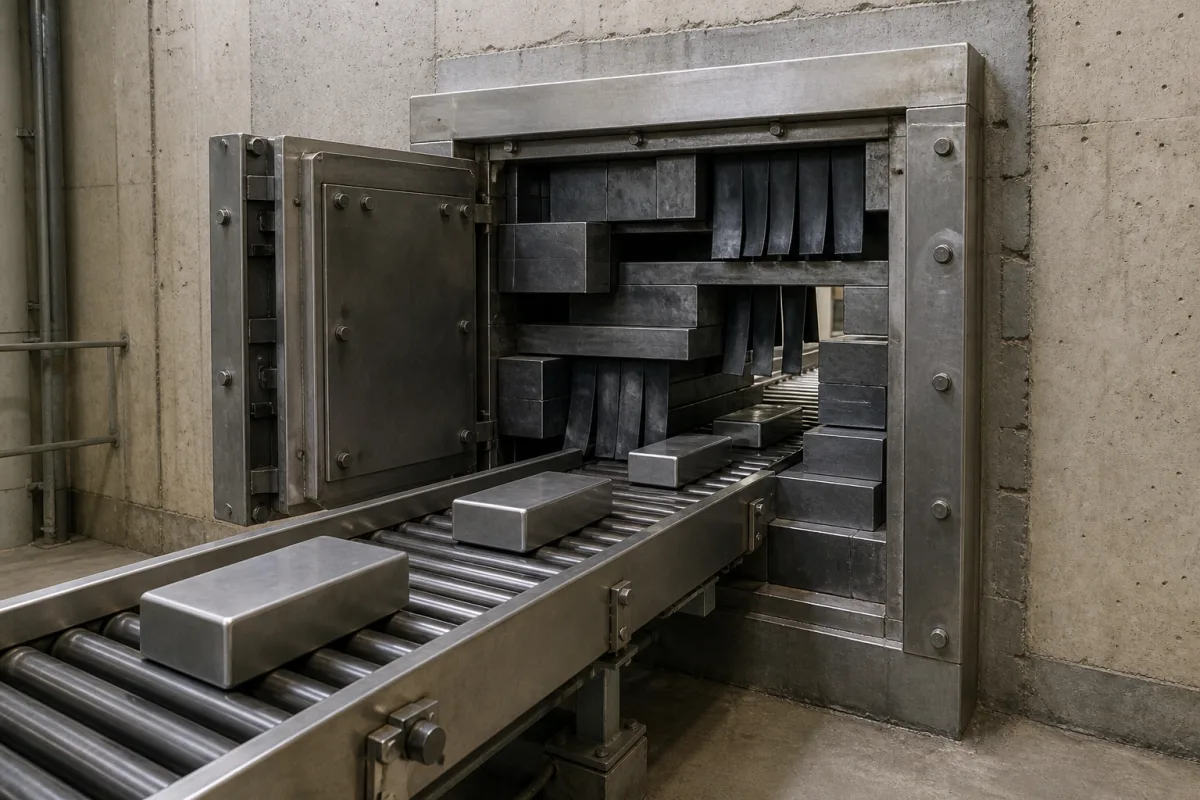
Representative product image. Confirm appearance and specifications with the manufacturer.

Product Specifications

Technical details and manufacturing context for Conveyor Port Shield

Definition
The Conveyor Port Shield is a critical component of Radiation Shielding Structures, specifically engineered to seal conveyor openings where materials enter or exit shielded areas. It maintains radiation containment integrity while permitting continuous material flow through conveyor systems in radioactive environments. The shield is available in nominal sizes from DN100 to DN600, matching standard conveyor port openings per ISO 6708. It operates at pressures between 1.0 and 1.6 MPa, with a leakage rate not exceeding 1×10⁻⁶ Pa·m³/s as verified by helium leak testing per ISO 15848-1. Operating temperature ranges from -40°C to 85°C, above which seal degradation may occur. Radiation shielding thickness varies from 50 to 150 mm, typically using lead or borated polyethylene, while the structural material is stainless steel grades SS304 or SS316L (ASTM A240) for corrosion resistance. Surface finish is Ra 0.8–1.6 μm (ISO 4287) to facilitate cleaning. The shield weighs between 50 and 500 kg, depending on size and shielding requirements. It offers ingress protection rated IP54–IP65 (IEC 60529) for dust and water resistance. Actuation can be manual or pneumatic, with pneumatic versions requiring a 24 V DC ±10% electrical supply for solenoid valves and a 4–20 mA control signal (IEC 60381-1) for position feedback. These specifications serve as reference ranges; actual model-specific values and compliance must be verified with the legal manufacturer or supplier. The shield is designed to integrate into radiation shielding structures, ensuring that conveyor openings do not compromise containment. Its working principle relies on dense materials and interlocking designs to attenuate radiation while accommodating conveyor movement. Selection requires consideration of port size, pressure, temperature, radiation levels, and material compatibility. Verification should include leak testing, material certifications, and dimensional checks. Maintenance signals include increased leakage rates, seal wear, or corrosion. Failure boundaries include exceeding temperature or pressure limits, which can compromise sealing integrity.
Working Principle
The shield creates a radiation-tight barrier around conveyor ports using dense materials that attenuate radiation. It typically employs overlapping or interlocking designs that maintain shielding effectiveness while accommodating conveyor movement and material passage. The dense material, such as lead or tungsten alloy, absorbs or scatters radiation, preventing leakage through the port. The design allows for continuous material flow while ensuring that the shielding integrity is not compromised. Seals and gaskets provide a tight closure, and the actuation mechanism enables remote operation when necessary. The shield's effectiveness is verified through helium leak testing, ensuring that the leakage rate remains within specified limits.
Common Materials
Lead, Tungsten alloy, Stainless steel
Technical Parameters
ParameterTypical rangeNotes & selection driver
Nominal SizeDN100–DN600 mmMatches conveyor port openingISO 6708
Operating Pressure1.0–1.6 MPa
Operating Temperature-40–85 °CSeals degrade above 85°C
Leakage Rate≤1×10⁻⁶ Pa·m³/sHelium leak testISO 15848-1
Radiation Shielding Thickness50–150 mmLead or borated polyethylene
Material GradeSS304/SS316LCorrosion resistantASTM A240
Surface FinishRa 0.8–1.6 μmFor cleanabilityISO 4287
Weight50–500 kgDepends on size and shielding
Ingress ProtectionIP54–IP65Dust and water resistantIEC 60529
Actuation TypeManual/PneumaticPneumatic for remote operation
Electrical Supply24 ±10% V DCFor solenoid valves if pneumatic
Control Signal4–20 mAFor position feedbackIEC 60381-1

Ranges are indicative industry figures for RFQ preparation, not a supplier commitment. Confirm every value and standard with the legal manufacturer before ordering.

Components / BOM
  • Shielding Plate Part
    Primary radiation attenuation element
    Material: Lead or tungsten alloy
  • Sealing Gasket Part
    Creates radiation-tight seal around conveyor
    Material: Neoprene or silicone rubber
  • Mounting Frame Part
    Structural support and attachment to shielding structure
    Material: Stainless steel

Applied To / Applications

This component is essential for the following industrial systems and equipment:

Industrial Ecosystem & Supply Chain Structure

Complementary Systems
Downstream Applications
Specialized Tooling

Application Fit & Sizing Matrix

Operational Limits
pressure: 0 to 2 bar (gauge)
other spec: Max particle size: 50mm, Slurry concentration: up to 60% solids by weight
temperature: -20°C to +150°C
Media Compatibility
✓ Uranium ore slurry ✓ Spent nuclear fuel transfer ✓ Radioactive waste handling
Unsuitable: High-velocity abrasive materials with sharp edges
Sizing Data Required
  • Conveyor port diameter (mm)
  • Radiation shielding thickness required (mm)
  • Material transfer rate (tons/hour)

Reliability & Engineering Risk Analysis

Failure Mode & Root Cause
Abrasive Wear
Cause: Continuous exposure to particulate material flow causing surface degradation and thinning of shield material.
Fatigue Cracking
Cause: Cyclic loading from material impact and vibration leading to stress concentration at mounting points or edges.
Maintenance Indicators
  • Visible material thinning or perforation allowing spillage past the shield
  • Abnormal vibration or rattling noises indicating loose mounting or structural compromise
Engineering Tips
  • Implement regular thickness measurements using ultrasonic testing to monitor wear rates and schedule replacement before failure
  • Install sacrificial wear liners or apply hard-facing coatings to high-impact areas to protect the base shield material

Indicative industry ranges for design and RFQ preparation. Confirm the exact figures and applicable standard with the manufacturer before specifying.

Compliance & Manufacturing Standards

Applicable Standards
ISO 14122-3:2016 - Safety of machinery - Permanent means of access to machinery - Stairs, stepladders and guard-rails ANSI B20.1-2021 - Safety Standard for Conveyors and Related Equipment DIN 22101:2011 - Continuous conveyors - Belt conveyors for loose bulk materials - Basis for calculation and dimensioning

Quoted from the published standard.

Manufacturing Precision
  • Shield mounting hole diameter: +/-0.5mm
  • Shield flatness: 1.0mm per meter length
Quality Inspection
  • Dimensional verification with CMM (Coordinate Measuring Machine)
  • Non-destructive testing: Visual inspection and dye penetrant test for weld integrity

Manufacturers of Conveyor Port Shield

Manufacturer profiles associated with Conveyor Port Shield.

Sourcing Conveyor Port Shield from China?
Tell us your specification and target quantity — we will match it against manufacturer records and come back with the factories that fit.
Request manufacturers We manufacture this

Manufacturer listings support early research and capability understanding. They are not certification, ranking, or transaction guarantees.

Technical documentation
Request current drawings, revision history, and a signed specification sheet.
Manufacturing capability
Verify equipment lists, process limits, capacity, and representative production evidence.
Inspection readiness
Confirm test methods, calibrated equipment, sampling plans, and traceable reports.
Supplier transparency
Check the legal entity, factory address, ownership, certifications, and direct contacts.

CNFX does not score or rank suppliers. Buyers must verify all claims and documents with the legal manufacturer before ordering.

Supply Chain Compatible Machinery & Devices

Hydraulic Press

Industrial machine using hydraulic pressure to compress, form, or assemble materials

Explore Specs →
Heavy-Duty CNC Plasma Cutting Machine

The Heavy-Duty CNC Plasma Cutting Machine is a standalone industrial device designed for cutting conductive metals such as steel, stainless steel, aluminum, and copper alloys.

Explore Specs →
Automated Powder Coating System

Integrated industrial system for applying dry powder coatings to metal substrates.

Explore Specs →
Centrifugal Pump Impeller

The centrifugal pump impeller is a critical rotating component that converts mechanical energy from the motor into kinetic energy in fluid systems.

Explore Specs →

Frequently Asked Questions

What is the purpose of a Conveyor Port Shield?

It seals conveyor openings in radiation shielding structures to prevent radiation leakage while allowing materials to pass through, maintaining containment integrity.

What materials are used in the Conveyor Port Shield?

The shield uses lead or tungsten alloy for radiation attenuation, and stainless steel (SS304/SS316L) for structural parts, with shielding thickness typically 50-150 mm.

What are the operating limits of the shield?

It operates at pressures 1.0-1.6 MPa, temperatures -40 to 85°C, and has a leakage rate ≤1×10⁻⁶ Pa·m³/s. Exceeding these limits may compromise sealing.

How is the shield's performance verified?

Performance is verified through helium leak testing per ISO 15848-1, and material grades per ASTM A240. Always confirm model-specific values with the manufacturer.

Data Basis

Editorial classification, named public sources where available, and source-reviewed manufacturer records.

Preliminary Technical Classification
This page supports structured research, RFQ preparation, and supplier evaluation. It does not replace buyer-led supplier qualification, standards review, or technical approval.
Buyer enquiry

Request manufacturing insight for Conveyor Port Shield

Ask for use case, specification boundaries, supplier type, and RFQ preparation information for this product.

Where it goes
Straight to the CNFX editorial desk, and to the manufacturer if this product is linked to a claimed profile. Nothing is broadcast to a supplier list.
Your details stay here
We do not sell or rent enquiry data, and we do not add you to a mailing list. Used only to answer this request.
No commission, no middleman
CNFX is a directory. We take no cut of any order and never negotiate on a supplier's behalf.
What we don't claim
A listing is not an endorsement. Qualify every supplier and verify every figure yourself before ordering.

Your business information is used only to process this request.

Thank you! Your message has been sent. We'll respond within 1–3 business days.
Sorry, we couldn't send your message. Please try again, or email us at contact@cnfx.com.

Need to Manufacture Conveyor Port Shield?

Compare manufacturer profiles with relevant product and process capability.

Previous Product
Z-axis Ram/Spindle
Last Product
Get QuotesChat