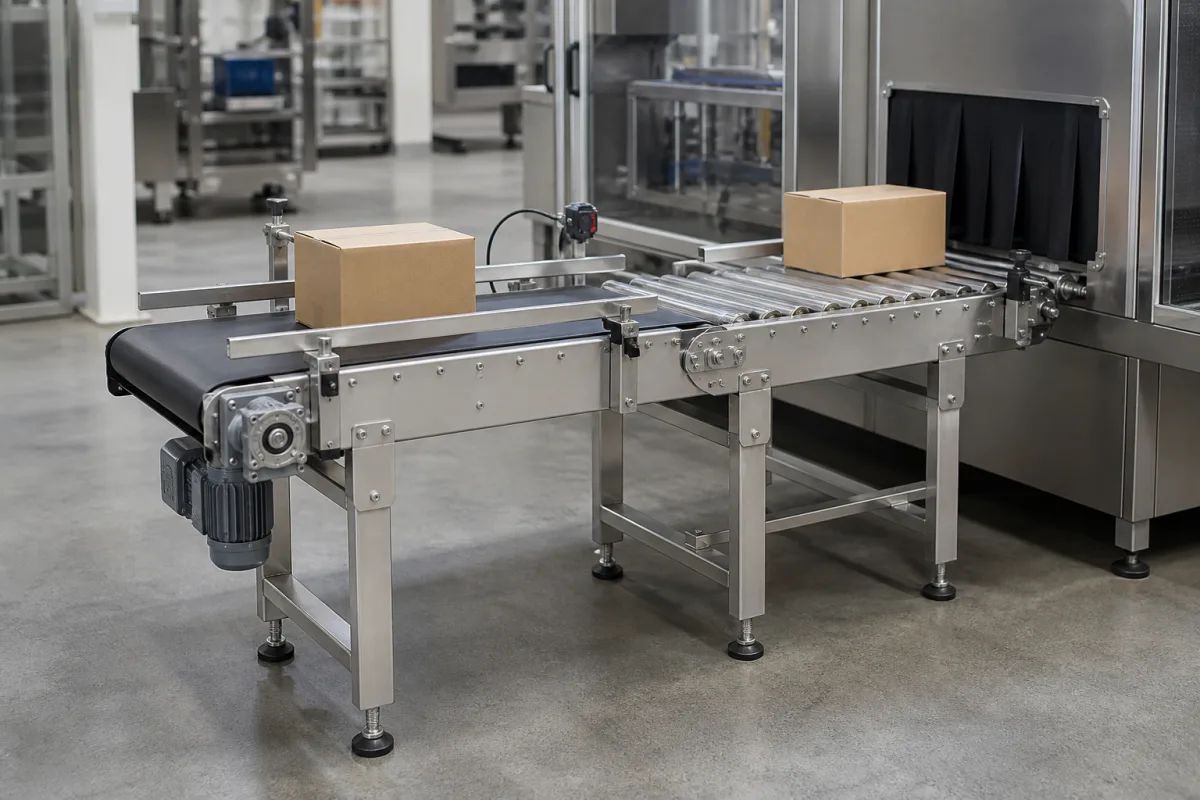
Conveyor section (modular straight, curve and drive/return modules and the transfers between them)
Modular conveyor sections · straight, curve and drive/return modules, chain widths, and the transfer between one section and the next
A conveyor section is one module of a modular conveyor line: a straight belt, roller or chain section, a curve, or a drive or return unit, joined end to end or side to side with the next. Ask three things first: which modules the line is built from and how long each section is, how the product crosses each joint between sections, and what the smallest and heaviest product is at each transfer.
Modular conveyor sections and the transfers between them: straight belt, roller and flexible chain sections, curves, drive and return units, transfer plates and nose bars. Complete conveyor systems are covered on the Conveyor systems page; conveyor belting or chain sold alone, pallet transfer systems and bulk belt conveyors are outside this page.
CNFX editorial research · Sources checked October 12, 2026 · 3 sources
Plan how the product crosses each joint between sections
Dorner's guide to six product transfer methods states that in an inline (end-to-end) transfer "there is typically a small gap between the two conveyor ends", so it may not suit tiny or flexible parts, and that its low-profile conveyors close that gap to as little as 1.25 inches. A nose bar transfer replaces one or both ends with a small-diameter end roller and lower profile supports, reducing the gap to as little as 0.31 inches; Dorner lists it as ideal for small parts and machine infeed and outfeed, but limited to certain belting and models, not recommended for high-speed applications and needing shorter maintenance intervals. Transfer plates bridge the gap and, it says, call for guiding to avoid product loss. [1]
For turns, Dorner's 90° adjustable transfer manual (851-335 Rev. D, titled for its 2200, 3200 and LPZ conveyors) requires low side conveyors and a transfer plate and guiding on the discharge end of the infeed conveyor, and gives a maximum recommended part weight of 20 lb (9 kg) at 50 ft/min (15 m/min), conveyor widths up to 12 in (the metric figure is printed as 610 mm), a 1/4 in (6 mm) minimum part thickness, and minimum product sizes of 3/4 in (19 mm) with a transfer tail option and 1-1/4 in (32 mm) with the standard 3 in (76 mm) tail; the size lines refer to 2100 and 3100 Series models. [2]
Editorial calculation: 1.25 in is about 31.8 mm and 0.31 in about 7.9 mm, so a 25 mm long part would be longer than a nose bar gap but shorter than the inline gap; check the gap at every joint against the shortest product, and note the manual's 12 in width is 305 mm, not the 610 mm printed beside it, so confirm the width limit with the maker. [1][2]
Give the supplier the products (smallest and largest size, weight, stability, packaging), throughput and speed, line layout with every joint and turn, transfer method at each joint, section lengths and widths, drive and return positions, guiding, washdown or material requirements, controls and quantity.
02
Pick the section modules and widths
Vitrans, a modular conveyor maker, lists its flexible chain conveyor as built from conveyor section profiles (full and semi section profiles), chain guide profiles, product guide profiles and brackets, with flexible chains of 43, 63, 83, 103, 140 and 175 mm width, plus curve sections (horizontal and vertical), drive and return units and supports. It also lists belt conveyors, pallet conveyors and roller conveyors among its modular ranges. [3]
Dorner describes 90° transfers as suited to medium to larger products because the product crosses a small part of the frame, side transfers as needing little or no frame past the belt edge and better suited to modular or flexible plastic chain, and states that product orientation is not kept through a 90° transfer. [1] Editorial note: choose the section type at each joint with the transfer in mind, since the transfer method limits which belting and frame profile the adjoining sections can use.
03
Vitrans flexible chain sections, curves and drive units
Vitrans lists flexible chain conveyor sections and profiles in chain widths from 43 to 175 mm, curve sections, drive and return units, belt conveyors and pallet conveyors. Ask for the section lengths, joint details and transfer options available for your products.
04
Straight runs, curves, drive ends, transfer plates and nose bars
The joints decide whether tiny or flexible parts cross from one section to the next: end-to-end gaps, nose bars and transfer plates each leave a different gap.
Chain or belt width, transfer load and speed limits at section joints
Width and belt type are set by the product, but the transfer between sections limits load and speed: one 90° transfer is rated with 9 kg parts at 50 ft/min, and nose bars are not recommended at high speed.
Field
What it means and published values
Ask the supplier for
Belt width (mm)
Examples: flexible chain 43-175 mm; 90° transfer kit for conveyors up to 12 in. [3][2]
Width per section.
Section length (mm)
Length of each module.
Lengths and joint positions.
Load capacity (kg/m)
Example: 20 lb (9 kg) parts at 50 ft/min through one 90° transfer. [2]
Vitrans lists flexible chain sections in chain widths of 43 to 175 mm, curves, drive and return units and belt conveyors.
Vitrans Automation Equipment Co.,Ltd
Manufacturing site to be confirmed for the order
Lists flexible chain conveyor sections and profiles from 43 to 175 mm chain width, curve sections, drive and return units, belt, roller and pallet conveyors.
Explore company information and manufacturing capabilities, then discuss the scope of your project with a relevant supplier.
Share this page
Compiled and source-reviewed by the CNFX editorial team.
Each manufacturer above links to the page on that company's own website where the product is listed, with the date we checked it. How we source and review
· Page last updated 13 October 2026
Buyer questions
How small a gap can two conveyor sections have?
Dorner states as little as 1.25 inches for its low-profile inline transfers and as little as 0.31 inches with a nose bar. [1]
What is the smallest product a 90° transfer can take?
Dorner's manual gives 3/4 inch (19 mm) with a transfer tail and 1-1/4 inch (32 mm) with the standard 3 inch tail, with a 1/4 inch minimum thickness. [2]
What widths do flexible chain sections come in?
Vitrans lists flexible chains of 43, 63, 83, 103, 140 and 175 mm. [3]
Does a product keep its orientation through a 90° transfer?
Dorner states product orientation is not maintained through a 90° transfer. [1]
Sources and what still needs a direct check
Sources checked 2026-10-12. Dorner is a conveyor maker describing transfer methods and its 90° transfer kit; Vitrans describes its own modular conveyor ranges.