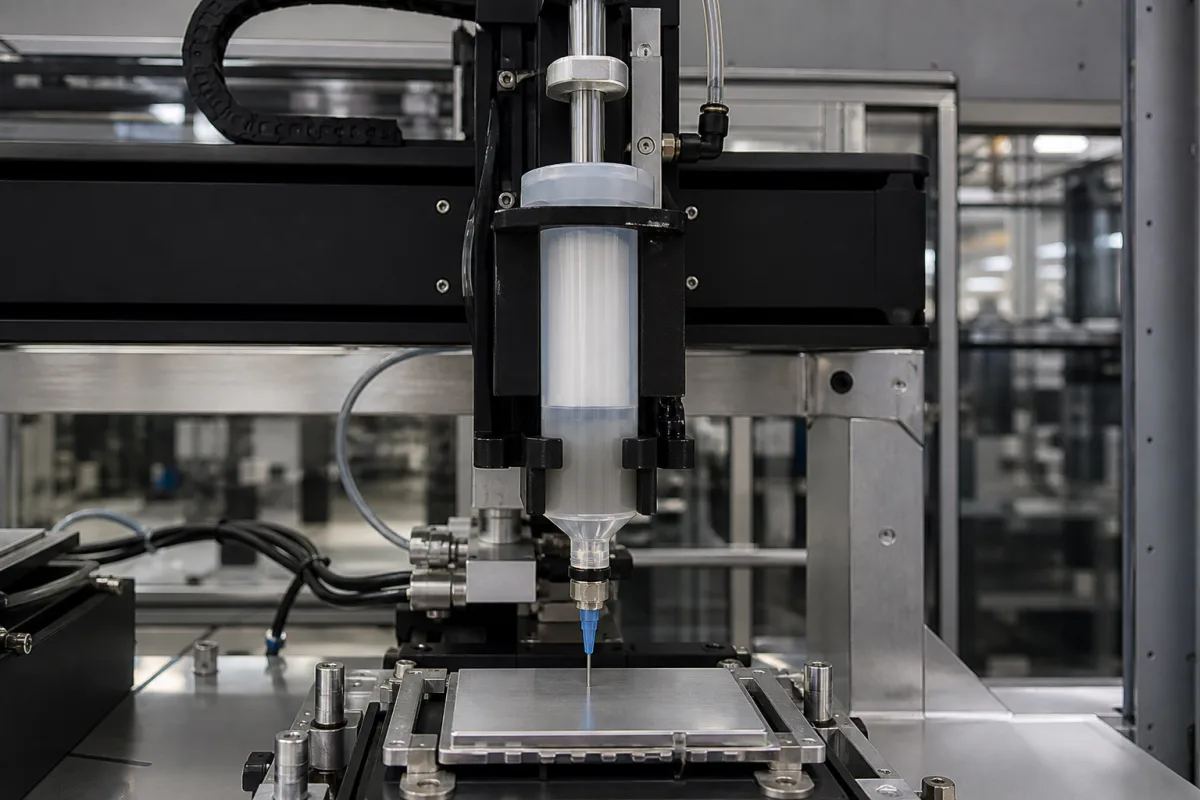
Dispensing syringe barrel for thermal paste and adhesives
Paste and adhesive dispensing · Barrel size and light protection, pistons against tunnelling, tip gauge, time-pressure vs auger for thermal paste
A dispensing syringe barrel is the reservoir of a syringe dispensing system: the barrel holds the paste or adhesive, a piston (wiper) rides on top of the fluid, an adapter connects the barrel to the air-pressure controller or pump, and a dispensing tip on the Luer outlet forms the dot or bead. Ask three things first: which barrel size and colour suit the fluid and run length, which piston keeps viscous paste from tunnelling or dripping, and which tip gauge and drive (time-pressure or auger) give repeatable dots of the volume you need.
Syringe barrels for pneumatic and pump-fed dispensing of thermal paste, adhesives and sealants, with their pistons, adapters and tips. Two-component cartridges, medical injection syringes, dispensing valves and complete dispensing robots are outside this page.
CNFX editorial research · Sources checked October 12, 2026 · 5 sources
Fisnar lists its QuantX syringe barrels in 3, 5, 10, 30 and 55 cc sizes with inside diameters of 9.62, 12.72, 15.78, 22.62 and 22.57 mm and lengths of 74.7 to 175.2 mm, moulded from silicone-free polypropylene: clear for non-UV materials, amber for UV protection up to 550 nm visible light, opaque black for maximum light protection, and an ESD-safe version. [1]
Fisnar explains that pistons apply pressure evenly across the fluid, trap fluid and fumes in the barrel and help prevent tunnelling in higher-viscosity fluids. Its range covers smooth-flow, double-wipe pistons, flat-wall pistons to reduce stringing and bouncing with high-viscosity fluids, low-viscosity pistons to prevent dripping and back-flow into the dispenser, and soft rubber pistons against tunnelling in high-viscosity materials. [2]
Editorial calculation: Bergquist estimates about 0.02 ml of its TGR 4000 grease for a 0.5 in × 0.5 in interface at 0.005 in thick (12.7 × 12.7 × 0.127 mm ≈ 20.5 mm³). [5] In a 10 cc barrel of 15.78 mm inside diameter (cross-section ≈ 196 mm²), that volume moves the piston only about 0.10 mm, so a full 10 cc barrel holds roughly 500 such doses before dead volume. [1] Small, repeated doses are why barrel uniformity and fill level matter.
Give the supplier the fluid (product name, viscosity, filler, pot life, light or moisture sensitivity), dot or bead volume and size, parts per hour and run length, dispenser type (time-pressure, auger, positive displacement), barrel size and colour, piston type, tip type and gauge, ESD requirement, and whether barrels are filled in-house or supplied pre-filled.
02
Match the tip gauge and the dispensing drive
Fisnar's tapered tips, recommended for medium to high viscosity materials such as epoxy, silicone, RTV, sealants and grease, range from 10 gauge (3.00 mm inside diameter) to 30 gauge (0.15 mm), for example 18 gauge at 0.84 mm and 22 gauge at 0.41 mm, on Luer-lock polypropylene hubs; UV-blocking versions are offered for light-curing materials. [3]
In a GPD Global application trial dispensing a thermally conductive material to a 1 mm dot, the specialist used a precision auger pump with fluid pressure control and an 18G S-type nozzle of 0.864 mm inside diameter; the resulting syringe pressure was 60–70 psi, peaking at 90 psi, with a 0.2 s dot time and a one-second dwell for adhesion. GPD explains that its fluid pressure control adjusts the pressure of fluid entering the pump regardless of reservoir level, and the setup dispensed two full syringes without interruption. [4]
Bergquist notes that its grease needs assembly pressure to flow and that an optimised application uses the minimum volume needed to wet out both interfaces. [5] Editorial note: with plain time-pressure dispensing, the paste column shortens as the barrel empties, so ask the supplier how dot volume is held constant over the barrel (pressure compensation, auger or positive-displacement drive) and confirm with weighed test dots.
03
Syringes, cartridges and pistons sold as dispenser accessories
Listings include dispensing syringes and cartridges with pistons, needles, mixing tubes and glue guns as dispensing machine accessories; ask each for barrel dimensions, material, colour options and piston types.
04
Barrel, piston, adapter, tip and end cap
Choose the piston row by viscosity: Fisnar offers flat-wall and soft rubber pistons for high-viscosity fluids and a low-viscosity piston against dripping and back-flow. [2]
Explore company information and manufacturing capabilities, then discuss the scope of your project with a relevant supplier.
Share this page
Compiled and source-reviewed by the CNFX editorial team.
Each manufacturer above links to the page on that company's own website where the product is listed, with the date we checked it. How we source and review
· Page last updated 13 October 2026
Buyer questions
What syringe barrel sizes are available?
Fisnar lists 3, 5, 10, 30 and 55 cc barrels with inside diameters from 9.62 to 22.62 mm. [1]
Why use a piston in a syringe barrel?
Fisnar says pistons apply even pressure, trap fumes and help prevent tunnelling in viscous fluids; other types prevent dripping. [2]
What tip size suits thermal paste dots?
In one GPD Global trial a 1 mm dot of thermal material was dispensed through an 18G nozzle of 0.864 mm inside diameter with an auger pump. [4]
Sources and what still needs a direct check
Sources checked 2026-10-12. Fisnar is a dispensing equipment maker listing its own components; GPD Global's case study and Bergquist's datasheet describe one thermal material each.