Industry-Verified Manufacturing Data (2026)

Distribution Nozzle Array

Based on aggregated insights from multiple verified factory profiles within the CNFX directory, the standard Distribution Nozzle Array used in the Machinery and Equipment Manufacturing sector typically supports operational capacities ranging from standard industrial configurations to heavy-duty production requirements.

Technical Definition & Core Assembly

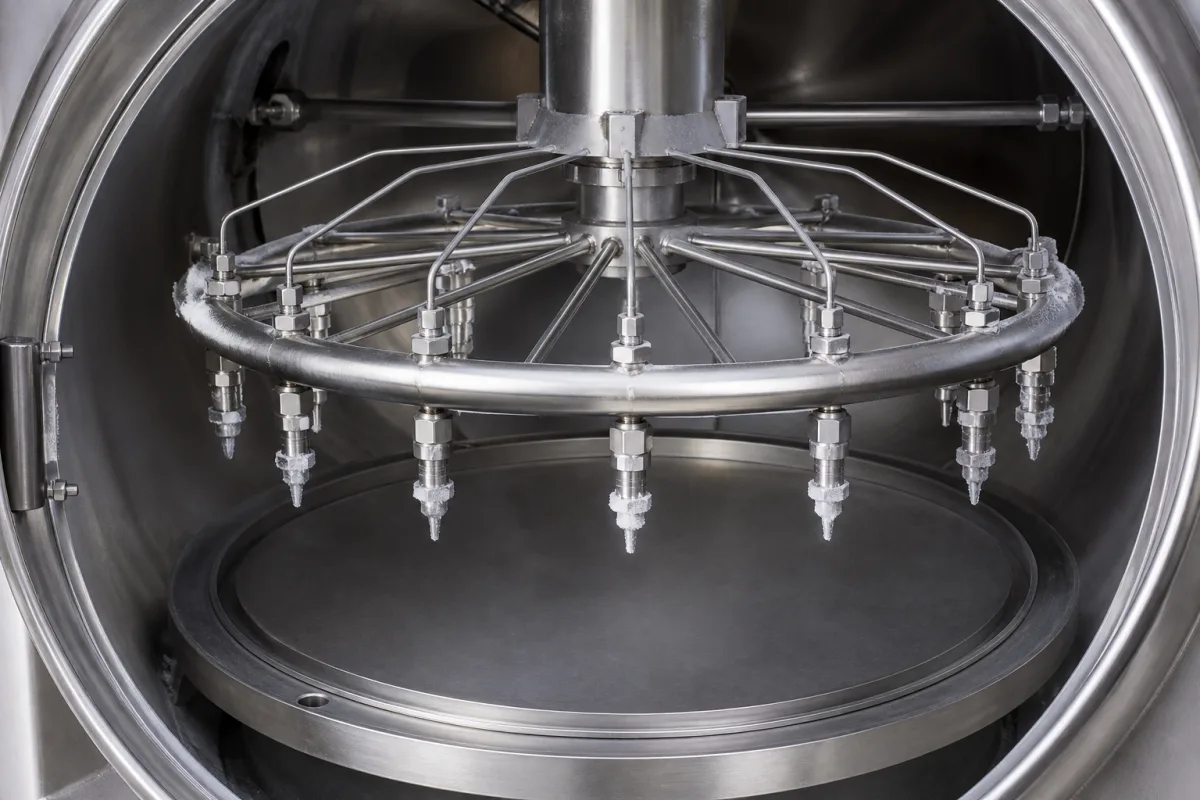
A canonical Distribution Nozzle Array is characterized by the integration of Manifold Block and Nozzle Body. In industrial production environments, manufacturers listed on CNFX commonly emphasize Stainless Steel (e.g., 316L) construction to support stable, high-cycle operation across diverse manufacturing scenarios.

A precisely arranged assembly of nozzles designed to distribute cryogenic fluids uniformly across a target area within a cryogenic injection system.
Product Specifications

Technical details and manufacturing context for Distribution Nozzle Array

Definition
The Distribution Nozzle Array is a critical component of the Cryogenic Injection System, responsible for the controlled and uniform dispersion of cryogenic fluids (such as liquid nitrogen or liquid CO2) onto a surface or into a process stream. It consists of multiple nozzles arranged in a specific pattern to ensure optimal coverage, temperature distribution, and process efficiency in applications requiring rapid cooling, freezing, or temperature control.
Working Principle
Cryogenic fluid under pressure is supplied to the manifold of the array. The fluid is then metered and directed through individual nozzles. The nozzle design (orifice shape, size) and the spatial arrangement of the array determine the spray pattern, droplet size, and distribution profile, ensuring the cryogenic fluid is applied evenly and effectively to the target.
Common Materials
Stainless Steel (e.g., 316L), High-performance Plastics (e.g., PEEK, PTFE)
Technical Parameters
  • Nozzle orifice diameter, typically ranging from 0.1mm to 2.0mm depending on flow rate and droplet size requirements. (mm) Customizable
Components / BOM
  • Manifold Block
    Distributes incoming cryogenic fluid from a single inlet to all individual nozzle ports.
    Material: Stainless Steel
  • Nozzle Body
    Houses the orifice and defines the internal flow path that shapes the spray.
    Material: Stainless Steel or PEEK
  • Orifice Insert
    Precision component with a drilled or formed hole that meters the fluid flow and creates the spray pattern.
    Material: Hardened Steel, Sapphire, or Ceramic
  • Sealing Gasket/O-Ring
    Ensures a leak-proof connection between the nozzle and the manifold or mounting surface.
    Material: Viton, Kalrez, or other cryogenic-compatible elastomer
Engineering Reasoning
0.5-15 bar at 77-293 K
18 bar internal pressure differential at 77 K
Design Rationale: Brittle fracture due to thermal stress concentration exceeding 350 MPa yield strength of 316L stainless steel at cryogenic temperatures
Risk Mitigation (FMEA)
Trigger Phase change from liquid to gas within nozzle orifices
Mode: Flow instability causing maldistribution exceeding ±15% from design specification
Strategy: Implement tapered orifice design with 3:1 L/D ratio and maintain subcooling of 5 K minimum
Trigger Thermal cycling between 77 K and 293 K exceeding 1000 cycles
Mode: Fatigue cracking at brazed joints with crack propagation rate exceeding 10^-8 m/cycle
Strategy: Replace brazed joints with electron beam welded connections using Inconel 718 filler material

Industry Taxonomies & Aliases

Commonly used trade names and technical identifiers for Distribution Nozzle Array.

Applied To / Applications

This component is essential for the following industrial systems and equipment:

Industrial Ecosystem & Supply Chain DNA

Complementary Systems
Downstream Applications
Specialized Tooling

Application Fit & Sizing Matrix

Operational Limits
pressure: Up to 10 bar (150 psi)
flow rate: 0.5-50 L/min per nozzle
temperature: -196°C to 25°C (cryogenic to ambient)
slurry concentration: Up to 30% solids by weight
Media Compatibility
✓ Liquid nitrogen (LN2) ✓ Liquid argon (LAr) ✓ Cryogenic slurries (e.g., LNG with particulates)
Unsuitable: High-temperature corrosive gases (e.g., chlorine gas above 100°C)
Sizing Data Required
  • Total required flow rate (L/min)
  • Target area dimensions and uniformity requirements
  • Fluid properties (viscosity, density, phase)

Reliability & Engineering Risk Analysis

Failure Mode & Root Cause
Abrasive erosion
Cause: High-velocity particulate-laden fluid flow causing gradual material loss, especially at nozzle orifices and internal surfaces, leading to altered spray patterns and reduced efficiency.
Cavitation
Cause: Rapid pressure drops across nozzle orifices causing vapor bubble formation and implosion, resulting in pitting, material fatigue, and eventual structural failure of nozzle components.
Maintenance Indicators
  • Irregular or asymmetric spray patterns visible during operation, indicating nozzle clogging, wear, or misalignment.
  • Unusual audible vibrations, whistling, or hammering noises from the array, suggesting cavitation, flow restriction, or loose components.
Engineering Tips
  • Implement routine ultrasonic thickness testing and flow pattern analysis to detect early-stage erosion or cavitation damage before catastrophic failure.
  • Install upstream filtration systems and maintain optimal fluid pressure/temperature parameters to minimize particulate ingress and prevent cavitation conditions.

Compliance & Manufacturing Standards

Reference Standards
ISO 5167-1:2022 Measurement of fluid flow by means of pressure differential devices ANSI B16.5:2020 Pipe Flanges and Flanged Fittings DIN EN 1092-1:2018 Flanges and their joints - Circular flanges for pipes, valves, fittings and accessories
Manufacturing Precision
  • Bore diameter: +/-0.02mm
  • Nozzle alignment: +/-0.1mm over array length
Quality Inspection
  • Dye Penetrant Test for surface defects
  • Flow uniformity test using calibrated flow meters

Factories Producing Distribution Nozzle Array

Verified manufacturers with capability to produce this product in China

✓ 96% Supplier Capability Match Found

P Procurement Specialist from Australia Jan 03, 2026
★★★★★
"The Distribution Nozzle Array we sourced perfectly fits our Machinery and Equipment Manufacturing production line requirements."
Technical Specifications Verified
T Technical Director from Singapore Dec 31, 2025
★★★★★
"Found 27+ suppliers for Distribution Nozzle Array on CNFX, but this spec remains the most cost-effective."
Technical Specifications Verified
P Project Engineer from Germany Dec 28, 2025
★★★★★
"The technical documentation for this Distribution Nozzle Array is very thorough, especially regarding technical reliability."
Technical Specifications Verified
Verification Protocol

“Feedback is collected from verified sourcing managers during RFQ (Request for Quote) and factory evaluation processes on CNFX. These reports represent historical performance data and technical audit summaries from our B2B manufacturing network.”

5 sourcing managers are analyzing this specification now. Last inquiry for Distribution Nozzle Array from Turkey (14m ago).

Supply Chain Compatible Machinery & Devices

Hydraulic Press

Industrial machine using hydraulic pressure to compress, form, or assemble materials

Explore Specs →
Heavy-Duty CNC Plasma Cutting Machine

Industrial machine for precision metal cutting using plasma arc technology

Explore Specs →
Automated Assembly Line System

Integrated production system for sequential component assembly operations

Explore Specs →
Automated Powder Coating System

Integrated industrial system for applying dry powder coatings to metal substrates.

Explore Specs →

Frequently Asked Questions

What materials are used in the distribution nozzle array?

The nozzle array is constructed from corrosion-resistant stainless steel (typically 316L) and high-performance plastics like PEEK and PTFE, ensuring durability and compatibility with cryogenic fluids.

What are the key components in the nozzle array's bill of materials?

The BOM includes a manifold block, nozzle body, orifice insert, and sealing gasket or O-ring, all designed for precise fluid distribution and leak-free operation in cryogenic systems.

How does the nozzle array ensure uniform fluid distribution?

The precisely arranged assembly of nozzles with calibrated orifice inserts creates consistent flow patterns, delivering cryogenic fluids evenly across the target area for optimal system performance.

Can I contact factories directly on CNFX?

CNFX is an open directory, not a transaction platform. Each factory profile provides direct contact information and production details to help you initiate direct inquiries with Chinese suppliers.

Get Quote for Distribution Nozzle Array

Request technical pricing, lead times, or customized specifications for Distribution Nozzle Array directly from verified manufacturing units.

Your business information is encrypted and only shared with verified Distribution Nozzle Array suppliers.

Thank you! Your message has been sent. We'll respond within 1–3 business days.

Need to Manufacture Distribution Nozzle Array?

Connect with verified factories specializing in this product category

Add Your Factory Contact Us
Previous Product
Distribution Manifold/Nozzle
Next Product
Distribution System (Steam Pipes/Nozzles or Spray Headers)