Industry-Verified Manufacturing Data (2026)

Dust Handling System

Based on aggregated insights from multiple verified factory profiles within the CNFX directory, the standard Dust Handling System used in the Machinery and Equipment Manufacturing sector typically supports operational capacities ranging from standard industrial configurations to heavy-duty production requirements.

Technical Definition & Core Assembly

A canonical Dust Handling System is characterized by the integration of Collection Hood and Ductwork. In industrial production environments, manufacturers listed on CNFX commonly emphasize Carbon Steel construction to support stable, high-cycle operation across diverse manufacturing scenarios.

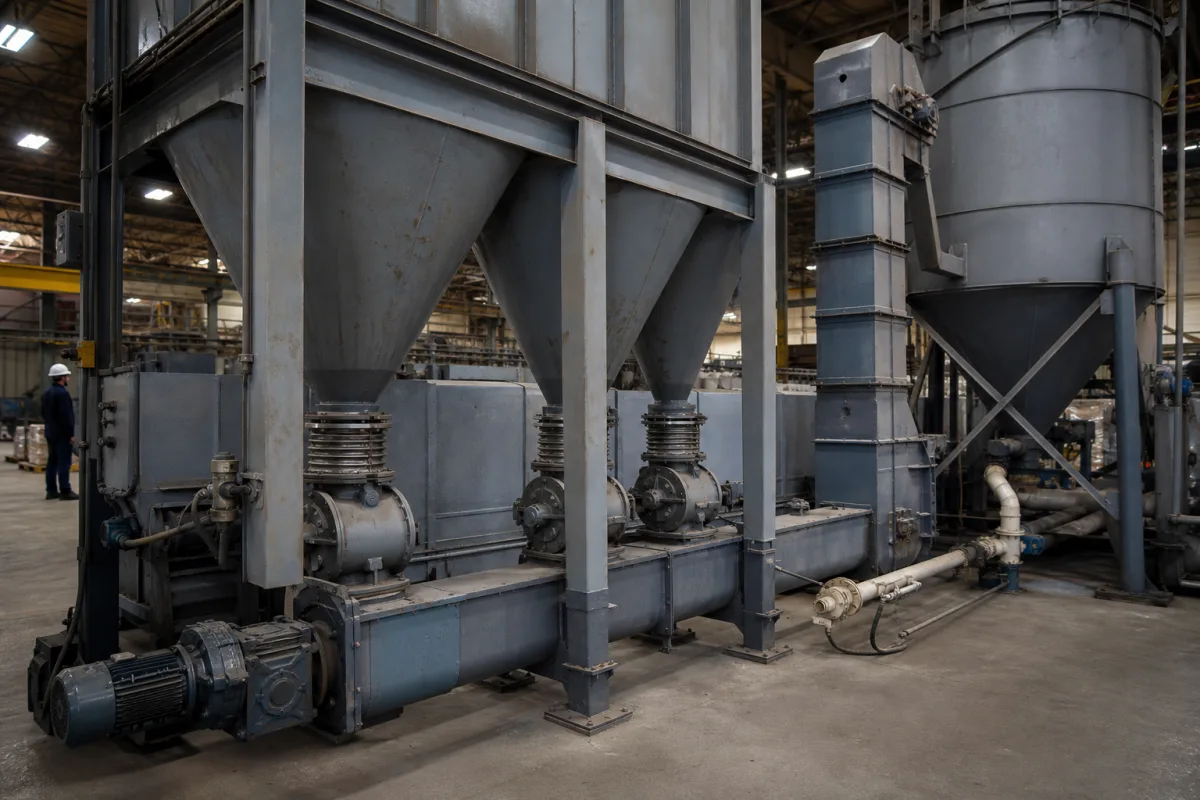
A system designed to collect, transport, and manage dust particles generated during industrial processes.
Product Specifications

Technical details and manufacturing context for Dust Handling System

Definition
As a critical component of the Off-gas Cleaning System, the Dust Handling System is responsible for capturing airborne dust particles from process exhaust streams, conveying them through ductwork, and delivering them to collection or disposal points to prevent environmental contamination and maintain air quality standards.
Working Principle
The system operates by creating negative pressure through fans or blowers to draw dust-laden air into collection hoods, then transports the captured dust through sealed ductwork using pneumatic conveying or mechanical methods to filtration units or storage containers.
Common Materials
Carbon Steel, Stainless Steel, Fiberglass Reinforced Plastic
Technical Parameters
  • Air handling capacity indicating the volume of air the system can process per hour (m³/h) Per Request
Components / BOM
  • Collection Hood
    Captures dust particles at the source of generation
    Material: Stainless Steel
  • Ductwork
    Transports dust-laden air from collection points to filtration units
    Material: Galvanized Steel
  • Fan/Blower
    Creates negative pressure to draw air through the system
    Material: Cast Iron/Steel
  • Filter Unit
    Separates dust particles from the air stream
    Material: Fabric/Stainless Steel
  • Dust Discharge Mechanism
    Removes collected dust from the system for disposal
    Material: Carbon Steel
Engineering Reasoning
0.5-2.0 m/s transport velocity, 500-2000 Pa negative pressure differential
Dust concentration exceeding 50 g/m³ at filter inlet, particle velocity below 0.3 m/s causing settling
Design Rationale: Electrostatic discharge ignition at dust cloud concentrations above lower explosive limit (LEG) of 20 g/m³ for wood dust, laminar flow transition causing particle deposition at Reynolds numbers below 2000
Risk Mitigation (FMEA)
Trigger Moisture ingress exceeding 5% relative humidity in transported air
Mode: Dust agglomeration and bridging in ductwork
Strategy: Desiccant air dryers maintaining <2% RH, heated duct sections at 40°C
Trigger Filter differential pressure exceeding 2500 Pa for 30 minutes
Mode: Filter media rupture and dust bypass
Strategy: Differential pressure transducers with automatic bypass valves at 2000 Pa, pleated filter design with 0.3 μm pore size

Industry Taxonomies & Aliases

Commonly used trade names and technical identifiers for Dust Handling System.

Applied To / Applications

This component is essential for the following industrial systems and equipment:

Industrial Ecosystem & Supply Chain DNA

Complementary Systems
Downstream Applications
Specialized Tooling

Application Fit & Sizing Matrix

Operational Limits
pressure: Up to 10 bar
flow rate: 100 to 10,000 m³/h
temperature: -20°C to 150°C
slurry concentration: Up to 30% solids by weight
Media Compatibility
✓ Wood dust ✓ Metal powders ✓ Mineral dusts
Unsuitable: Explosive or pyrophoric dust environments
Sizing Data Required
  • Dust generation rate (kg/h)
  • Particle size distribution (μm)
  • Required capture efficiency (%)

Reliability & Engineering Risk Analysis

Failure Mode & Root Cause
Abrasive wear on fan impellers and ductwork
Cause: High-velocity particulate flow causing erosion, especially with hard, angular dust particles like silica or metal fines
Dust accumulation and bridging in hoppers/silos
Cause: Moisture absorption, poor material flow properties, or inadequate aeration leading to compaction and blockages
Maintenance Indicators
  • Unusual vibration or imbalance in fan/motor assemblies
  • Reduced suction pressure or visible dust leakage at joints and seals
Engineering Tips
  • Implement wear-resistant linings (ceramic, polyurethane) in high-velocity zones and install erosion monitoring patches
  • Maintain consistent material moisture control and install aeration pads/air cannons to prevent bridging in storage vessels

Compliance & Manufacturing Standards

Reference Standards
ISO 14644-1:2015 Cleanrooms and associated controlled environments ANSI/ASHRAE Standard 52.2-2017 Method of Testing General Ventilation Air-Cleaning Devices for Removal Efficiency by Particle Size DIN EN 779:2012 Particulate air filters for general ventilation
Manufacturing Precision
  • Ductwork diameter: +/- 1.5% of nominal diameter
  • Filter housing sealing surface flatness: 0.5 mm across any 300 mm length
Quality Inspection
  • Pressure decay leak test for ductwork and containment vessels
  • Particle counting efficiency test for filtration units

Factories Producing Dust Handling System

Verified manufacturers with capability to produce this product in China

✓ 97% Supplier Capability Match Found

P Project Engineer from Canada Jan 25, 2026
★★★★★
"Found 45+ suppliers for Dust Handling System on CNFX, but this spec remains the most cost-effective."
Technical Specifications Verified
S Sourcing Manager from United States Jan 22, 2026
★★★★★
"The technical documentation for this Dust Handling System is very thorough, especially regarding technical reliability."
Technical Specifications Verified
P Procurement Specialist from United Arab Emirates Jan 19, 2026
★★★★★
"Reliable performance in harsh Machinery and Equipment Manufacturing environments. No issues with the Dust Handling System so far."
Technical Specifications Verified
Verification Protocol

“Feedback is collected from verified sourcing managers during RFQ (Request for Quote) and factory evaluation processes on CNFX. These reports represent historical performance data and technical audit summaries from our B2B manufacturing network.”

15 sourcing managers are analyzing this specification now. Last inquiry for Dust Handling System from Brazil (1h ago).

Supply Chain Compatible Machinery & Devices

Automated Assembly Line System

Integrated production system for sequential component assembly operations

Explore Specs →
Automated Powder Coating System

Integrated industrial system for applying dry powder coatings to metal substrates.

Explore Specs →
Centrifugal Pump Impeller

Rotating component that transfers energy to fluid in centrifugal pumps.

Explore Specs →
High-Precision CNC Laser Cutting Machine

Computer-controlled industrial machine using focused laser beams to cut sheet metal with micron-level accuracy.

Explore Specs →

Frequently Asked Questions

What materials are best for corrosive dust environments?

For corrosive environments, we recommend stainless steel or fiberglass reinforced plastic (FRP) components, which offer superior resistance to chemical degradation compared to standard carbon steel.

How do I determine the right fan/blower capacity for my facility?

Fan capacity depends on dust volume, particle size, ductwork length, and system resistance. Our engineers calculate CFM requirements based on your specific process data and facility layout to ensure optimal performance.

What maintenance is required for the filter unit?

Regular filter inspection and replacement is essential. Maintenance frequency depends on dust load, but typically includes monthly inspections, periodic cleaning of filter media, and replacement every 6-24 months based on usage conditions.

Can I contact factories directly on CNFX?

CNFX is an open directory, not a transaction platform. Each factory profile provides direct contact information and production details to help you initiate direct inquiries with Chinese suppliers.

Get Quote for Dust Handling System

Request technical pricing, lead times, or customized specifications for Dust Handling System directly from verified manufacturing units.

Your business information is encrypted and only shared with verified Dust Handling System suppliers.

Thank you! Your message has been sent. We'll respond within 1–3 business days.

Need to Manufacture Dust Handling System?

Connect with verified factories specializing in this product category

Add Your Factory Contact Us
Previous Product
Dust Extraction Unit
Next Product
Dust Hopper