Industry-Verified Manufacturing Data (2026)

Dust Hopper

Based on aggregated insights from multiple verified factory profiles within the CNFX directory, the standard Dust Hopper used in the Machinery and Equipment Manufacturing sector typically supports operational capacities ranging from standard industrial configurations to heavy-duty production requirements.

Technical Definition & Core Assembly

A canonical Dust Hopper is characterized by the integration of Hopper Body and Discharge Outlet. In industrial production environments, manufacturers listed on CNFX commonly emphasize Carbon Steel construction to support stable, high-cycle operation across diverse manufacturing scenarios.

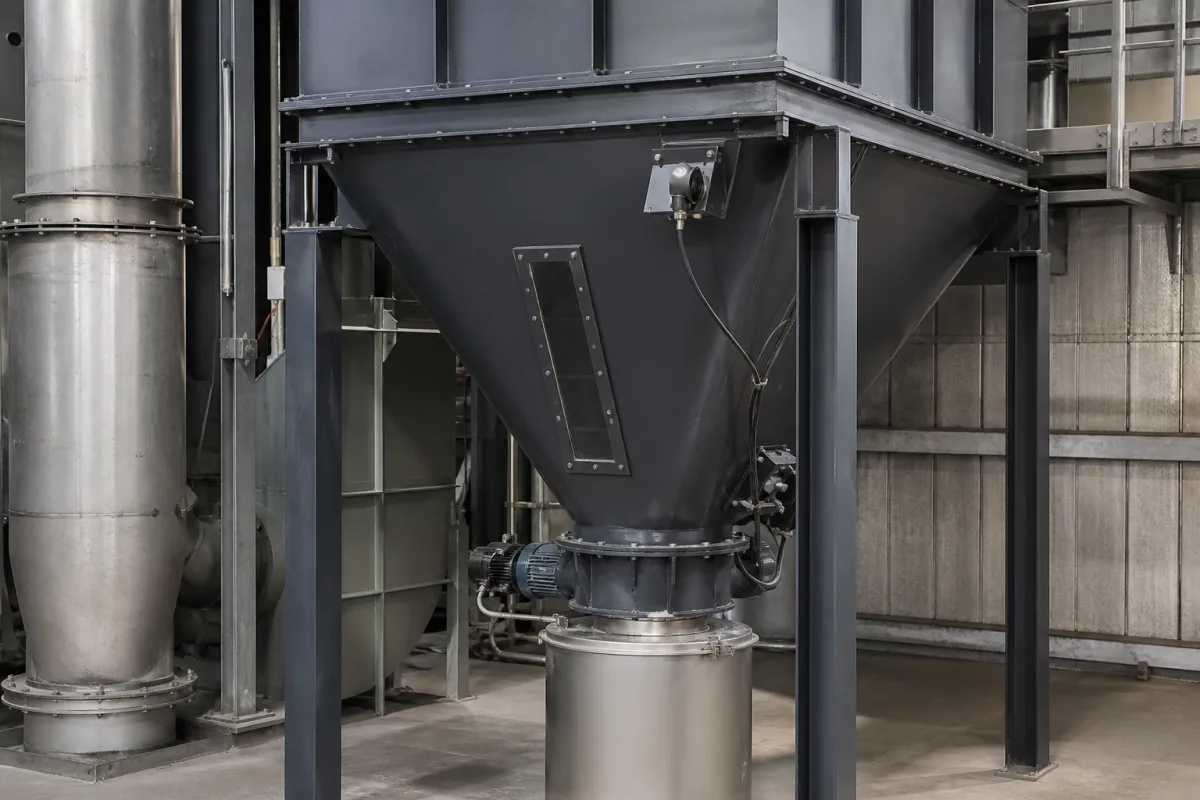
A conical or pyramidal container that collects and temporarily stores dust and particulate matter separated from air streams by dust collection systems.
Product Specifications

Technical details and manufacturing context for Dust Hopper

Definition
The dust hopper is an essential component of industrial dust collection systems, serving as the primary collection and storage vessel for captured particulate matter. Located at the bottom of dust collectors, cyclones, or baghouses, it receives separated dust from filtration media or centrifugal separation processes. Its design facilitates material accumulation while preventing re-entrainment into the air stream, typically featuring sloped walls to promote material flow toward discharge mechanisms.
Working Principle
Dust-laden air enters the dust collection system where particulate matter is separated through filtration, centrifugal force, or electrostatic precipitation. The separated dust particles fall by gravity into the hopper below. The hopper's sloped walls guide the accumulated material toward the discharge outlet, where it can be removed manually or through automated systems like rotary valves, screw conveyors, or dump valves. Proper hopper design prevents bridging and rat-holing of material while maintaining system pressure integrity.
Common Materials
Carbon Steel, Stainless Steel, Aluminum
Technical Parameters
  • Hopper outlet diameter for discharge compatibility (mm) Customizable
Components / BOM
  • Hopper Body
    Primary containment structure with sloped walls for dust collection and flow
    Material: Carbon Steel
  • Discharge Outlet
    Opening at the bottom for dust removal, often with flange for valve attachment
    Material: Carbon Steel
  • Support Structure
    Legs or brackets to mount the hopper to the dust collector or floor
    Material: Carbon Steel
  • Access Door
    Removable panel for inspection, cleaning, and maintenance
    Material: Carbon Steel
  • Vibration Mechanism
    Optional device to prevent material bridging and promote flow (air vibrators or mechanical rappers)
    Material: Stainless Steel
Engineering Reasoning
0-2.5 bar differential pressure, 0-150°C material temperature
3.0 bar differential pressure causing structural deformation, 200°C material temperature causing thermal degradation
Design Rationale: Von Mises yield criterion exceeding 250 MPa yield strength of carbon steel, Arrhenius equation thermal degradation at activation energy 80 kJ/mol
Risk Mitigation (FMEA)
Trigger Electrostatic discharge accumulation exceeding 10 kV potential
Mode: Dust explosion propagation through hopper volume
Strategy: Grounding system with resistance <10 ohms and explosion venting at 0.5 bar relief pressure
Trigger Moisture ingress raising humidity above 60% RH
Mode: Bridging and compaction forming 1.5 g/cm³ dust cakes
Strategy: Heated jacket maintaining 5°C above dew point and 45° inclined walls

Industry Taxonomies & Aliases

Commonly used trade names and technical identifiers for Dust Hopper.

Applied To / Applications

This component is essential for the following industrial systems and equipment:

Industrial Ecosystem & Supply Chain DNA

Complementary Systems
Downstream Applications
Specialized Tooling

Application Fit & Sizing Matrix

Operational Limits
pressure: Atmospheric to 0.5 bar gauge (typically operates at slight negative pressure)
flow rate: Dependent on upstream dust collector capacity and discharge frequency
temperature: -20°C to 150°C (depending on material of construction)
slurry concentration: Not applicable - designed for dry particulate storage only
Media Compatibility
✓ Wood dust ✓ Metal grinding fines ✓ Plastic powder
Unsuitable: Corrosive chemical vapors or wet slurry environments
Sizing Data Required
  • Dust collection rate (kg/hr)
  • Required storage capacity (m³)
  • Discharge frequency/cycle time

Reliability & Engineering Risk Analysis

Failure Mode & Root Cause
Structural fatigue cracking
Cause: Cyclic loading from material accumulation and discharge, vibration from connected equipment, and stress concentrations at weld joints or sharp corners.
Material buildup and bridging
Cause: Inadequate hopper angle, moisture ingress causing material adhesion, or electrostatic buildup leading to flow obstruction and increased structural stress.
Maintenance Indicators
  • Visible deformation or bulging of hopper walls
  • Unusual vibration or audible rattling during material discharge
Engineering Tips
  • Implement regular internal inspections using ultrasonic thickness testing to monitor wall thinning and schedule preventive lining replacement before failure occurs.
  • Optimize hopper geometry with steeper angles and install vibrators or air blasters at strategic points to prevent material bridging and reduce structural stress.

Compliance & Manufacturing Standards

Reference Standards
ISO 8573-1:2010 (Compressed air purity classes) ANSI/ASME B31.3 (Process piping design and safety) DIN EN 1092-1 (Flanges and their joints)
Manufacturing Precision
  • Weld seam alignment: +/- 1.5mm
  • Outlet flange flatness: 0.2mm across diameter
Quality Inspection
  • Visual weld inspection per AWS D1.1
  • Pressure test at 1.5x working pressure for 30 minutes

Factories Producing Dust Hopper

Verified manufacturers with capability to produce this product in China

✓ 93% Supplier Capability Match Found

T Technical Director from Germany Feb 11, 2026
★★★★★
"The Dust Hopper we sourced perfectly fits our Machinery and Equipment Manufacturing production line requirements."
Technical Specifications Verified
P Project Engineer from Brazil Feb 08, 2026
★★★★☆
"Found 58+ suppliers for Dust Hopper on CNFX, but this spec remains the most cost-effective. (Delivery took slightly longer than expected, but technical support was excellent.)"
Technical Specifications Verified
S Sourcing Manager from Canada Feb 05, 2026
★★★★★
"The technical documentation for this Dust Hopper is very thorough, especially regarding technical reliability."
Technical Specifications Verified
Verification Protocol

“Feedback is collected from verified sourcing managers during RFQ (Request for Quote) and factory evaluation processes on CNFX. These reports represent historical performance data and technical audit summaries from our B2B manufacturing network.”

11 sourcing managers are analyzing this specification now. Last inquiry for Dust Hopper from Mexico (1h ago).

Supply Chain Compatible Machinery & Devices

Hydraulic Press

Industrial machine using hydraulic pressure to compress, form, or assemble materials

Explore Specs →
Heavy-Duty CNC Plasma Cutting Machine

Industrial machine for precision metal cutting using plasma arc technology

Explore Specs →
Automated Assembly Line System

Integrated production system for sequential component assembly operations

Explore Specs →
Automated Powder Coating System

Integrated industrial system for applying dry powder coatings to metal substrates.

Explore Specs →

Frequently Asked Questions

What materials are available for dust hoppers in machinery manufacturing?

Dust hoppers are typically constructed from carbon steel, stainless steel, or aluminum, chosen based on corrosion resistance, material compatibility, and budget requirements.

How does the vibration mechanism work in a dust hopper?

The vibration mechanism prevents material bridging and ensures consistent dust flow through the discharge outlet by applying controlled vibrations to the hopper walls.

What are the key components of a dust hopper system?

Essential components include the hopper body, discharge outlet, support structure, access door for maintenance, and vibration mechanism for material flow management.

Can I contact factories directly on CNFX?

CNFX is an open directory, not a transaction platform. Each factory profile provides direct contact information and production details to help you initiate direct inquiries with Chinese suppliers.

Get Quote for Dust Hopper

Request technical pricing, lead times, or customized specifications for Dust Hopper directly from verified manufacturing units.

Your business information is encrypted and only shared with verified Dust Hopper suppliers.

Thank you! Your message has been sent. We'll respond within 1–3 business days.

Need to Manufacture Dust Hopper?

Connect with verified factories specializing in this product category

Add Your Factory Contact Us
Previous Product
Dust Handling System
Next Product
Dust Suppression System