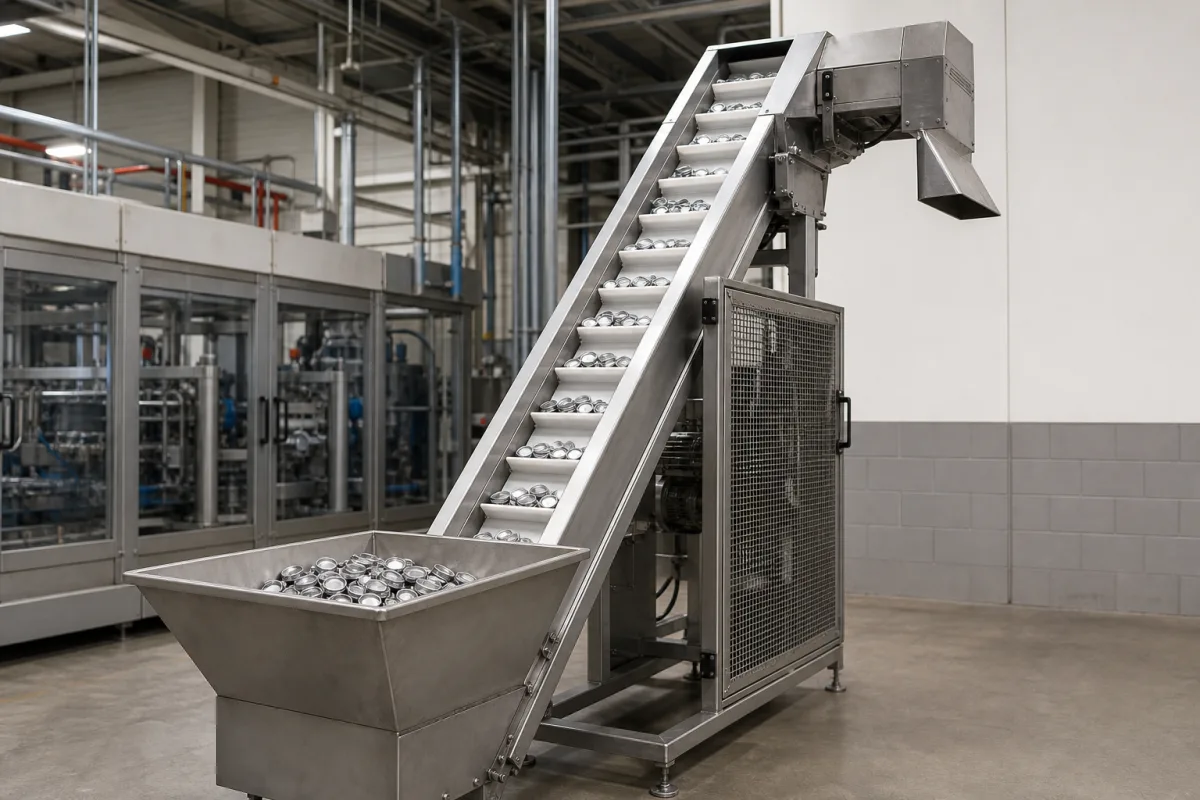
Crown cork elevator: the hopper and cleated incline belt that lift metal crowns to the crowner chute on a beer or soft-drink line
The hopper-and-belt unit that lifts loose metal crown corks from floor level to the crowner chute · sized in crowns per hour and hours of hopper autonomy, built so that upside-down crowns never reach the chute
Crown corks arrive at a bottling line in bulk, loose in boxes or bags, and the crowner needs them one at a time, skirt down, in a chute. The elevator in between is a floor-level hopper and an inclined belt that lifts the crowns to a chute, with a check that keeps upside-down crowns out of it. Because crowns touch the bottle mouth, the unit is also a hygiene point: dust, liner fragments and condensation in the hopper end up on the seal.
Hopper elevators and feeders that store, lift and orient metal crown corks for crowners on beer, soft-drink and other glass-bottle lines: hopper capacity and autonomy, cleated incline belts, orientation and upside-down crown rejection, air de-dusting and filtration, and the crown dimensions that the chute must fit. Cleated-belt elevators and orienting sorters for plastic screw caps are covered on the Cap sorter and elevator page; crowners and other crimping and roll-on capping machines, with their capping heads, on the Automated bottle capping machine for crimped, rolled-on and corked closures page.
CNFX editorial research · Sources checked October 13, 2026 · 4 sources
Crowns per hour and hours of autonomy: what the Gebo Aidlin 24CR states, and how it keeps upside-down crowns out of the chute
Sidel describes the Gebo Aidlin 24CR as one unit for storage, elevation, orientation and high-speed crown feeding, built on what it calls waterfall technology, which it says creates no dust. [1]
Editorial calculation: 81,000 crowns an hour is 1,350 a minute, so a full standard hopper of 90,000 crowns lasts about 67 minutes at the top rating; a 36,000 bottle-per-hour line would draw the same hopper down in 2.5 hours. Ask for autonomy at your own line speed, and for the hopper volume if you refill from bags or boxes of a fixed count.
Sidel lists a raised hopper with a secure front access door for cleaning and washable materials (PET and stainless steel) on this unit. [1] For comparison, a used Gebo Aidlin waterfall cap elevator sold for plastic screw, snap or child-resistant caps is described with a 48 × 52 × 30 inch split hopper, a 24-inch belt with ½-inch cleats on 2⅛-inch centres discharging at 150 inches, and a 12-inch belt with ⅝-inch cleats discharging at 132 inches, rated by the dealer at 50 to 2,000 caps per minute depending on materials and configuration. [4] Editorial calculation: 150 inches is about 3.8 m, the height a cleated belt has to lift caps to feed a chute above a capper turret.
State crowner speed in bottles per hour, how crowns arrive (boxes, bags, size of each), the refill height your operators can reach, the chute height at the crowner, and whether HEPA filtration and upside-down rejection are required.
02
The 26 mm crown the chute has to pass: 32.05 mm across, 6.0 mm high, 21 flutes
Tapón Corona's technical data sheet for its 26 mm pry-off crown gives the dimensions that an elevator's cleats, guides and chute have to handle: [2]
Editorial calculation: the millimetre values are conversions of the inch figures at 25.4 mm per inch; the crown is about 5.3 times wider than it is high (32.05 ÷ 6.0), so guide and chute clearances are set from the 6.0 mm height and the 32.05 mm diameter with their tolerances.
The same data sheet limits storage to 12 months at 20 to 30 °C in a dry place free of moisture. [2] Editorial note: an elevator hopper is part of that storage, so a larger hopper autonomy keeps crowns in the bottling hall's air for longer.
On the bottle side, EN ISO 12821 specifies the 26 H 180 crown finish for glass beverage bottles, designed for a metal crown closure according to CETIE data sheet EC 01-02; the 2015 German edition corrected a radius in its Figure 2 from 27.7 mm to 28.6 mm. [3]
Send the crown supplier's drawing (diameter, height, flute count, liner) and the bottle finish; ask the elevator supplier which change parts are needed for 26 mm and 29 mm crowns if both are run.
03
What to send for a crown cork elevator
Paste it into your enquiry below or into an email to a maker, then replace every bracket.
Line: [crowner model; bottles per hour]
Crowns: [26 or 29 mm; drawing; liner type]
Supply: [boxes or bags; count per pack; refill height]
Hopper: [autonomy in hours; large hopper option]
Quality: [upside-down rejection; de-dusting; HEPA filtration]
Installation: [chute height and length; floor space]
Explore company information and manufacturing capabilities, then discuss the scope of your project with a relevant supplier.
Share this page
Compiled and source-reviewed by the CNFX editorial team.
Each manufacturer above links to the page on that company's own website where the product is listed, with the date we checked it. How we source and review
· Page last updated 13 October 2026
Buyer questions
How fast can a crown feeder deliver crowns?
Sidel rates its Gebo Aidlin 24CR at up to 81,000 crowns per hour, with a standard hopper autonomy of 90,000 crowns. [1]
What are the dimensions of a 26 mm crown cork?
Tapón Corona's data sheet gives a crown height of 0.236 in (6.0 mm), an external diameter of 1.262 in (32.05 mm), an internal diameter of 1.055 in (26.8 mm) and 21 flutes. [2]
How are upside-down crowns kept out of the crowner?
The Gebo Aidlin 24CR lists ejection systems for upside-down crowns among its quality controls. [1]
Sources and what still needs a direct check
Sources checked 2026-10-13. Machine data are Sidel's own product page and a used-equipment dealer's listing; crown dimensions are a crown maker's technical data sheet; the bottle finish is the DIN Media summary of EN ISO 12821.