Industry-Verified Manufacturing Data (2026)

Encoder/Resolver

Based on aggregated insights from multiple verified factory profiles within the CNFX directory, the standard Encoder/Resolver used in the Machinery and Equipment Manufacturing sector typically supports operational capacities ranging from standard industrial configurations to heavy-duty production requirements.

Technical Definition & Core Assembly

A canonical Encoder/Resolver is characterized by the integration of Code Disk and Light Source/Detector (for optical encoders). In industrial production environments, manufacturers listed on CNFX commonly emphasize Aluminum housing construction to support stable, high-cycle operation across diverse manufacturing scenarios.

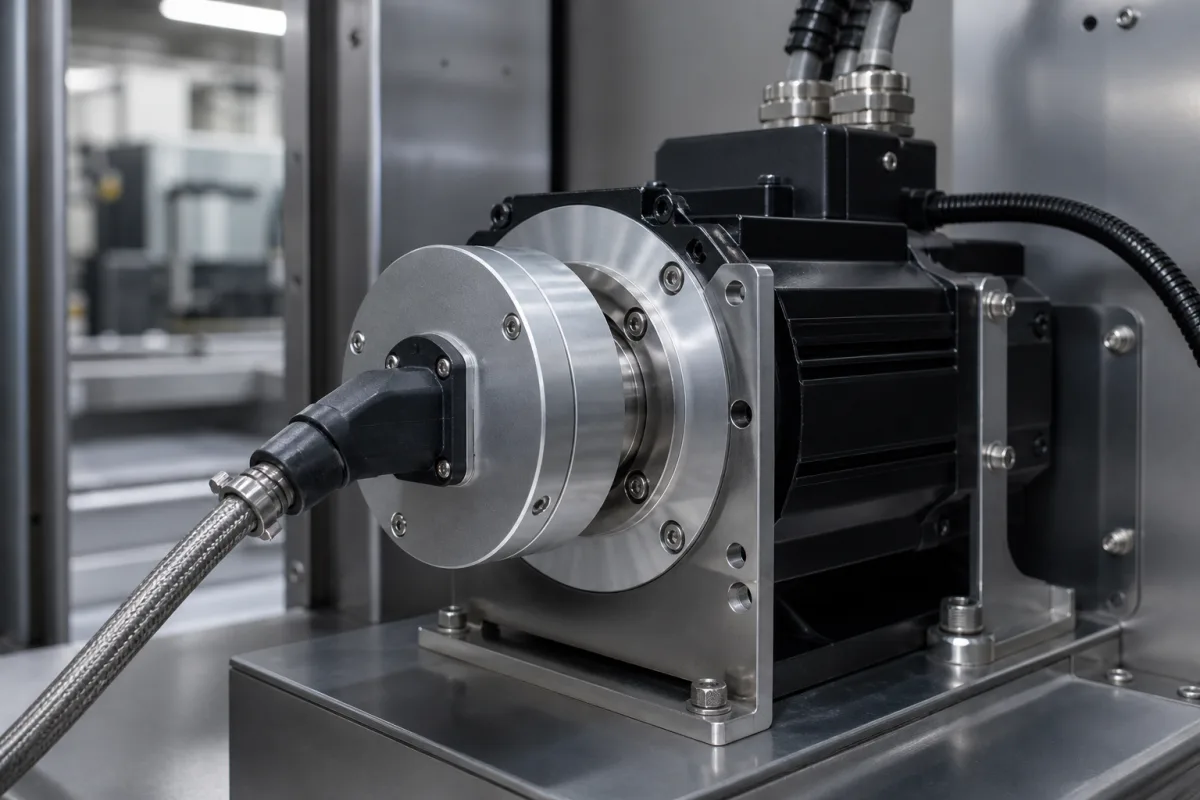
A sensor that converts mechanical motion into electrical signals for position, speed, or direction feedback in control systems.
Product Specifications

Technical details and manufacturing context for Encoder/Resolver

Definition
An encoder/resolver is a critical feedback component within control systems and motor drives that provides precise position, velocity, and direction information by converting rotary or linear mechanical motion into digital or analog electrical signals. It enables closed-loop control for accurate motion regulation in industrial automation applications.
Working Principle
Encoders typically use optical, magnetic, or capacitive sensing to generate digital pulses corresponding to position changes. Resolvers operate on electromagnetic induction principles, producing sine/cosine analog signals that represent angular position through transformer coupling between rotor and stator windings.
Common Materials
Aluminum housing, Stainless steel shaft, PCB with sensing elements, Magnetic/optical disks
Technical Parameters
  • Resolution determines position measurement precision (pulses/revolution) Per Request
Components / BOM
  • Code Disk
    Contains optical or magnetic patterns that are read to determine position
    Material: Glass or metal with patterned coating
  • Light Source/Detector (for optical encoders)
    Emits and detects light through code disk patterns
    Material: LED and phototransistor array
  • Rotor/Stator Windings (for resolvers)
    Electromagnetic components that generate position-dependent signals
    Material: Copper wire with insulation
  • Signal Conditioning Circuitry
    Processes raw sensor signals into usable output formats
    Material: PCB with integrated circuits
  • Housing
    Protects internal components from environmental factors
    Material: Aluminum alloy or stainless steel
Engineering Reasoning
0-10000 RPM rotational speed, -40°C to 125°C temperature, 5-24 VDC supply voltage
15000 RPM centrifugal force causing bearing deformation, 150°C thermal degradation of Hall-effect sensors, 30 VDC dielectric breakdown of insulation
Design Rationale: Centrifugal force exceeding yield strength of bearing materials (σ_yield = 250 MPa for 52100 steel), Arrhenius equation thermal aging (E_a = 0.7 eV for epoxy encapsulation), Fowler-Nordheim tunneling in oxide layers at 6 MV/cm electric field
Risk Mitigation (FMEA)
Trigger Electrostatic discharge (ESD) exceeding 8 kV HBM
Mode: Gate oxide breakdown in CMOS circuitry
Strategy: Integrated ESD protection diodes with 15 kV IEC 61000-4-2 rating and 5 Ω series resistance
Trigger Shaft misalignment exceeding 0.05 mm radial runout
Mode: Uneven bearing wear causing signal jitter > 5 arc-minutes
Strategy: Precision ground shaft with 0.01 mm tolerance and dual angular contact bearings with 15° contact angle

Industry Taxonomies & Aliases

Commonly used trade names and technical identifiers for Encoder/Resolver.

Applied To / Applications

This component is essential for the following industrial systems and equipment:

Industrial Ecosystem & Supply Chain DNA

Complementary Systems
Downstream Applications
Specialized Tooling

Application Fit & Sizing Matrix

Operational Limits
pressure: Atmospheric to 2 bar (typical), IP65/IP67/IP69K ratings available
other spec: Vibration: 20g @ 2kHz, Shock: 100g @ 11ms, Speed: Up to 30,000 RPM, Resolution: 12-24 bits
temperature: -40°C to +125°C (operating), -55°C to +150°C (storage)
Media Compatibility
✓ Industrial machinery (CNC, robotics) ✓ Automotive steering/transmission systems ✓ Aerospace flight control actuators
Unsuitable: High-pressure washdown with direct water jet impingement (unless IP69K rated)
Sizing Data Required
  • Required resolution (bits/counts per revolution)
  • Maximum operating speed (RPM)
  • Mounting configuration (shaft/hollow/flange type)

Reliability & Engineering Risk Analysis

Failure Mode & Root Cause
Signal degradation or loss
Cause: Contamination ingress (dust, oil, moisture) compromising optical/electrical components, or wear/damage to encoder disc/resolver windings from vibration/misalignment
Mechanical binding or bearing failure
Cause: Bearing wear due to inadequate lubrication, excessive axial/radial loads, or shaft misalignment leading to increased friction and eventual seizure
Maintenance Indicators
  • Intermittent or erratic position feedback (e.g., jumps, dropouts in data) during operation
  • Unusual audible noise (grinding, clicking) or increased vibration from the encoder/resolver housing
Engineering Tips
  • Ensure proper environmental sealing (IP rating) and regular cleaning to prevent contamination; use shielded cables and proper grounding to protect signal integrity
  • Maintain precise shaft alignment, avoid overloading, and follow manufacturer's lubrication schedule for bearings; monitor vibration trends for early detection of mechanical issues

Compliance & Manufacturing Standards

Reference Standards
ISO 9001:2015 (Quality Management Systems) IEC 60068-2-6 (Vibration Testing) EN 61000-6-2 (EMC Immunity for Industrial Environments)
Manufacturing Precision
  • Radial Runout: ≤0.01mm
  • Shaft Straightness: ≤0.005mm/m
Quality Inspection
  • High-Resolution Signal Accuracy Test (using precision rotary table)
  • IP Rating Verification (dust/water ingress protection per IEC 60529)

Factories Producing Encoder/Resolver

Verified manufacturers with capability to produce this product in China

✓ 96% Supplier Capability Match Found

P Project Engineer from Australia Feb 06, 2026
★★★★★
"Found 13+ suppliers for Encoder/Resolver on CNFX, but this spec remains the most cost-effective."
Technical Specifications Verified
S Sourcing Manager from Singapore Feb 03, 2026
★★★★★
"The technical documentation for this Encoder/Resolver is very thorough, especially regarding technical reliability."
Technical Specifications Verified
P Procurement Specialist from Germany Jan 31, 2026
★★★★★
"Reliable performance in harsh Machinery and Equipment Manufacturing environments. No issues with the Encoder/Resolver so far."
Technical Specifications Verified
Verification Protocol

“Feedback is collected from verified sourcing managers during RFQ (Request for Quote) and factory evaluation processes on CNFX. These reports represent historical performance data and technical audit summaries from our B2B manufacturing network.”

16 sourcing managers are analyzing this specification now. Last inquiry for Encoder/Resolver from UAE (40m ago).

Supply Chain Compatible Machinery & Devices

Automated Assembly Line System

Integrated production system for sequential component assembly operations

Explore Specs →
Automated Powder Coating System

Integrated industrial system for applying dry powder coatings to metal substrates.

Explore Specs →
Centrifugal Pump Impeller

Rotating component that transfers energy to fluid in centrifugal pumps.

Explore Specs →
High-Precision CNC Laser Cutting Machine

Computer-controlled industrial machine using focused laser beams to cut sheet metal with micron-level accuracy.

Explore Specs →

Frequently Asked Questions

What is the difference between an encoder and a resolver?

Encoders use optical or magnetic disks to provide digital position feedback, while resolvers use electromagnetic induction to deliver analog signals. Resolvers are more robust in harsh environments, while encoders offer higher resolution.

What materials are used in encoder/resolver construction?

Our sensors feature aluminum housings for durability, stainless steel shafts for corrosion resistance, and high-quality PCBs with sensing elements. Optical versions use precision code disks, while magnetic versions use magnetic disks.

How do I choose between optical and magnetic encoders?

Optical encoders provide higher resolution and accuracy for clean environments, while magnetic encoders are better for dusty, humid, or high-vibration applications where contamination resistance is critical.

Can I contact factories directly on CNFX?

CNFX is an open directory, not a transaction platform. Each factory profile provides direct contact information and production details to help you initiate direct inquiries with Chinese suppliers.

Get Quote for Encoder/Resolver

Request technical pricing, lead times, or customized specifications for Encoder/Resolver directly from verified manufacturing units.

Your business information is encrypted and only shared with verified Encoder/Resolver suppliers.

Thank you! Your message has been sent. We'll respond within 1–3 business days.

Need to Manufacture Encoder/Resolver?

Connect with verified factories specializing in this product category

Add Your Factory Contact Us
Previous Product
Encoder/Feedback Sensor
Next Product
Encoder/Sensor