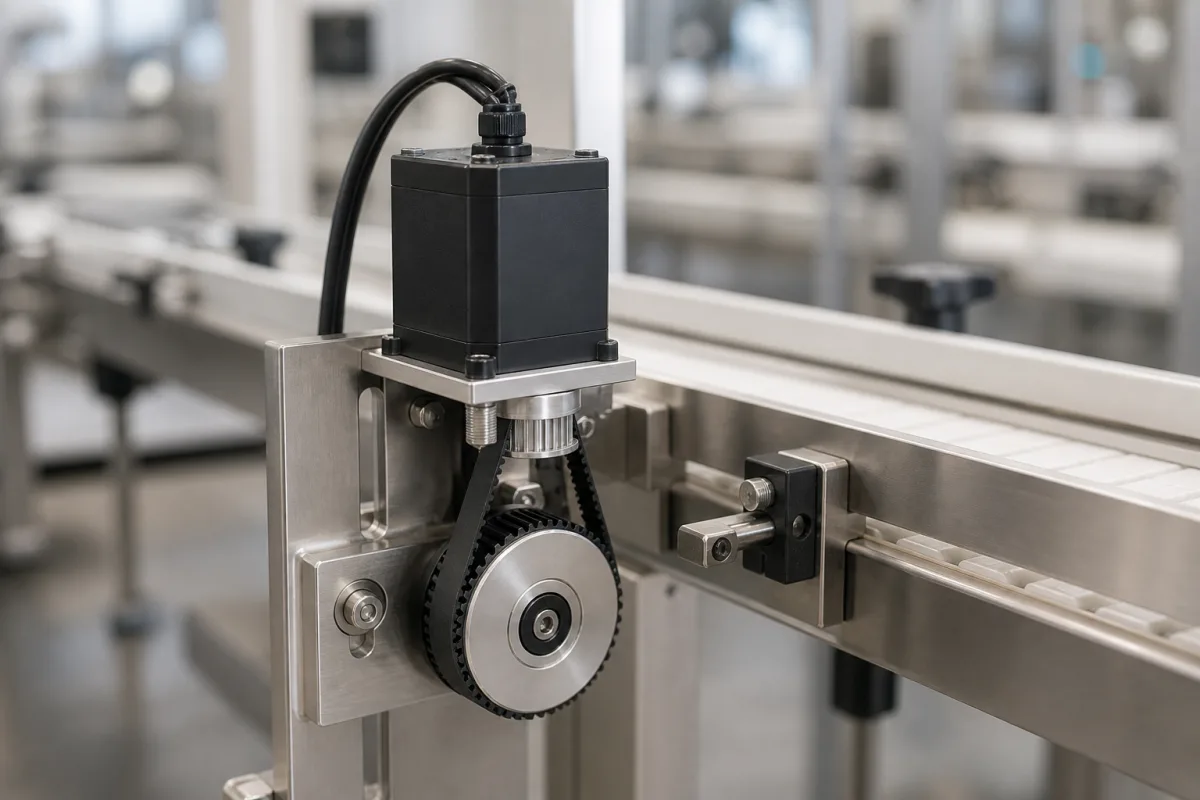
Integrated servo or stepper motor with built-in drive and encoder (all-in-one motor for DC-powered axes)
Integrated motors · closed-loop stepper or brushless servo with encoder and drive in the motor housing, DC supply, pulse or fieldbus command
An integrated servo or stepper motor puts the drive electronics and the position encoder inside, or bolted onto, the motor housing. The machine then needs only a DC supply and a command cable to each axis, instead of a drive in the cabinet, a motor power cable and a separate encoder cable. Two families share the idea: closed-loop hybrid steppers, which add an encoder so that lost steps are caught and corrected, and small brushless servo motors with their amplifier on board. The choice turns on torque and speed, supply voltage, the command signal or network the controller speaks, and where the heat from the drive goes.
Integrated motors in which a hybrid stepper or a brushless servo motor, its encoder and its drive form one unit, powered from DC and commanded by pulse and direction, digital I/O or a fieldbus. Separate AC and DC servo motors, sized against their speed–torque curves, are covered on the Servo motor page; open-loop and closed-loop stepper motors used with a separate driver on the Stepper motor page; separate stepper drivers on the Stepper motor driver page; separate servo amplifiers on the Servo drive page; built-in absolute encoders with digital drive interfaces on the Servo motor feedback encoder page; matched cabinet drive and motor packages on the Servo motor and drive set page; and servo press modules on the Servo motor actuator for press-fitting page.
CNFX editorial research · Sources checked October 12, 2026 · 4 sources
Drive, encoder and controller inside the motor: what leaves the cabinet
Teknic describes its ClearPath motors as a brushless permanent-magnet motor, high-resolution encoder, servo drive and motion controller in one package, and points out that the cable between motor and drive is eliminated altogether. The encoder signals stay inside the motor; a digital status output reports when moves are done or gives 1, 2, 4, 8 or 16 pulses per revolution. [4]
Leadshine builds its iCS series the same way on the stepper side: a stepper motor with a 14-bit absolute magnetic encoder and drive integrated, intended to solve the loss-of-step problem of open-loop stepper systems. Leadshine says integration saves mounting space, removes encoder connection and motor wiring time and reduces interference. [1]
Xinlichuan's integrated servo combines a servo motor, servo driver and encoder in one unit and claims that it reduces wiring by over 50%, a maker's claim without a stated basis. [3] Teknic adds a thermal point: ClearPath has a compression-fit aluminium housing around the stator to carry heat into the mounting surface, which it says acts as a heat sink and raises continuous power output. [4]
Because the drive sits on the motor, the mounting bracket is also its heat path. Ask for the continuous rating at your mounting (metal plate, plastic bracket or open frame) and ambient temperature.
02
Closed-loop stepper or integrated servo: torque, supply voltage and encoder counts
Published figures from three makers show where the two families sit. The iCS closed-loop stepper tops out at 3.5 N·m; the integrated servos run at 3000 rpm and are rated by power. [1][3]
Editorial calculation: 0.637 N·m at 3000 rpm is 0.637 × 2π × 50 ≈ 200 W, and 3.2 N·m at 3000 rpm ≈ 1005 W, so Xinlichuan's torque and power ratings agree. A 14-bit encoder resolves 360° / 16,384 ≈ 0.022° per count, Teknic's 12,800 counts ≈ 0.028°, and a 17-bit encoder ≈ 0.0027°. On the NEMA 23 ClearPath, peak power reaches about 4.8 times continuous power at the top of the range (770 / 162). [3][1][4]
Teknic markets its step-and-direction model as a drop-in for a stepper drive: re-wire the step and direction signals from the stepper drive to ClearPath-SD. [4] That makes the two families interchangeable at the command level; the deciding numbers are the torque needed at operating speed and the voltage the machine already distributes.
Digital I/O, step and direction, software API, EtherNet/IP, EtherCAT [4]
03
Command inputs, protection rating and bearing life on a motor that carries its own electronics
With the drive on board, the motor's control inputs are exposed to the machine's wiring. Teknic states that ClearPath inputs are optically isolated, protected against reverse polarity, and withstand a continuous overvoltage of up to 30 VDC. [4]
Ingress ratings differ by model: Teknic offers IP53 and IP67/66K versions, with EtherCAT and EtherNet/IP models in IP67 only [4]; Xinlichuan rates its integrated servos IP65 [3]. Leadshine's iSV2-RS is commissioned with its Motion Studio GUI software. [2]
Teknic says the only wearing parts in ClearPath are the shaft bearings, sealed and oversized, with an expected front-bearing life of more than 25 billion revolutions, which it equates to almost 50 years at 1,000 rpm around the clock. [4] Editorial calculation: 1,000 rpm for a year is 525.6 million revolutions, so 25 billion revolutions is about 47.6 years.
State the supply voltage and current budget per axis, the command (pulse, RS485/Modbus, CANopen, EtherCAT, EtherNet/IP), the torque and speed at the working point, the load inertia, the protection rating, and the cable exit direction the bracket allows.
04
Axis data for an integrated motor quotation
Paste it into your enquiry below or into an email to a maker, then replace every bracket.
Motion: [torque at speed; peak torque; speed; inertia]
Type: [closed-loop stepper / integrated servo]
Frame: [NEMA or mm flange; shaft]
Supply: [VDC; current per axis]
Command: [pulse-direction / digital I/O / RS485 / CANopen / EtherCAT / EtherNet/IP]
Feedback: [incremental / absolute; resolution]
Environment: [IP rating; ambient; mounting surface]
Options: [brake; gearbox; cable length]
1 company lists this product among what they make. Company figures are quoted from each
company's own website; every card states where the relationship came from.
Shenzhen Xinlichuan Electric Co., Ltd.
Manufacturing site to be confirmed for the order
Lists a 200 W integrated servo motor that combines motor, servo driver and 17-bit encoder in one IP65 unit, with pulse, RS485 or CANopen control at DC 24/48 V.
Integrated servo motor product page on the company's site (lichuanservo.com, legal name Shenzhen Xinlichuan Electric Co., Ltd.) · profile compiled by CNFX from public sources
Explore company information and manufacturing capabilities, then discuss the scope of your project with a relevant supplier.
Share this page
Compiled and source-reviewed by the CNFX editorial team.
Each manufacturer above links to the page on that company's own website where the product is listed, with the date we checked it. How we source and review
· Page last updated 13 October 2026
Buyer questions
What is inside an integrated servo or stepper motor?
The motor, its encoder and its drive in one unit; Teknic's ClearPath also includes a motion controller, and Leadshine's iCS pairs a stepper with a 14-bit absolute magnetic encoder and drive. [4][1]
What supply voltages do integrated motors use?
DC: Leadshine gives 24–60 VDC for its iSV2-RS, Xinlichuan DC24 V or DC48 V, and Teknic 24–75 VDC for its NEMA 23 ClearPath. [2][3][4]
Can an integrated servo replace a stepper motor and drive?
Teknic says its ClearPath-SD can take the step and direction signals from an existing stepper drive; the torque at operating speed still has to be checked. [4]
How fine is the built-in encoder?
Teknic gives 12,800 counts per revolution (64,000 on AC-input models); Xinlichuan lists 17-bit encoders; Leadshine's iCS uses a 14-bit magnetic encoder, about 0.022° per count (editorial calculation). [4][3][1]
Sources and what still needs a direct check
Sources checked 2026-10-12. Leadshine (Shenzhen) and Shenzhen Xinlichuan are Chinese motion-control makers; Teknic is a US maker of the ClearPath integrated servo. Each describes its own products.