Industry-Verified Manufacturing Data (2026)

Indexing Motor

Based on aggregated insights from multiple verified factory profiles within the CNFX directory, the standard Indexing Motor used in the Machinery and Equipment Manufacturing sector typically supports operational capacities ranging from standard industrial configurations to heavy-duty production requirements.

Technical Definition & Core Assembly

A canonical Indexing Motor is characterized by the integration of Stator and Rotor. In industrial production environments, manufacturers listed on CNFX commonly emphasize Electrical steel laminations construction to support stable, high-cycle operation across diverse manufacturing scenarios.

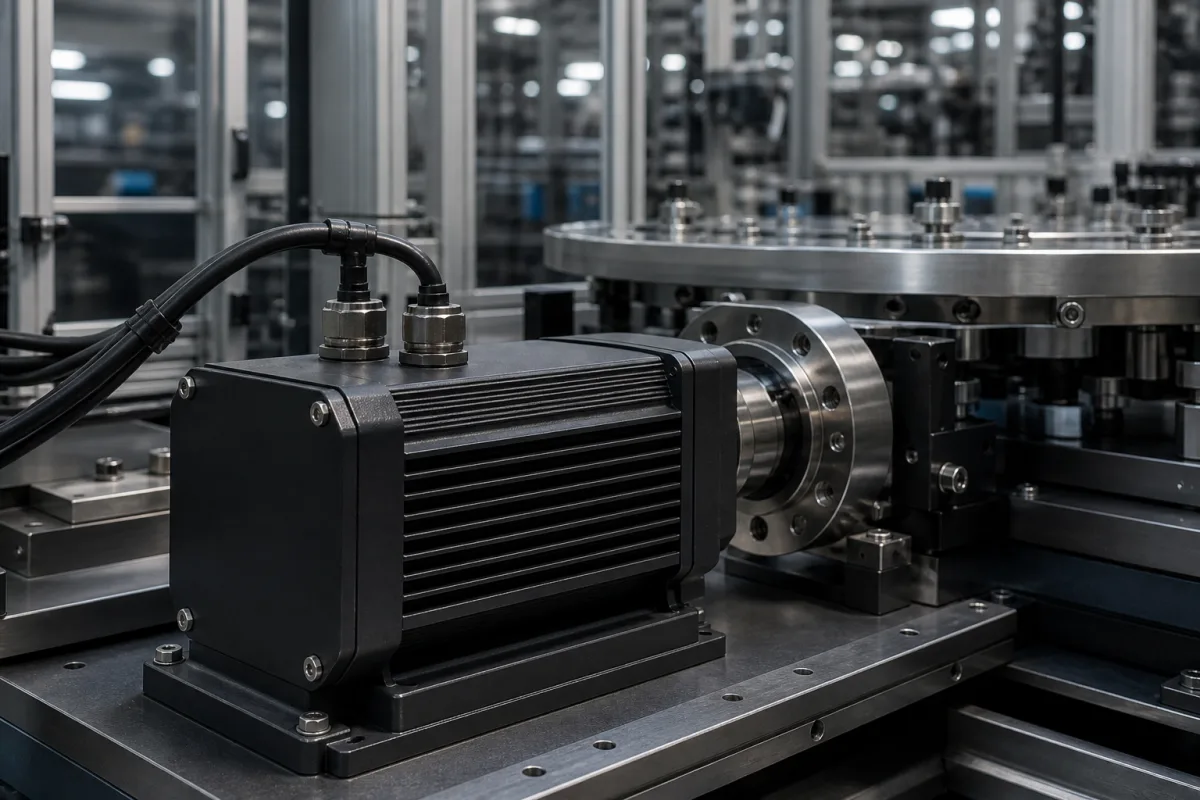
A specialized motor designed to provide precise rotational positioning and intermittent motion for indexing mechanisms.
Product Specifications

Technical details and manufacturing context for Indexing Motor

Definition
An indexing motor is a critical component within indexing mechanisms that enables controlled, stepwise rotational movement. It provides the precise angular positioning required for operations such as part transfer, tool positioning, assembly station indexing, and material handling in automated systems. The motor delivers intermittent motion with accurate stopping positions, allowing machinery to perform sequential operations at predetermined intervals.
Working Principle
The indexing motor operates by converting electrical energy into controlled mechanical rotation through electromagnetic principles. It receives positioning commands from a controller and executes precise angular movements to specific positions. Most modern indexing motors incorporate feedback systems (encoders or resolvers) to monitor position and ensure accuracy. They can operate in various modes including single-step indexing, continuous indexing with dwell periods, and programmable multi-position sequences.
Common Materials
Electrical steel laminations, Copper windings, Permanent magnets, Aluminum or steel housing
Technical Parameters
  • Indexing angle - the precise angular displacement per indexing step (degree) Customizable
Components / BOM
  • Stator
    Stationary part containing windings that create rotating magnetic field
    Material: Electrical steel laminations with copper windings
  • Rotor
    Rotating part that responds to magnetic field to produce torque
    Material: Permanent magnets or laminated steel
  • Encoder/Resolver
    Provides position feedback for closed-loop control
    Material: Optical or magnetic sensing elements with electronics
  • Brake
    Holds position during dwell periods to prevent drift
    Material: Friction materials with electromagnetic actuation
  • Housing
    Protects internal components and provides mounting interface
    Material: Aluminum alloy or steel
Engineering Reasoning
0.5-5.0 N·m torque, 0.1-10.0 rpm rotational speed, ±0.05° positioning accuracy
Continuous torque exceeding 6.0 N·m for >30 seconds, bearing temperature >120°C, encoder signal loss >100ms
Design Rationale: Bearing seizure due to lubricant breakdown at 120°C glass transition temperature, permanent magnet demagnetization at 150°C Curie point, encoder misalignment from thermal expansion coefficient mismatch (17×10⁻⁶/°C aluminum vs 11×10⁻⁶/°C steel)
Risk Mitigation (FMEA)
Trigger Back-EMF voltage spike exceeding 150% rated voltage during rapid deceleration
Mode: Insulation breakdown in stator windings causing phase-to-phase short circuit
Strategy: Integrated dynamic braking resistor with 100ms response time and varistor protection at drive terminals
Trigger Harmonic resonance at 2.5kHz matching natural frequency of rotor assembly
Mode: Accelerated bearing wear with vibration amplitude exceeding 0.5mm/s RMS
Strategy: Stiffness-tuned rotor design with damping ratio ζ=0.25 and notch filter at 2.5kHz in drive controller

Industry Taxonomies & Aliases

Commonly used trade names and technical identifiers for Indexing Motor.

Applied To / Applications

This component is essential for the following industrial systems and equipment:

Industrial Ecosystem & Supply Chain DNA

Complementary Systems
Downstream Applications
Specialized Tooling

Application Fit & Sizing Matrix

Operational Limits
pressure: Ambient to 2 bar (typical), up to 5 bar with special seals
other spec: Indexing accuracy: ±0.05° to ±0.5°, Torque range: 0.5 Nm to 500 Nm, Duty cycle: 10-100% intermittent
temperature: -20°C to +80°C (operating), -40°C to +100°C (storage)
Media Compatibility
✓ Clean air/dry gas environments ✓ Light lubricated mechanical systems ✓ Packaging machinery with controlled atmospheres
Unsuitable: Submerged or high-moisture corrosive environments without IP68+ protection
Sizing Data Required
  • Required indexing torque (Nm) at operational speed
  • Indexing angle precision (±°) and repeatability
  • Cycle time (seconds) and duty cycle percentage

Reliability & Engineering Risk Analysis

Failure Mode & Root Cause
Bearing degradation
Cause: Inadequate lubrication, contamination ingress, or misalignment leading to increased friction, overheating, and eventual seizure or catastrophic failure.
Winding insulation breakdown
Cause: Thermal cycling, moisture ingress, voltage spikes, or contamination causing insulation deterioration, leading to short circuits, phase-to-phase faults, or ground faults.
Maintenance Indicators
  • Abnormal audible noise (e.g., grinding, screeching, or humming) indicating bearing wear, misalignment, or electrical issues.
  • Excessive vibration or overheating detected via thermal imaging or vibration analysis, signaling imbalance, looseness, or impending mechanical failure.
Engineering Tips
  • Implement a condition-based maintenance program using vibration analysis, thermography, and motor current signature analysis to detect early degradation and schedule proactive interventions.
  • Ensure proper installation alignment, use clean and appropriate lubricants, and maintain environmental controls (e.g., sealing, ventilation) to prevent contamination and thermal stress.

Compliance & Manufacturing Standards

Reference Standards
ISO 1940-1:2003 (Balance quality requirements for rotors in a constant rigid state) ANSI/ASME B5.45-1972 (Spindle Noses and Tool Shanks for Indexing and Rotary Tables) DIN 5480-1:2006 (Involute splines based on reference diameters)
Manufacturing Precision
  • Shaft bore: +/-0.01mm (H7 tolerance)
  • Faceplate flatness: 0.05mm per 300mm diameter
Quality Inspection
  • Runout test (axial and radial) with dial indicator
  • Hardness testing (Rockwell C scale) of critical components

Factories Producing Indexing Motor

Verified manufacturers with capability to produce this product in China

✓ 94% Supplier Capability Match Found

T Technical Director from United Arab Emirates Jan 18, 2026
★★★★★
"As a professional in the Machinery and Equipment Manufacturing sector, I confirm this Indexing Motor meets all ISO standards."
Technical Specifications Verified
P Project Engineer from Australia Jan 15, 2026
★★★★☆
"Standard OEM quality for Machinery and Equipment Manufacturing applications. The Indexing Motor arrived with full certification. (Delivery took slightly longer than expected, but technical support was excellent.)"
Technical Specifications Verified
S Sourcing Manager from Singapore Jan 12, 2026
★★★★★
"Great transparency on the Indexing Motor components. Essential for our Machinery and Equipment Manufacturing supply chain."
Technical Specifications Verified
Verification Protocol

“Feedback is collected from verified sourcing managers during RFQ (Request for Quote) and factory evaluation processes on CNFX. These reports represent historical performance data and technical audit summaries from our B2B manufacturing network.”

5 sourcing managers are analyzing this specification now. Last inquiry for Indexing Motor from Germany (1h ago).

Supply Chain Compatible Machinery & Devices

Hydraulic Press

Industrial machine using hydraulic pressure to compress, form, or assemble materials

Explore Specs →
Heavy-Duty CNC Plasma Cutting Machine

Industrial machine for precision metal cutting using plasma arc technology

Explore Specs →
Automated Assembly Line System

Integrated production system for sequential component assembly operations

Explore Specs →
Automated Powder Coating System

Integrated industrial system for applying dry powder coatings to metal substrates.

Explore Specs →

Frequently Asked Questions

What is the primary application of an indexing motor in machinery manufacturing?

Indexing motors are used to provide precise rotational positioning and controlled intermittent motion in automated machinery, such as assembly lines, packaging equipment, and CNC machines, ensuring accurate part placement and timing.

How does the encoder or resolver enhance the performance of an indexing motor?

The encoder or resolver provides real-time feedback on the motor's position, enabling closed-loop control for high accuracy in rotational positioning, reducing errors, and improving repeatability in indexing applications.

What materials are used in the construction of indexing motors for durability?

Indexing motors are built with electrical steel laminations for efficient magnetic performance, copper windings for reliable electrical conductivity, permanent magnets for strong torque, and aluminum or steel housing for robust protection in industrial environments.

Can I contact factories directly on CNFX?

CNFX is an open directory, not a transaction platform. Each factory profile provides direct contact information and production details to help you initiate direct inquiries with Chinese suppliers.

Get Quote for Indexing Motor

Request technical pricing, lead times, or customized specifications for Indexing Motor directly from verified manufacturing units.

Your business information is encrypted and only shared with verified Indexing Motor suppliers.

Thank you! Your message has been sent. We'll respond within 1–3 business days.

Need to Manufacture Indexing Motor?

Connect with verified factories specializing in this product category

Add Your Factory Contact Us
Previous Product
Indexing Mechanism
Next Product
Indexing Sensor