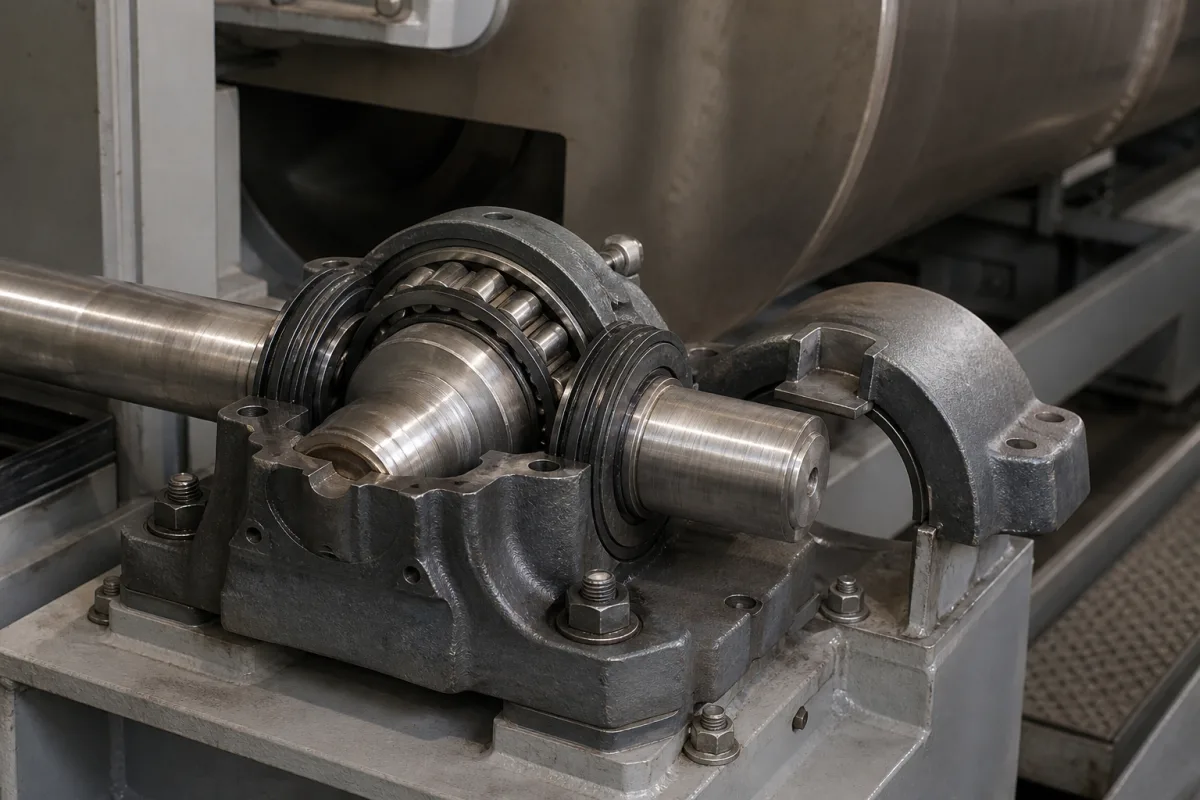
Bearing housings · Split plummer blocks and mounted units, load direction, locating and lubrication
A pillow block housing holds a bearing on a foot-mounted base. Ask three things first: which bearing and shaft it carries, which direction and size the load is, and whether it must locate the shaft axially and how it will be sealed and lubricated.
Split plummer (pillow) block housings for spherical roller, self-aligning and similar bearings, and one-piece mounted units with ball-bearing inserts (UCP type). Flange units, take-up units and bearings bought alone are outside this page.
CNFX editorial research · Sources checked October 12, 2026 · 5 sources
Schaeffler's SNV split plummer block catalogue gives housing rupture loads for load directions of 55°, 90°, 120°, 150° and 180° and the capacity of the bolts joining upper and lower halves; the values are for static load, a flat mounting surface (IT8) and a fully, rigidly supported base. It applies a safety factor of 6 to housing rupture load and 3 to the connecting bolts, limits axial load to two-thirds of the rupture load at 180°, and recommends stops or dowels when the load acts between 55° and 120° or axially. [1]
SKF's SNL 212 data sheet likewise lists breaking loads from 120 kN to 300 kN depending on load angle, an axial breaking load of 100 kN, and cap-bolt yield loads of 110–220 kN at 120° to 180°. [2] Check which angle convention each maker uses before comparing.
Editorial calculation: for Schaeffler's SNV110-F-L at a 150° load direction, housing rupture load 125 kN ÷ 6 ≈ 20.8 kN, and connecting-bolt capacity 45 kN ÷ 3 = 15 kN; the lower value, about 15 kN, sets the permissible static load. [1] The bearing's own ratings must also be checked.
Give the supplier the bearing designation and shaft diameter, load size and direction including axial load, speed, temperature, the mounting surface, the seal type, lubrication method and whether the housing is the locating or non-locating position.
02
Set locating, seals and lubrication
Schaeffler machines SNV bearing seats so the bearing can move axially as a non-locating bearing; fitting a locating ring on each side of the outer ring makes it the locating bearing, and the rings are ordered separately. Each housing size suits bearings of the matching outside diameter, and seals are chosen to match the shaft diameter, which differs when an adapter sleeve is used. [1]
For grease, Schaeffler fills the bearing completely and about 60% of the housing's free volume at first fill, gives minimum relubrication quantities, and tells fitters to open the grease outlet while relubricating so excess grease can escape and double-lip seals are not pushed out. Oil-bath and recirculating-oil versions are available. [1] SKF gives an initial grease fill of 80 g at 20% and 135 g at 40% for SNL 212. [2]
For mounted units, LDK describes cast grey iron, ductile iron and pressed-steel housings, UCP200, UCPX and UCP300 load groups, self-aligning inserts that accept slight static misalignment, and locking by set screws, eccentric collars, adapter sleeves or concentric collars. [3]
03
Check interchangeability against the ISO boundary dimension standards
ISO 113:2010 "specifies boundary dimensions for two-bolt plummer block housings primarily intended for rolling bearings in diameter series 0, 1, 2 and 3, as specified in ISO 15, and for four-bolt plummer block housings primarily intended for rolling bearings in diameter series 0, 1 and 2". It is the third edition, published on 29 June 2010, revising ISO 113:1999. For one-piece units, ISO 3228:2013 specifies boundary dimensions and tolerances for cast and pressed housings for insert bearings whose dimensions are given in ISO 9628, covering plummer block, flanged and take-up housings. [4][5]
These standards fix the mounting envelope, not the load capacity. The SKF SNL 212 sheet gives a bolt hole spacing of 210 mm and a shaft centre height of 70 mm [2], and Schaeffler's SNV catalogue gives rupture loads by direction [1]. Ask a supplier offering a replacement housing whether it conforms to ISO 113 for that size, so that the centre height and bolt spacing match the existing base, and request its own load data separately.
For mounted units with ball-bearing inserts, ISO 3228 notes that relubrication features are optional, but when provided they are meant to feed lubricant through the zone specified in ISO 9628; the exact design is not covered by the standard [5]. LDK lists cast, stainless, thermoplastic and pressed-steel units [3]; ask whether the housing offered is to ISO 3228 and whether it has a grease fitting that lines up with the insert.
Editorial calculation: ISO 113 covers four bearing diameter series for two-bolt housings and three for four-bolt housings; ISO 113:2010 replaced an edition 11 years older (1999), and ISO 3228:2013 one 20 years older (1993). [4][5]
Item
ISO 113:2010
ISO 3228:2013
Housing type
Split plummer block housings: two-bolt and four-bolt
Cast and pressed housings for insert bearings: plummer block, flanged, take-up
Bearings
Rolling bearings, diameter series 0, 1, 2, 3 (two-bolt) or 0, 1, 2 (four-bolt), per ISO 15
Insert bearings with boundary dimensions per ISO 9628
What it fixes
Boundary dimensions
Boundary dimensions and tolerances; relubrication features optional
Edition and date
Edition 3, 29 June 2010
Edition 4, 30 January 2013
Replaced
ISO 113:1999
ISO 3228:1993
Values are from the Standard Norge catalogue pages for ISO 113:2010 and ISO 3228:2013; the dimension tables were not reviewed.
04
Split-housing makers versus mounted-unit catalogues
HOLK lists large bearing housings, split plummer blocks and adapter sleeves; Neworld lists split pillow block and plummer block housings; DEBOT lists pillow block bearings, plummer blocks and pressed housings; LDK lists cast, stainless, thermoplastic and pressed-steel pillow block units; Motion lists pillow blocks including zinc-alloy types; Xinri lists UCP200-series units; LYC, Tengxiao, VAFEM, Sun Rises, SOGEARS and JLCMC list pillow block bearings among other bearings and parts. [3]
05
Base, cap bolts, bearing seat, locating rings and seals
Watch the cap bolts: their capacity changes with load angle and, in the SNV110-F-L example above, they set the permissible load before the housing does. [1]
Part
Role
Fix in the order
Housing base and cap
Carry the bearing and loads; e.g. flake or spheroidal graphite cast iron. [1][2]
Material, split or one-piece.
Cap bolts
Join the halves; capacity varies with load angle. [1][2]
Size, grade, torque.
Bearing seat
Sized to bearing outside diameter; e.g. 110 mm, G7. [2]
Diameter, tolerance, width.
Locating rings
Fix the bearing axially for a locating position. [1]
Grease nipple and outlet plug; oil versions. [1][2]
Grease or oil; fitting thread.
Insert and locking (mounted units)
Self-aligning ball insert; set screw or collar. [3]
Insert series and locking.
06
What a replacement housing must match, from bore to bolt spacing
The dimension rows use SKF's SNL 212 as the worked example; a replacement only drops onto an existing base if its centre height and bolt spacing match. [2]
Split plummer blocks and large bearing housings, plus mounted pillow block units in cast, stainless, thermoplastic, pressed-steel and zinc-alloy forms.
HOLK Bearing Co., Ltd.
Manufacturing site to be confirmed for the order
Lists large bearing housings, split plummer blocks and adapter sleeves.
Explore company information and manufacturing capabilities, then discuss the scope of your project with a relevant supplier.
Share this page
Compiled and source-reviewed by the CNFX editorial team.
Each manufacturer above links to the page on that company's own website where the product is listed, with the date we checked it. How we source and review
· Page last updated 13 October 2026
Buyer questions
Why does load direction matter for a pillow block?
Housing rupture and cap-bolt limits vary with load angle, and one maker recommends dowels or stops for loads between 55° and 120° or with axial load. [1][2]
What is a locating ring in a plummer block?
A ring fitted beside the bearing outer ring to fix it axially, turning a non-locating housing into the locating bearing position. [1]
Pillow block housing or mounted unit?
Split housings carry separate bearings such as spherical roller bearings; mounted units combine a housing with a self-aligning ball insert locked to the shaft. [1][3]
Are plummer block housings from different makers interchangeable?
ISO 113:2010 specifies boundary dimensions for two-bolt and four-bolt plummer block housings, and ISO 3228:2013 for cast and pressed housings for insert bearings. Ask whether a replacement conforms to the same standard for your size. [4][5]
Sources and what still needs a direct check
Sources checked 2026-10-12. Schaeffler and SKF are bearing makers; the SKF sheet is hosted by a distributor. LDK is a supplier listed on this page. Values are catalogue figures for named models.