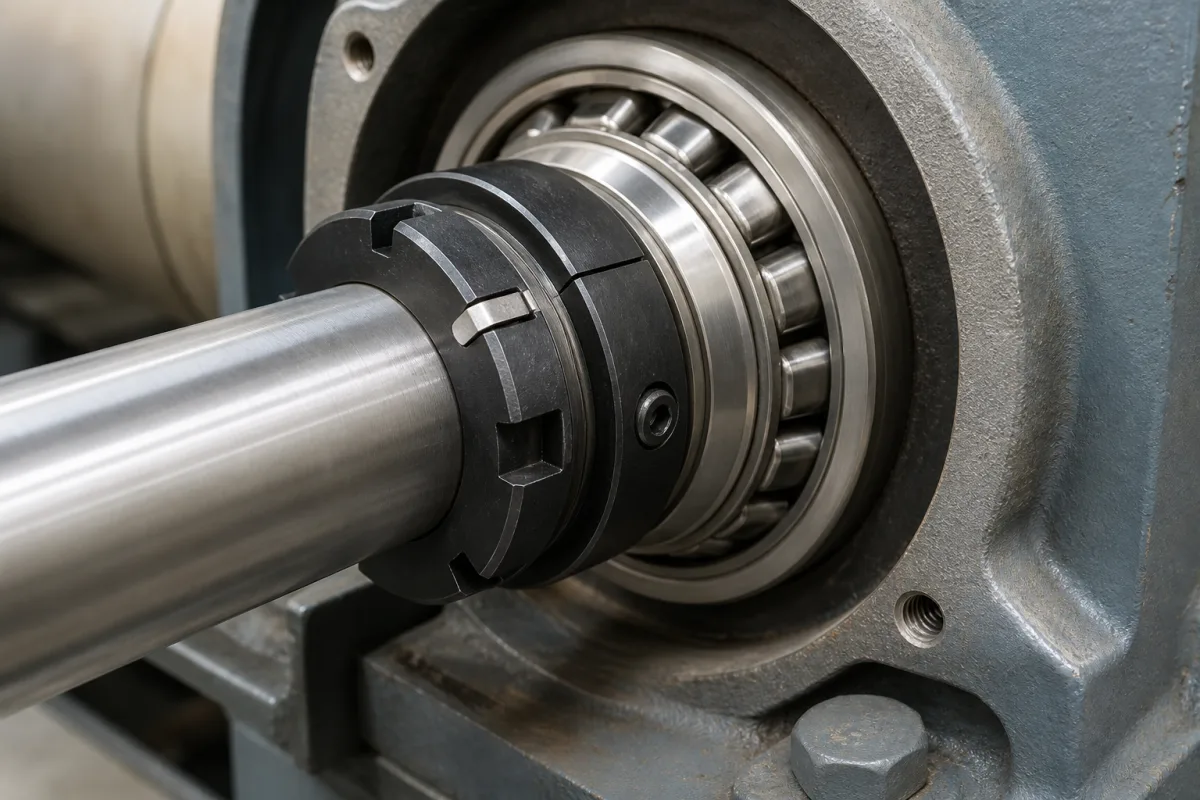
Bearing lock nut and lock washer (slotted KM nuts with tab washers, and precision lock nuts with grub-screw locking, that hold a bearing axially on its shaft)
Bearing lock nuts and their locking · slotted KM nuts with tab lock washers, KMT-type precision nuts with locking pins and grub screws, double-nut wedge locking, axial load capacity on the same thread
A bearing lock nut is a threaded ring screwed onto the shaft, or onto an adapter or withdrawal sleeve, to clamp the bearing inner ring axially. On its own a nut can loosen under vibration and temperature cycling, so it is always paired with a locking feature: a tab lock washer whose inner tang sits in a shaft keyway and whose outer tab is bent into a slot on the nut, a set of grub screws that press locking pins against the thread, or a second nut that wedges against the first. The buying questions are the thread, the axial load the nut must carry, the space available, and which locking method the shaft can accept.
Lock nuts and their locking elements used to retain rolling bearings and other shaft components axially: slotted KM/KML-type nuts with MB-type tab lock washers, precision lock nuts locked by grub screws and pins, and double-nut wedge-locking bearing nuts. Spherical roller bearings themselves and their adapter-sleeve mounting are covered on the Spherical roller bearings page. Keyless shaft-hub locking assemblies, caster brakes, tool-holder locking seats and electric locks share the words "locking device" but are different products and are outside this page.
CNFX editorial research · Sources checked October 12, 2026 · 3 sources
KM 18 with a tab washer against a KMT18 precision nut on the same M90×2 thread
SKF describes KM and KML lock nuts as locating bearings onto a shaft, with metric threads and four equally spaced slots for a spanner, to be locked by a lock washer against unintentional loosening and reusable with a new lock washer if undamaged; the range covers threads M10×0.75 to M200×3 (sizes 0 to 40). [1] On the same thread size, the slotted nut and the precision nut differ mainly in width and axial capacity.
Editorial calculation: on the M90×2 thread the KMT18 is twice the width of the KM 18 and lists about 3.1 times the static axial load carrying capacity (680 ÷ 216). The KM 18's 216 kN is a nut rating; the bearing, sleeve and shaft shoulder have their own limits. [1][2]
The precision series runs from KMT0 on M10×0.75 (28 mm diameter, M5 grub screw at 4.5 Nm, 35 kN) upward, with the grub screw and its torque stepping up with size. [2]
State the thread (diameter and pitch), the axial load the nut must retain, the space for nut width and outside diameter, whether the shaft has or can have a keyway, and the locking element you want supplied with the nut.
02
Tab washer in a keyway, grub screws on the thread, or a wedging second nut
A toothed or tab lock washer is keyed to the shaft, which is why Misumi points out that standard bearing nut and toothed washer sets need a keyway machined in the shaft. [3] SKF pairs the KM 18 with the MB 18 washer and states the nut is reusable only with a new washer. [1] Precision nuts avoid the washer: grub screws in the nut are tightened to a stated torque, 35 Nm for the M10 screws on the KMT18. [2]
Misumi's hard-locking bearing nut uses a third method: two nuts, the upper one with an eccentric boss offset from the thread centre. Tightening the upper nut against the lower builds a wedge action that locks both, and no keyway has to be machined in the shaft. The male thread should be JIS 6g with a chamfer of one pitch at its tip; nut threads are 6H. Standard types cover M10 to M50 on fine threads, in 1018 carbon steel, 1045 carbon steel at 22 to 28 HRC, or 304 stainless steel, with a thin type from M25 to M50 that is mounted upper nut first. [3]
Misumi also sells the conventional set of bearing nut and toothed lock washer in steel or stainless steel, with nut threads from M10×0.75; its steel washers are low-carbon steel. [3]
Choose tab washers where the shaft already has a keyway and the nut is rarely adjusted; grub-screw precision nuts where a keyway is unwanted or axial load is high; double-nut wedge locking where neither a keyway nor locking pins suit the shaft. Ask for the locking torque and the reuse rules for each.
03
Data for a bearing lock nut quotation
Paste it into your enquiry below or into an email to a maker, then replace every bracket.
Thread: [diameter × pitch; shaft or sleeve; thread tolerance]
Load: [axial load to retain; shock or vibration]
Space: [maximum width; maximum outside diameter]
Locking: [tab lock washer and keyway; grub screws and pins; double nut]
Material: [carbon steel; hardened; stainless; finish]
Tools: [spanner type; torque values]
Quantity and documents: [drawings; axial load rating; tightening instructions]
Explore company information and manufacturing capabilities, then discuss the scope of your project with a relevant supplier.
Share this page
Compiled and source-reviewed by the CNFX editorial team.
Each manufacturer above links to the page on that company's own website where the product is listed, with the date we checked it. How we source and review
· Page last updated 13 October 2026
Buyer questions
What does a bearing lock nut do?
It clamps the bearing onto the shaft or sleeve; SKF's KM nuts locate bearings onto a shaft and are locked by a lock washer to prevent unintentional loosening. [1]
How much axial load can a lock nut carry?
SKF lists 216 kN static axial load carrying capacity for a KM 18 (M90×2); Ondrives lists 680 kN for a KMT18 precision nut on the same thread. [1][2]
Can a lock washer be reused?
SKF states KM lock nuts can be reused if undamaged, with a new lock washer. [1]
Is there a bearing nut lock that needs no shaft keyway?
Yes: grub-screw precision nuts, or Misumi's double-nut hard-locking type, which wedges the two nuts together without a toothed washer or keyway. [2][3]
Sources and what still needs a direct check
Sources checked 2026-10-12. SKF and Ondrives publish ratings for their own lock nuts; Misumi describes its own bearing nut sets and hard-locking nut. Ratings are per nut and do not cover the bearing, sleeve or shaft.