Industry-Verified Manufacturing Data (2026)

Feed Sensor

Based on aggregated insights from multiple verified factory profiles within the CNFX directory, the standard Feed Sensor used in the Machinery and Equipment Manufacturing sector typically supports operational capacities ranging from standard industrial configurations to heavy-duty production requirements.

Technical Definition & Core Assembly

A canonical Feed Sensor is characterized by the integration of Sensing Element and Signal Processor. In industrial production environments, manufacturers listed on CNFX commonly emphasize Stainless Steel Housing construction to support stable, high-cycle operation across diverse manufacturing scenarios.

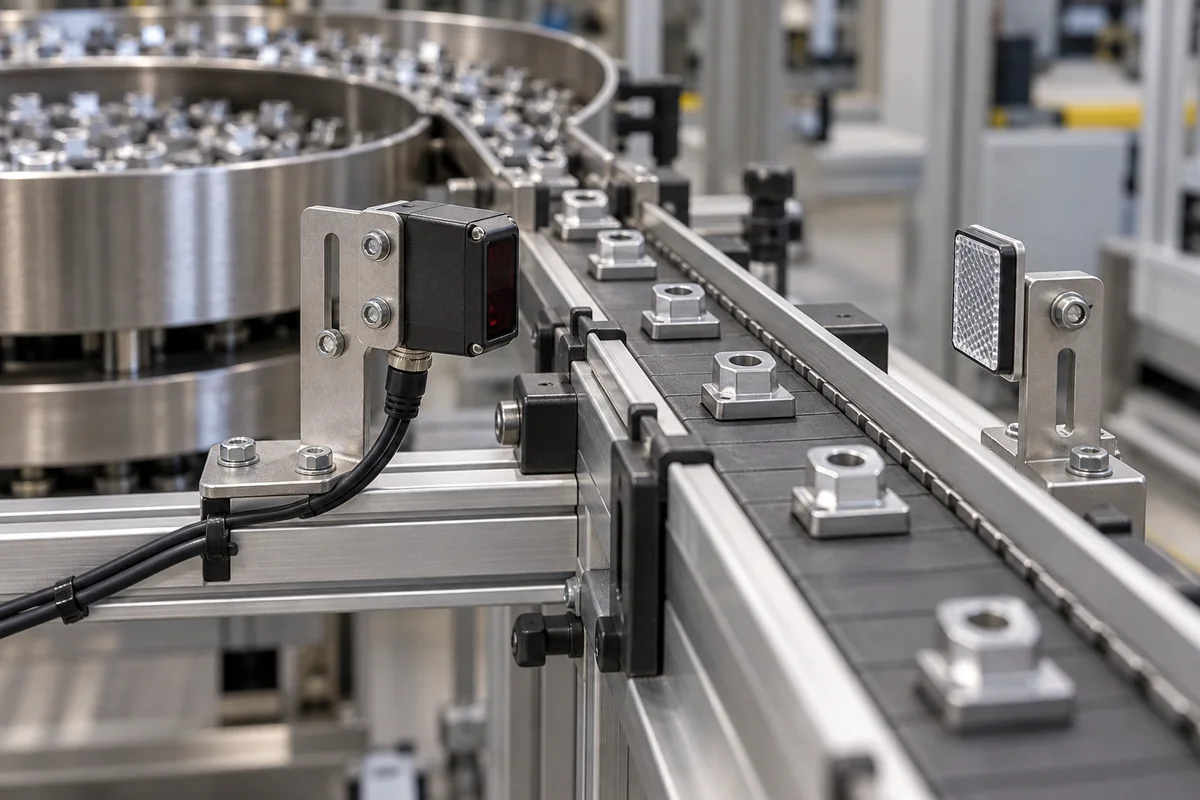
A sensor that detects the presence, position, or flow of materials in a product feeder system.
Product Specifications

Technical details and manufacturing context for Feed Sensor

Definition
A feed sensor is an electronic component integrated into product feeder systems that monitors material flow, detects jams, verifies feeding operations, and provides feedback to control systems to ensure consistent and reliable material handling in industrial automation processes.
Working Principle
Typically uses optical, capacitive, inductive, or ultrasonic sensing technologies to detect material presence or movement. When material interrupts the sensor's detection field or changes its electrical properties, the sensor sends a signal to the feeder's control system to confirm feeding status or trigger corrective actions.
Common Materials
Stainless Steel Housing, Polycarbonate Lens, Electronic Circuit Board
Technical Parameters
  • Detection distance range (mm) Customizable
Components / BOM
  • Sensing Element
    Detects material presence through optical, capacitive, or inductive means
    Material: Optical glass or ceramic
  • Signal Processor
    Converts raw sensor data into usable electrical signals
    Material: Silicon semiconductor
  • Protective Housing
    Shields internal components from environmental factors and mechanical damage
    Material: Stainless steel or industrial plastic
Engineering Reasoning
0.1-10 m/s material flow velocity, -20°C to 85°C ambient temperature, 12-24 VDC supply voltage
Material flow velocity exceeding 12 m/s causes sensor membrane rupture, ambient temperature beyond -25°C or 90°C causes piezoelectric crystal depolarization, supply voltage below 10.5 VDC or above 26.5 VDC causes Hall effect sensor saturation
Design Rationale: Membrane rupture due to Bernoulli principle pressure differential exceeding 150 kPa yield strength, piezoelectric depolarization from Curie temperature threshold violation at 90°C, Hall effect sensor saturation from magnetic flux density exceeding 0.5 Tesla at overvoltage conditions
Risk Mitigation (FMEA)
Trigger Electrostatic discharge exceeding 8 kV from triboelectric charging of polymer materials
Mode: Optical sensor CMOS array permanent damage with 15% pixel failure rate
Strategy: Integrated Faraday cage shielding with 0.5 mm aluminum enclosure and 1 MΩ bleed resistors on all signal lines
Trigger Mechanical resonance at 120 Hz from feeder vibration matching sensor natural frequency
Mode: Capacitive sensing plate microfractures reducing capacitance by 40% from 47 pF to 28 pF
Strategy: Viscous damping system with 0.15 N·s/m damping coefficient and anti-resonance mounting at 45° offset angle

Industry Taxonomies & Aliases

Commonly used trade names and technical identifiers for Feed Sensor.

Applied To / Applications

This component is essential for the following industrial systems and equipment:

Industrial Ecosystem & Supply Chain DNA

Complementary Systems
Downstream Applications
Specialized Tooling

Application Fit & Sizing Matrix

Operational Limits
pressure: 0 to 10 bar
flow rate: 0.1 to 100 m/s
temperature: -20°C to 85°C
slurry concentration: Up to 60% solids by weight
Media Compatibility
✓ Plastic pellets ✓ Cereal grains ✓ Powdered chemicals
Unsuitable: Highly corrosive acids or caustic solutions
Sizing Data Required
  • Material particle size (mm)
  • Required detection sensitivity (mm)
  • Feeder pipe/tube diameter (mm)

Reliability & Engineering Risk Analysis

Failure Mode & Root Cause
Signal Drift/Inaccuracy
Cause: Contamination buildup on sensing surfaces (dust, moisture, product residue) altering detection characteristics, or electronic component degradation from thermal cycling and vibration.
Mechanical Failure
Cause: Physical damage from impact or misalignment during installation/maintenance, or wear/fatigue of moving parts (e.g., in rotary encoders) due to excessive load or lack of lubrication.
Maintenance Indicators
  • Intermittent or erratic feed rate readings on the control system display
  • Unusual audible clicking, grinding, or humming from the sensor housing during operation
Engineering Tips
  • Implement regular cleaning schedules using approved methods (dry air, non-abrasive wipes) to prevent contamination buildup, and ensure proper environmental sealing per manufacturer specifications.
  • Establish precision alignment procedures during installation/replacement, and perform periodic vibration analysis to detect mechanical looseness or bearing wear before catastrophic failure.

Compliance & Manufacturing Standards

Reference Standards
ISO 13849-1:2015 - Safety of machinery ANSI/ASME B40.100-2013 - Pressure gauges and gauge attachments DIN EN 60529 - Degrees of protection provided by enclosures (IP Code)
Manufacturing Precision
  • Bore diameter: +/-0.01mm
  • Surface flatness: 0.05mm
Quality Inspection
  • Dimensional verification with coordinate measuring machine (CMM)
  • Environmental sealing test (IP rating verification)

Factories Producing Feed Sensor

Verified manufacturers with capability to produce this product in China

✓ 97% Supplier Capability Match Found

S Sourcing Manager from Canada Jan 24, 2026
★★★★★
"As a professional in the Machinery and Equipment Manufacturing sector, I confirm this Feed Sensor meets all ISO standards."
Technical Specifications Verified
P Procurement Specialist from United States Jan 21, 2026
★★★★☆
"Standard OEM quality for Machinery and Equipment Manufacturing applications. The Feed Sensor arrived with full certification. (Delivery took slightly longer than expected, but technical support was excellent.)"
Technical Specifications Verified
T Technical Director from United Arab Emirates Jan 18, 2026
★★★★★
"Great transparency on the Feed Sensor components. Essential for our Machinery and Equipment Manufacturing supply chain."
Technical Specifications Verified
Verification Protocol

“Feedback is collected from verified sourcing managers during RFQ (Request for Quote) and factory evaluation processes on CNFX. These reports represent historical performance data and technical audit summaries from our B2B manufacturing network.”

15 sourcing managers are analyzing this specification now. Last inquiry for Feed Sensor from Vietnam (12m ago).

Supply Chain Compatible Machinery & Devices

Hydraulic Press

Industrial machine using hydraulic pressure to compress, form, or assemble materials

Explore Specs →
Heavy-Duty CNC Plasma Cutting Machine

Industrial machine for precision metal cutting using plasma arc technology

Explore Specs →
Automated Assembly Line System

Integrated production system for sequential component assembly operations

Explore Specs →
Automated Powder Coating System

Integrated industrial system for applying dry powder coatings to metal substrates.

Explore Specs →

Frequently Asked Questions

What materials is the feed sensor constructed from?

The feed sensor features a durable stainless steel housing, a clear polycarbonate lens for protection, and a reliable electronic circuit board for accurate detection.

How does the feed sensor detect materials in a feeder system?

The sensor uses its sensing element to detect the presence, position, or flow of materials. The signal processor then interprets this data to provide real-time feedback for system control.

What are the main components in the feed sensor's bill of materials (BOM)?

The core BOM includes the sensing element for detection, the signal processor for data interpretation, and the protective housing (stainless steel with polycarbonate lens) for durability in industrial environments.

Can I contact factories directly on CNFX?

CNFX is an open directory, not a transaction platform. Each factory profile provides direct contact information and production details to help you initiate direct inquiries with Chinese suppliers.

Get Quote for Feed Sensor

Request technical pricing, lead times, or customized specifications for Feed Sensor directly from verified manufacturing units.

Your business information is encrypted and only shared with verified Feed Sensor suppliers.

Thank you! Your message has been sent. We'll respond within 1–3 business days.

Need to Manufacture Feed Sensor?

Connect with verified factories specializing in this product category

Add Your Factory Contact Us
Previous Product
Feed Roller Assembly
Next Product
Feedback Bellows or Diaphragm