Industry-Verified Manufacturing Data (2026)

Product Feeder

Based on aggregated insights from multiple verified factory profiles within the CNFX directory, the standard Product Feeder used in the Machinery and Equipment Manufacturing sector typically supports operational capacities ranging from standard industrial configurations to heavy-duty production requirements.

Technical Definition & Core Assembly

A canonical Product Feeder is characterized by the integration of Infeed Conveyor Belt and Orientation Guide. In industrial production environments, manufacturers listed on CNFX commonly emphasize Stainless Steel construction to support stable, high-cycle operation across diverse manufacturing scenarios.

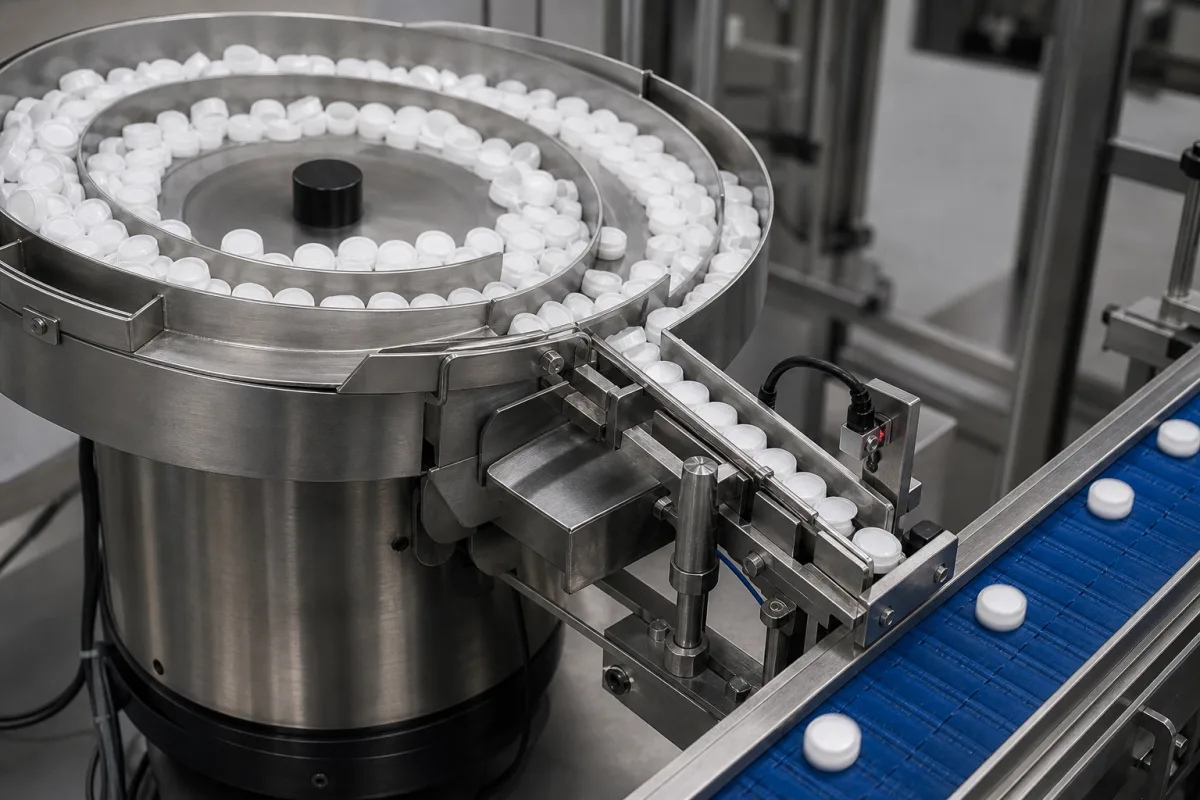
A mechanical component within a packaging station that systematically supplies products to the packaging line.
Product Specifications

Technical details and manufacturing context for Product Feeder

Definition
The Product Feeder is an integral part of a Packaging Station, responsible for the controlled and orderly transfer of products from storage or accumulation areas into the packaging process. It ensures consistent product flow, proper orientation, and precise timing to synchronize with downstream packaging operations such as filling, sealing, or labeling.
Working Principle
Typically operates via conveyor belts, vibratory trays, rotary discs, or robotic arms to pick and place products. It is synchronized with the main packaging line controller to maintain a steady feed rate, often using sensors to detect product presence and regulate flow to prevent jams or gaps in production.
Common Materials
Stainless Steel, Food-Grade Plastic, Aluminum Alloy
Technical Parameters
  • Maximum feed rate capacity (pcs/min) Per Request
Components / BOM
  • Infeed Conveyor Belt
    Transports products into the feeder from upstream storage
    Material: Food-grade rubber or PVC
  • Orientation Guide
    Ensures products are correctly aligned before feeding into packaging
    Material: Stainless steel or plastic
  • Feed Sensor
    Detects product presence and regulates feed timing
    Material: Stainless steel housing, optical/inductive sensor
  • Drive Motor
    Powers the feeding mechanism (conveyor, vibrator, etc.)
    Material: Aluminum alloy housing, copper windings
Engineering Reasoning
0.5-2.5 m/s feed rate, 0.1-1.0 mm positioning accuracy, 20-80 N actuation force
Feed rate exceeds 3.0 m/s causing product collision, positioning error exceeds 1.5 mm causing misalignment, actuation force drops below 15 N causing product slippage
Design Rationale: Kinetic energy accumulation at high feed rates (E_k = 0.5mv²) causing impact damage, cumulative positioning error from backlash exceeding 0.05 mm/cycle, static friction coefficient (μ_s) dropping below 0.3 due to surface wear
Risk Mitigation (FMEA)
Trigger Belt tension deviation exceeding ±15% from 50 N nominal
Mode: Product slippage and timing desynchronization
Strategy: Integrated tension monitoring with piezoelectric sensors and automatic servo-adjustment system
Trigger Guide rail wear rate exceeding 0.01 mm/10⁶ cycles
Mode: Product trajectory deviation exceeding ±0.8 mm
Strategy: Hardened steel rails (HRC 58-62) with diamond-like carbon coating (2-4 μm thickness)

Industry Taxonomies & Aliases

Commonly used trade names and technical identifiers for Product Feeder.

Applied To / Applications

This component is essential for the following industrial systems and equipment:

Industrial Ecosystem & Supply Chain DNA

Complementary Systems
Downstream Applications
Specialized Tooling

Application Fit & Sizing Matrix

Operational Limits
pressure: Atmospheric to 1.5 bar
flow rate: Up to 500 units/min
temperature: -20°C to 80°C
slurry concentration: Not applicable (dry products only)
Media Compatibility
✓ Dry granular materials (e.g., grains, nuts) ✓ Solid packaged items (e.g., boxes, bottles) ✓ Non-abrasive powders (e.g., flour, sugar)
Unsuitable: High-moisture or sticky materials (e.g., wet clay, adhesives)
Sizing Data Required
  • Product dimensions (L x W x H)
  • Required feed rate (units per minute)
  • Product weight and density

Reliability & Engineering Risk Analysis

Failure Mode & Root Cause
Bearing seizure
Cause: Inadequate lubrication leading to metal-on-metal contact, overheating, and eventual seizure; accelerated by contamination ingress or improper bearing alignment.
Drive chain/belt slippage or breakage
Cause: Excessive tension causing fatigue, or insufficient tension leading to slippage and wear; exacerbated by misalignment, worn sprockets/pulleys, or exposure to abrasive materials.
Maintenance Indicators
  • Unusual grinding or screeching noises from drive components, indicating bearing failure or severe misalignment.
  • Irregular or inconsistent feeding rates, often accompanied by visible vibration or jerking motions in the feeder mechanism.
Engineering Tips
  • Implement a precision alignment program for all drive components (motor, gearbox, shafts) using laser alignment tools to reduce bearing loads and prevent premature wear.
  • Establish a condition-based lubrication regimen using automated systems or ultrasonic grease guns, ensuring optimal lubricant volume and frequency while preventing contamination.

Compliance & Manufacturing Standards

Reference Standards
ISO 9001:2015 - Quality management systems ANSI/ASME B20.1 - Safety standards for conveyors and related equipment CE Marking - Machinery Directive 2006/42/EC
Manufacturing Precision
  • Feed rate accuracy: +/- 1% of set value
  • Alignment tolerance: +/- 0.5mm over 1 meter length
Quality Inspection
  • Functional safety test - Emergency stop and guarding verification
  • Material composition analysis - Verification of food-grade/industrial-grade materials

Factories Producing Product Feeder

Verified manufacturers with capability to produce this product in China

✓ 95% Supplier Capability Match Found

S Sourcing Manager from Brazil Feb 21, 2026
★★★★★
"Standard OEM quality for Machinery and Equipment Manufacturing applications. The Product Feeder arrived with full certification."
Technical Specifications Verified
P Procurement Specialist from Canada Feb 18, 2026
★★★★☆
"Great transparency on the Product Feeder components. Essential for our Machinery and Equipment Manufacturing supply chain. (Delivery took slightly longer than expected, but technical support was excellent.)"
Technical Specifications Verified
T Technical Director from United States Feb 15, 2026
★★★★★
"The Product Feeder we sourced perfectly fits our Machinery and Equipment Manufacturing production line requirements."
Technical Specifications Verified
Verification Protocol

“Feedback is collected from verified sourcing managers during RFQ (Request for Quote) and factory evaluation processes on CNFX. These reports represent historical performance data and technical audit summaries from our B2B manufacturing network.”

16 sourcing managers are analyzing this specification now. Last inquiry for Product Feeder from Mexico (1h ago).

Supply Chain Compatible Machinery & Devices

Automated Assembly Line System

Integrated production system for sequential component assembly operations

Explore Specs →
Automated Powder Coating System

Integrated industrial system for applying dry powder coatings to metal substrates.

Explore Specs →
Centrifugal Pump Impeller

Rotating component that transfers energy to fluid in centrifugal pumps.

Explore Specs →
High-Precision CNC Laser Cutting Machine

Computer-controlled industrial machine using focused laser beams to cut sheet metal with micron-level accuracy.

Explore Specs →

Frequently Asked Questions

What materials are used in this product feeder for food safety?

Our product feeder uses stainless steel and food-grade plastic components, making it suitable for food packaging applications where hygiene and corrosion resistance are critical.

How does the orientation guide work in the feeder system?

The orientation guide aligns products correctly before they enter the packaging line, ensuring consistent positioning for downstream processes like labeling or sealing.

What maintenance does the drive motor require?

The drive motor requires periodic lubrication and inspection of electrical connections. Regular maintenance ensures consistent feeding speed and extends the equipment's lifespan.

Can I contact factories directly on CNFX?

CNFX is an open directory, not a transaction platform. Each factory profile provides direct contact information and production details to help you initiate direct inquiries with Chinese suppliers.

Get Quote for Product Feeder

Request technical pricing, lead times, or customized specifications for Product Feeder directly from verified manufacturing units.

Your business information is encrypted and only shared with verified Product Feeder suppliers.

Thank you! Your message has been sent. We'll respond within 1–3 business days.

Need to Manufacture Product Feeder?

Connect with verified factories specializing in this product category

Add Your Factory Contact Us
Previous Product
Product Collection Hoppers
Next Product
Product Loading/Unloading Station